
How do cloud IT services scale as a small business grows?
Cloud IT services scale by allowing a small business to adjust users, storage, applications and computing resources as its needs change, without replacing its entire on-site infrastructure. This supports growth, new locations and changing workloads while keeping access, security and management aligned with the organisation’s size and requirements.
Cloud IT services scale as a small business grows by adding or reducing users, services and capacity through configuration rather than repeatedly replacing physical infrastructure. The practical benefit is that technology can develop in stages: a business can start with the services it needs, introduce stronger controls as its risks change, and extend the same management approach as teams, locations and workloads increase.
Scaling normally begins with user and access management. New employees can be given accounts, applications and permissions according to their role, while leavers can have access removed as part of a controlled process. Role-based access helps prevent every user from receiving unrestricted access, which becomes increasingly important as the organisation holds more data and uses more applications. Groups, departments and locations can also be managed through common policies rather than configured individually.
Cloud capacity can be adjusted in several areas:
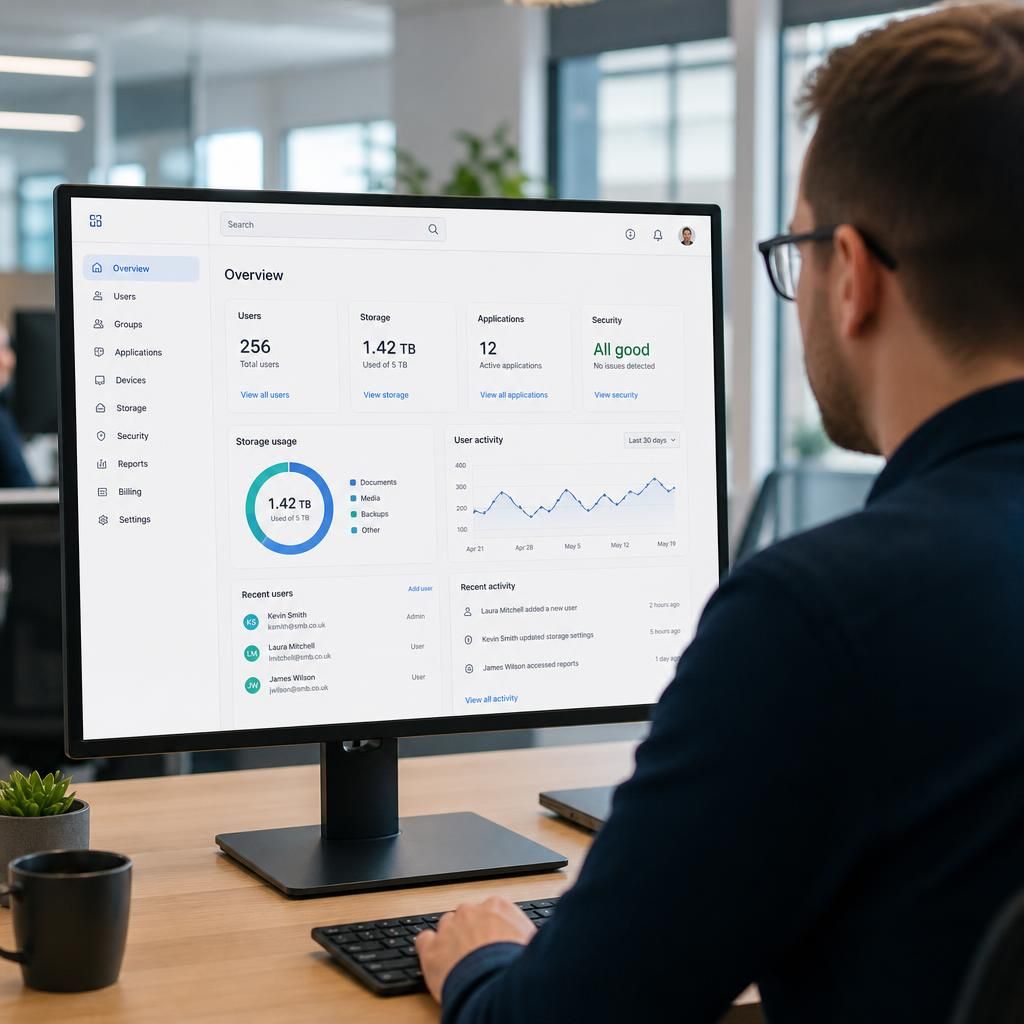
- Users: additional accounts, identities and application access can be provisioned as the workforce expands.
- Storage: capacity can be increased as documents, email, backups and operational data grow.
- Applications: new cloud applications can be introduced for departments, projects or business processes without installing the same software on every local device.
- Computing resources: workloads that require more processing capacity can be assigned suitable resources, while unused capacity can be reviewed and reduced.
- Locations: staff in another office or working from a different site can be brought into the organisation’s cloud environment using the same identity and security framework.
This flexibility does not remove the need for planning. A service may be technically capable of expanding, but poor configuration can create unnecessary cost, inconsistent permissions or weak security. A scalable design therefore includes clear ownership, documented standards and regular reviews of which users, applications and resources are still required.
Security controls should scale alongside the environment, not be added after growth has taken place. As more people and systems connect to cloud services, the business may need more detailed permission structures, multi-factor authentication, device policies, encryption settings, audit records and backup arrangements. Access should be based on business need, with administrative privileges limited to authorised personnel. Security monitoring and reviews should also cover newly introduced services rather than focusing only on the original environment.
Growth can expose weaknesses in identity and device management. Manual setup may be manageable for a small team but become inconsistent as recruitment increases or staff work across several locations. Standardised onboarding, offboarding and device configuration procedures reduce that risk. They also make it easier to apply the same security requirements to laptops, mobile devices and other equipment used to access business systems.
Cloud scaling can support operational changes as well as headcount growth. A business opening another site, adding a new department or taking on a larger workload may need additional applications, shared resources or controlled access to central systems. The design should distinguish between information that everyone needs, information limited to a team and sensitive data requiring tighter restrictions. This helps the environment grow without turning every shared location into an unrestricted repository.
Performance should be reviewed as usage patterns change. More users, larger files, data-intensive applications or increased collaboration can affect the internet connection, local network, endpoint devices and cloud configuration. Monitoring usage and identifying bottlenecks before making major changes helps determine whether the solution needs additional capacity, a different configuration or improvements to the surrounding infrastructure.
Scalability also depends on service governance. Useful checks include whether each account is still active, whether licences and storage match genuine requirements, whether backups can be restored, whether security policies are being applied consistently and whether important cloud services have an appropriate continuity plan. These reviews help prevent gradual growth from producing duplicated tools, abandoned accounts or unmanaged data.
For a small business, the most sustainable approach is usually incremental: establish a secure baseline, document how users and services are managed, then review the environment whenever there is a material change in staff, locations, applications or data. S2 Technology Group can advise on cloud IT services as part of a wider managed IT, cyber security and infrastructure strategy, helping organisations around Stourbridge, Kinver, Wordsley, Kingswinford, Kidderminster, Halesowen, Dudley and neighbouring areas assess what should change as the business develops.
Cloud IT services scale effectively only when the systems around them can support the increase. Adding users or applications may also require changes to identity services, internet connectivity, device management, data transfers and integrations with existing business software. Reviewing these dependencies before expansion helps identify constraints that may not be visible in the cloud service itself.
A practical approach is to assess each proposed change as a complete service rather than simply increasing capacity. For example, introducing a cloud application for a growing department should include checks for how users will authenticate, which information it can access, how data will be backed up and how it will connect with established processes. This makes growth more predictable and reduces the risk of creating isolated systems that are difficult to manage later.
Discuss how cloud IT services can support your growth
If your business is planning changes to its workforce, locations or systems, speak to S2 Technology Group about reviewing the cloud requirements behind that growth. A structured assessment can help identify suitable next steps for your existing IT environment.