How are cloud administrator actions monitored?
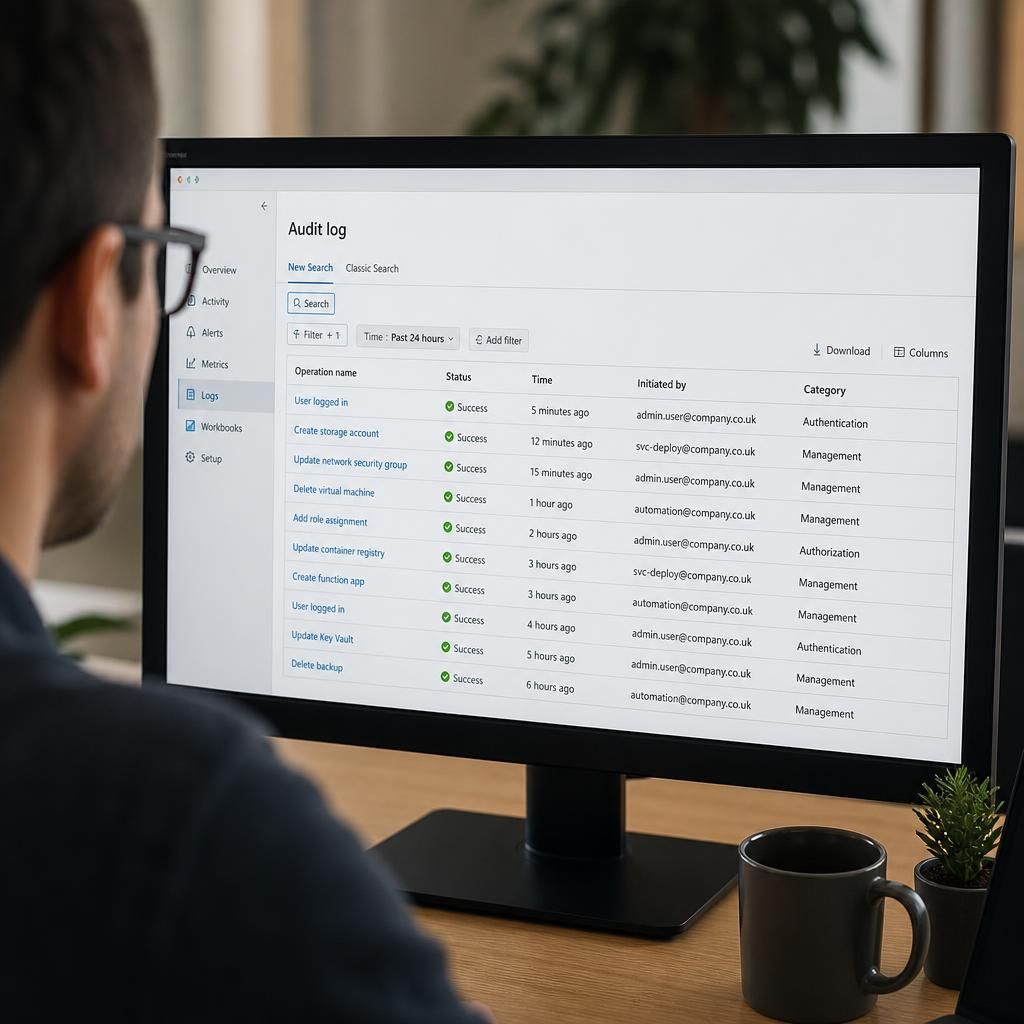
Cloud administrator actions are monitored through audit logs that record who accessed the environment, what they changed, and when each action occurred. Activity tracking, access controls and regular log reviews help identify unauthorised changes, investigate incidents and maintain accountability.
Cloud administrator actions are monitored through a combination of automated detection, privileged-access controls, change governance and independent review. The aim is not only to create a record of administrative activity, but to detect unusual behaviour, prevent inappropriate changes and provide reliable evidence when an incident or compliance query needs investigating.
Monitoring commonly includes:
- Centralised event collection: Events from cloud management consoles, identity services, virtual machines, storage platforms, network controls and security tools can be collected in one monitoring system. Centralisation makes it easier to correlate related actions across different parts of the environment.
- Privileged identity monitoring: Administrative accounts are monitored more closely than standard user accounts. The organisation can record when elevated permissions are granted, which role was used, whether access was temporary and whether an administrator attempted to use permissions outside their normal responsibilities.
- Alerts for high-risk activity: Rules can flag actions such as disabling security controls, changing authentication settings, creating new administrator accounts, opening network access, deleting backups or altering data-retention settings. An alert does not automatically prove that an action is malicious, but it identifies activity that requires assessment.
- Configuration and posture checks: Cloud security tools can compare the current environment with approved settings. This helps identify changes such as publicly accessible storage, weakened encryption settings or excessive permissions, including changes that were made through automation rather than manually.
- Session and command oversight: For particularly sensitive systems, organisations may monitor administrative sessions or record commands executed through management interfaces. This provides more context than a simple change event, although its use should be balanced with privacy, legal and operational requirements.
Controls around monitoring are equally important. Administrator access should use named accounts rather than shared credentials, with multi-factor authentication and role-based permissions. Privileged access management can provide elevated rights only for an approved task or period, reducing the risk associated with permanently powerful accounts. Separation of duties may also require one person to request or approve a change while another carries it out.
Administrative changes should follow a documented process. A change request can explain the purpose, affected systems, expected impact, approval and rollback method. Monitoring can then compare the recorded action with the approved request. This helps distinguish authorised maintenance from unexplained activity and makes it easier to investigate changes that produce an unexpected result.
Logs also need protection. If an administrator can alter or delete the evidence of their own actions, monitoring becomes less dependable. Logs should therefore be sent to a separate account or service with restricted write and deletion permissions. Appropriate retention, time synchronisation and access controls are needed so that events can be interpreted accurately and preserved for the period required by the organisation’s policies or compliance obligations.
Detection rules should be tuned to the business rather than enabled without review. For example, a new administrator account may be expected during a planned implementation but suspicious at another time. Context can come from approved maintenance windows, ticket references, device information, location indicators and the administrator’s normal duties. Regular testing is also necessary to confirm that alerts are generated, delivered to the right people and investigated consistently.
A practical monitoring arrangement usually defines:
- which cloud platforms, accounts and administrative interfaces are in scope;
- which activities are considered high risk;
- who receives and investigates alerts;
- how suspicious changes are contained and reversed;
- how evidence is retained and protected;
- how privileged access and monitoring rules are reviewed; and
- how findings are reported to management or the relevant compliance owner.
For a business using managed cloud IT, these controls should be documented as part of the service design rather than treated as an optional add-on. The monitoring approach should reflect the sensitivity of the data, the number of administrators, the organisation’s compliance requirements and the importance of each cloud service. This produces a clearer balance between security oversight and the practical administration needed to operate the environment.
Cloud administrator monitoring must also account for automated actions. Infrastructure-as-code tools, deployment pipelines and service accounts can change cloud resources without a person using the management console directly. The activity record should therefore identify the application, workload or service account that performed the action, along with the human-approved change or deployment associated with it.
This link is important because an event attributed only to an automation account may show what changed but not why it changed. Organisations should control which systems can use service accounts, limit their permissions, and retain deployment records that connect automated activity to an authorised administrator or change request. Monitoring can then distinguish an expected deployment from an unapproved process, compromised credential or incorrectly configured automation.