Which IT responsibilities should a small business outsource?
A small business should consider outsourcing routine IT support, device and user management, cyber security, backups, cloud administration and network maintenance when it lacks the specialist expertise or capacity to manage them securely. Strategic technology planning and complex projects can also be outsourced, while business-critical decisions and oversight should remain with the organisation’s leadership.
The responsibilities most suitable for outsourcing are repeatable, specialist or risk-sensitive tasks that require consistent processes rather than daily direction from the business. A small organisation can delegate the operational work while retaining ownership of business priorities, risk appetite, budgets and decisions about how technology supports its objectives.
Start by separating accountability from execution. An outsourced provider may administer systems, investigate alerts, maintain documentation and carry out approved changes, but the business should still decide who is authorised to access information, which systems are critical, what risks are acceptable and how much investment is appropriate. These decisions should have named owners within the organisation, even where the practical work is performed externally.
A useful assessment is to classify each responsibility against four questions:
- Does it require specialist knowledge that is difficult to maintain internally?
- Is it performed regularly enough to benefit from a defined process?
- Would an error create material operational, financial or regulatory risk?
- Can the result be checked through records, reports or agreed service measures?
Responsibilities that score highly against these tests are usually stronger candidates for outsourcing. Tasks that depend on confidential commercial judgement, leadership direction or close knowledge of internal processes may be better retained, or managed jointly.
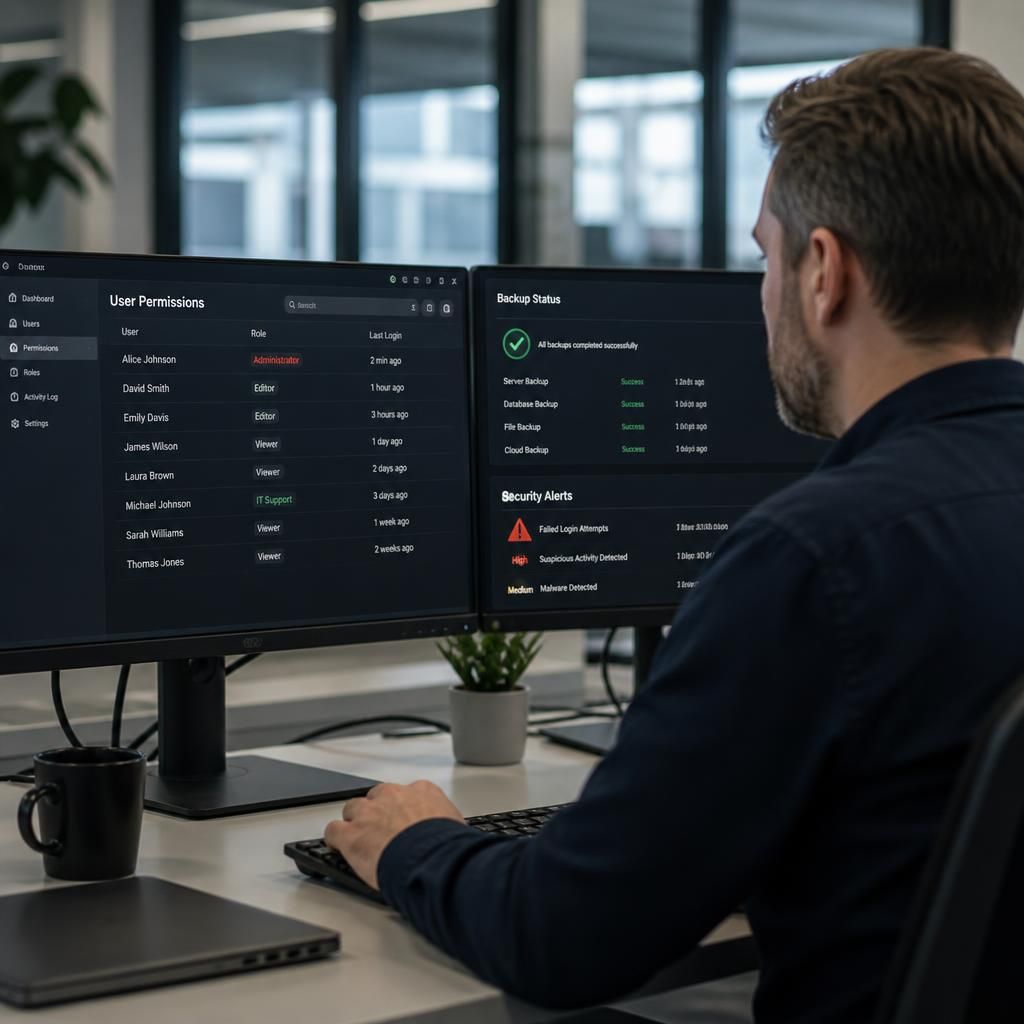
Technical administration is often suitable for delegation. This can include maintaining user accounts, applying approved access changes, managing permissions, recording devices, supporting software deployments and keeping technical records accurate. The provider carries out the controlled activity; the business confirms employment status, role changes and access approvals. This division reduces the risk of an administrator granting access without a legitimate business reason.
Security operations can also be outsourced, but not security ownership. External specialists may monitor for suspicious activity, manage security tools, investigate events and recommend corrective action. The organisation remains responsible for deciding which information and systems are most sensitive, approving risk treatment and determining when an incident requires involvement from senior management, legal advisers, insurers or other parties. An agreement should explain how alerts are assessed, escalated and documented.
Data protection and recovery duties need clearly defined boundaries. A provider can operate backup processes, test restoration procedures and maintain recovery documentation. The business must identify the data that must be recoverable, decide acceptable disruption levels and approve how long information should be retained. A backup that has never been restored successfully should not be treated as a proven recovery measure, so evidence of testing should form part of the governance record.
Cloud and infrastructure administration may be outsourced where internal capability is limited. This can cover configuration, permissions, capacity reviews, network changes, technical monitoring and planned improvements. The provider should work from an agreed change process, with emergency changes recorded afterwards. The business should retain approval of changes that could affect production systems, customer access, financial processing or regulatory obligations.
Project work is another area to consider, particularly when the organisation is moving systems, opening a site, replacing infrastructure or introducing remote access. Outsourcing delivery does not remove the need for an internal project owner. Someone in the business should define the desired outcome, approve scope and budget, identify operational constraints and accept the completed work. Without that ownership, a technically successful project may still fail to meet business requirements.
Some responsibilities are usually best retained internally. These commonly include setting business priorities, approving technology expenditure, deciding which information may be shared, appointing senior suppliers and determining the organisation’s tolerance for disruption or cyber risk. A small business does not need an in-house technical specialist to perform these duties, but its leadership must remain able to make informed decisions.
Outsourcing everything is not the only model. A business might retain a technically confident employee for first-line coordination while outsourcing specialist administration and security. Alternatively, an outsourced provider may manage routine operations while an internal manager controls priorities, approvals and supplier relationships. The appropriate arrangement depends on the organisation’s complexity, risk profile, existing skills and dependence on technology.
Before transferring a responsibility, document its boundaries. The service description should state what is included, what requires approval, which systems are covered, who owns credentials and records, how changes are authorised, how incidents are escalated and what happens when the arrangement ends. It should also identify dependencies such as software suppliers, connectivity providers and internal process owners. Vague ownership is particularly risky during staff departures, security incidents and major system changes.
The decision should be reviewed when the organisation grows, adds locations, handles more sensitive information, adopts new cloud services or becomes more dependent on a particular system. A responsibility that was appropriate to retain when the business was small may later require specialist management, while a service that was initially outsourced may eventually justify internal ownership. Periodic review keeps the arrangement aligned with the business rather than treating the original division of work as permanent.
S2 Technology Group can help small and medium-sized organisations assess these boundaries and manage the technical responsibilities that are appropriate to outsource. The important objective is not simply to reduce the amount of work handled internally, but to create clear ownership, controlled processes and sufficient specialist capability for the organisation’s actual risks and operational needs.
A phased approach helps a small business decide which IT responsibilities to outsource without transferring too much operational knowledge at once. Begin with clearly defined, repeatable activities, then assess the working arrangement before adding responsibilities that affect more critical systems.
For each phase, agree the starting position, the provider’s permitted actions and the evidence needed to confirm that the work is being completed properly. Useful evidence may include completed maintenance records, access reviews, backup test results, asset information or change documentation, depending on the responsibility being transferred.
- Start with a defined group of systems or processes rather than an unrestricted handover.
- Confirm that the provider has the information and access needed to perform the task without unnecessary privileges.
- Review exceptions, recurring issues and outstanding decisions with the business owner.
- Expand the scope only when responsibilities, records and approval routes are working as intended.
This approach distinguishes a suitable outsourcing decision from a simple removal of internal workload. It also gives the business a practical basis for deciding whether a responsibility should remain outsourced, be managed jointly or return to internal ownership.