

How much does an outsourced IT department cost?
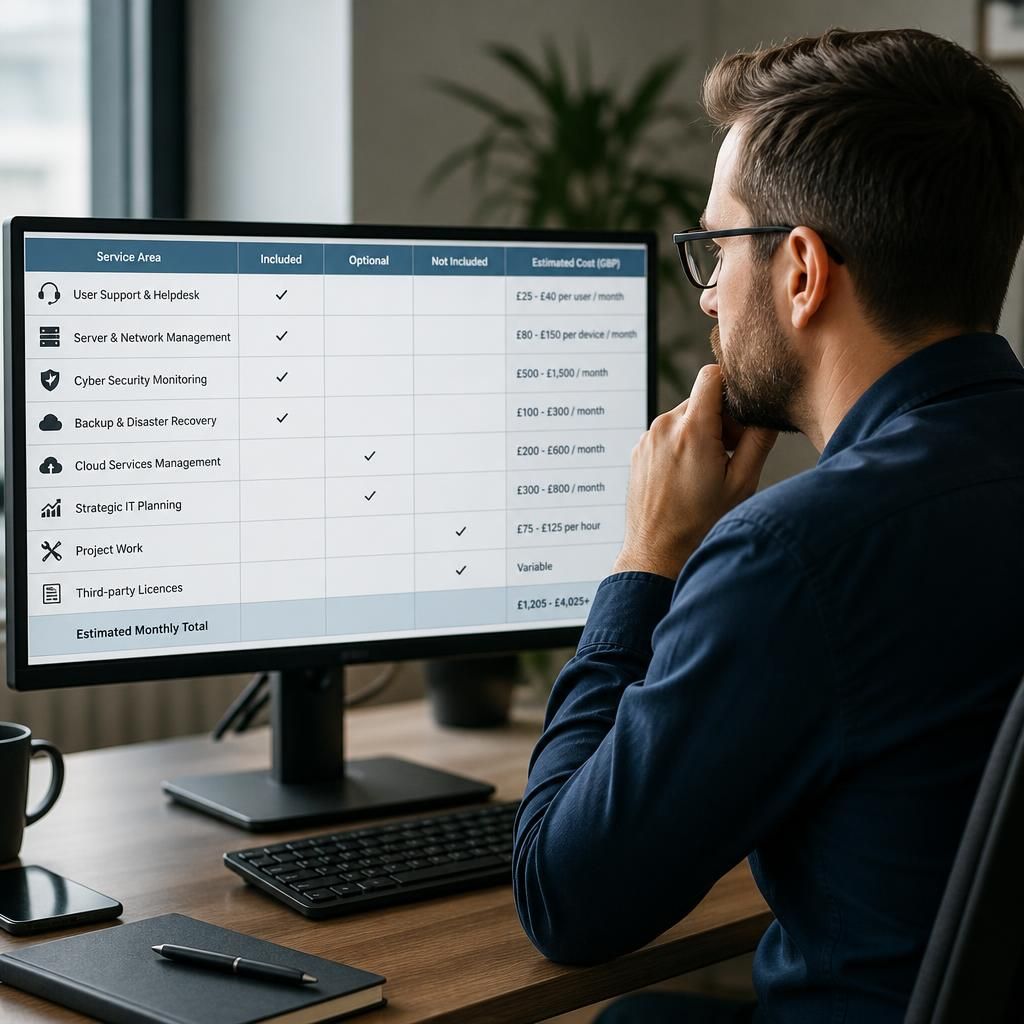
Outsourced IT department cost varies according to the number of users and locations, the systems covered, required support, and the level of cyber security, cloud and connectivity management included. UK businesses should compare what each package covers, including onboarding, proactive maintenance, security management, strategic advice and any project or third-party charges, rather than judging providers on a headline price alone.
There is no single standard price for an outsourced IT department. In the UK, the cost is normally agreed as a recurring service fee based on the scope of support, the users and technology included, the organisation’s risk profile, and the amount of strategic or project work required. A reliable comparison therefore starts with the service definition, not the monthly figure alone.
Most providers use one of several pricing structures:
- Per-user pricing: a recurring charge is applied to each supported user. This can be straightforward for businesses with relatively consistent user requirements, but you should check whether shared accounts, contractors, mobile workers and occasional users are charged differently.
- Per-device pricing: charges are based on computers, servers, network equipment or other managed devices. This may suit an organisation with a stable device estate, although the definition of a managed device should be made clear.
- Tiered packages: different service levels provide different inclusions, such as basic technical support, broader proactive management, or more extensive security and strategic guidance.
- Fixed-fee agreements: a defined set of services is supplied for an agreed recurring fee. This gives greater predictability when the scope is properly documented, but additional work may still be chargeable.
- Time-and-materials support: the business pays for work undertaken. This can be appropriate for limited requirements, but costs may be less predictable where systems need frequent attention.
Some providers combine these approaches. For example, routine management may be covered by a fixed fee while infrastructure projects, new-site deployments, specialist consultancy and non-standard requests are billed separately.
The main cost distinction is between services included in the regular agreement and work treated as an additional charge. A quotation should explain how it handles:
- user onboarding, leavers and changes to access;
- new computers, replacements and software deployment;
- server, network and cloud administration;
- cyber security monitoring, policy management and incident support;
- backup management and recovery testing;
- supplier liaison and communications troubleshooting;
- strategic reviews and technology planning;
- office moves, system upgrades and other projects;
- travel, equipment, licences and third-party subscriptions; and
- out-of-scope work and the rate used for it.
Onboarding is another cost to examine separately. An outsourced IT department needs to understand the existing environment, review documentation, check administrative access, identify weaknesses and establish its management tools and processes. Some providers include this work in the agreement, while others charge an initial implementation fee. A low recurring price may therefore have a higher initial cost, or may leave important discovery and remediation work outside the quoted service.
Cyber security can materially affect the cost because the requirements vary between organisations. Basic device protection is not equivalent to a wider programme covering identity controls, security policies, email protection, vulnerability management, staff guidance, monitoring and incident procedures. The quotation should state which security controls are supplied, which are optional, and which licences or specialist services are paid directly to another supplier.
Cloud services also need careful treatment. An IT provider may manage a cloud environment without including the underlying subscription, storage, backup capacity or application licences in its own fee. Ask whether the proposal covers administration only, or also the relevant third-party charges. The same principle applies to internet connectivity, telephony, domain services and other recurring technology costs.
For businesses with more than one site, pricing may reflect additional networks, connectivity arrangements, equipment and local requirements. The agreement should identify whether all locations are covered under the same terms and how new premises would be added. This is particularly important for growing organisations, where a change in sites or staffing can affect the cost without changing the core service model.
To compare proposals fairly, prepare the same information for each provider. This should include the number and type of users, locations, devices, servers, cloud systems, line-of-business applications, connectivity services and any known compliance or security requirements. Request an itemised breakdown separating:
- the recurring managed service fee;
- one-off onboarding or transition costs;
- licence and subscription charges;
- project and consultancy rates;
- hardware and third-party expenses; and
- any exclusions, minimum terms or annual price-review provisions.
It is also useful to assess what the business currently spends on internal IT, even if there is no direct employee equivalent. Include recruitment, salaries, training, tools, security products, backup services, consultancy, equipment and the management time spent coordinating suppliers. This does not mean outsourcing will always be cheaper. Its value may instead come from combining operational support, specialist knowledge and technology planning within a defined service arrangement.
Contract terms can affect the total cost as much as the initial quotation. Check the minimum contract period, notice requirements, renewal arrangements, treatment of price changes, ownership of documentation, responsibility for licences and the process for ending the relationship. Confirm whether support is limited to named systems and devices, and whether changes in the organisation’s size or technology create a formal review of the fee.
For a small or medium-sized business, the most useful question is not simply “what is the cheapest package?” It is “which package covers the risks and responsibilities the business actually needs, with clear charges for everything else?” A well-defined proposal should make the recurring service, one-off work, third-party costs and exclusions easy to distinguish. S2 Technology Group can discuss these considerations with organisations in Stourbridge, Kinver, Wordsley, Kingswinford, Kidderminster, Halesowen, Dudley and neighbouring areas as part of assessing an appropriate outsourced IT arrangement.
The cost of an outsourced IT department should also be assessed against the level of responsibility transferred from the business. A lower-priced arrangement may cover helpdesk assistance while leaving internal staff responsible for supplier coordination, user administration, security decisions or technology planning. Those retained tasks still require employee time and may create additional consultancy costs when specialist input is needed.
When reviewing a proposal, list the IT activities currently handled by employees, directors or external specialists and identify where each would sit under the outsourced model. This provides a more accurate comparison than matching monthly fees alone. It also highlights whether the agreement is intended to replace day-to-day IT administration, supplement an existing team, or provide specialist oversight alongside internal ownership.
Discuss your outsourced IT department requirements
Discuss your outsourced IT department requirements with S2 Technology Group to clarify the service scope, responsibilities and cost structure that fit your organisation. This provides a practical basis for assessing whether an outsourced arrangement is appropriate for your business.