

Can an outsourced IT department work alongside an internal IT team?
Yes. An outsourced IT department can work alongside an internal IT team through a defined hybrid model, with responsibilities, access permissions and escalation routes agreed between both parties.
The internal team can retain day-to-day business knowledge and user relationships, while the outsourced provider adds specialist expertise, strategic guidance, security support or additional capacity where required.
Yes. The arrangement works best when the internal and outsourced teams operate as one coordinated service, with clear ownership for each area of technology rather than both teams informally handling the same tasks. The agreement should define who makes decisions, who carries out work, who approves changes and how unresolved issues move between teams.
Start with a responsibility model
A written responsibility matrix prevents assumptions from becoming service gaps. It should cover users, devices, servers, networks, cloud services, applications, backups, cyber security controls, suppliers and technology projects. For each area, record whether the internal team, the outsourced provider or both are responsible for:
- Monitoring and identifying issues
- Investigating the root cause
- Authorising changes
- Implementing fixes or improvements
- Testing and documenting the result
- Communicating with affected staff
Responsibilities may differ by system. For example, an internal team might own a specialist business application because it understands the operational process, while the outsourced provider manages the underlying devices, identity controls or connectivity on which that application depends.
Agree who owns each type of work
Day-to-day support needs a clear route into the service. The teams should decide whether all requests enter through one service desk or whether some requests go directly to the internal team. A single route is often easier for users and produces more complete records, but direct handling can be appropriate for sensitive or highly specialised matters.
Ownership should also be defined for recurring activities, including user onboarding and offboarding, access changes, device deployment, patching, backup checks, vulnerability remediation and supplier coordination. If both teams can complete a task, the process should still identify one accountable owner. Shared capability without accountable ownership can result in duplicated work or an issue being passed between teams.
Use structured escalation
Escalation should be based on the type of issue, its business impact and the expertise required, not on informal personal contacts. An internal team may handle an application fault initially, then involve the outsourced provider where evidence points to a network, device, identity or security problem. The reverse may apply where the provider identifies an application or process issue that requires internal knowledge.
For significant incidents, agree who coordinates the response, who approves containment or recovery actions and who keeps business stakeholders informed. This avoids conflicting instructions during an outage or suspected security event. After resolution, both teams should contribute to a review of the cause, actions taken and any changes needed to reduce recurrence.
Coordinate tools and technical standards
Two teams can work efficiently only if they have an agreed view of the environment. This normally requires consistent records for assets, users, systems, configurations, suppliers, known issues and changes. Where separate tools are unavoidable, decide how information is synchronised and which record is authoritative.
Technical standards should also be agreed. These may include device configuration, administrative access, software deployment, logging, backup arrangements, network changes and security controls. Without common standards, one team may introduce a configuration that makes the other team’s monitoring, troubleshooting or security work less reliable.
Access should be limited to the systems and functions each team needs. Use named accounts rather than shared credentials, apply appropriate administrative separation and remove access when a person changes role or leaves. The access model should be reviewed when responsibilities change and recorded so that the business can establish who can reach critical systems.
Set a practical communication rhythm
Operational communication and strategic governance serve different purposes. Operational contacts deal with active tickets, incidents and planned changes. Governance meetings can review recurring issues, risks, capacity, security findings, technology plans and dependencies between projects.
Useful information to review includes:
- Open issues requiring action from the other team
- Changes planned across shared systems
- Repeated incidents and their underlying causes
- Outstanding security or compliance actions
- Upcoming staff, site or system changes
- Documentation that is incomplete or out of date
The purpose is not to create meetings for their own sake. It is to make decisions visible, identify ownership and ensure that work affecting both teams is planned together.
Protect internal knowledge during handovers
An internal team often holds important operational context that is not visible in technical records, such as business-critical periods, dependencies between departments and the consequences of changing a particular system. That context should be captured in suitable documentation rather than kept only in individual knowledge.
Conversely, the outsourced provider should record technical findings, changes, risks and recommendations in a form the internal team can understand and use. Documentation should explain the current state, not merely list historic activity. Both teams should know where it is stored, who maintains it and how proposed changes are approved.
Plan for changes and projects
Hybrid arrangements need a shared change process. Before a change is made, identify its scope, dependencies, risk, approval route, implementation steps, testing method and rollback option. The team making the technical change should not automatically be the team that decides whether the business is ready for it.
For larger projects, define the respective roles at the start. The internal team may provide business requirements and coordinate affected departments, while the outsourced provider may advise on architecture, security, migration or implementation. Regular checkpoints help identify when a project has introduced a new support responsibility that must be transferred into normal operations.
Measure the relationship, not just ticket volume
Service reviews should assess whether the combined model is functioning effectively. Relevant measures can include the age and ownership of open issues, repeat incidents, completion of agreed changes, quality of documentation, outstanding security actions and progress against technology priorities. Ticket counts alone do not show whether the teams are reducing underlying risk or working well together.
The arrangement should be revisited if the business grows, changes locations, adopts new cloud services, restructures its internal team or experiences repeated uncertainty over ownership. These changes can make an earlier division of responsibilities unsuitable.
Common warning signs include duplicate tools, conflicting technical advice, users receiving different answers, undocumented changes, unclear responsibility during incidents and projects being delivered without a support handover. Each indicates a process or governance problem rather than proof that an outsourced team and an internal team cannot work together.
Before entering the arrangement, document the current environment, agree the operating model, confirm access boundaries and test the escalation process with realistic scenarios. A defined review process then allows the model to develop as the organisation’s systems and internal capabilities change.
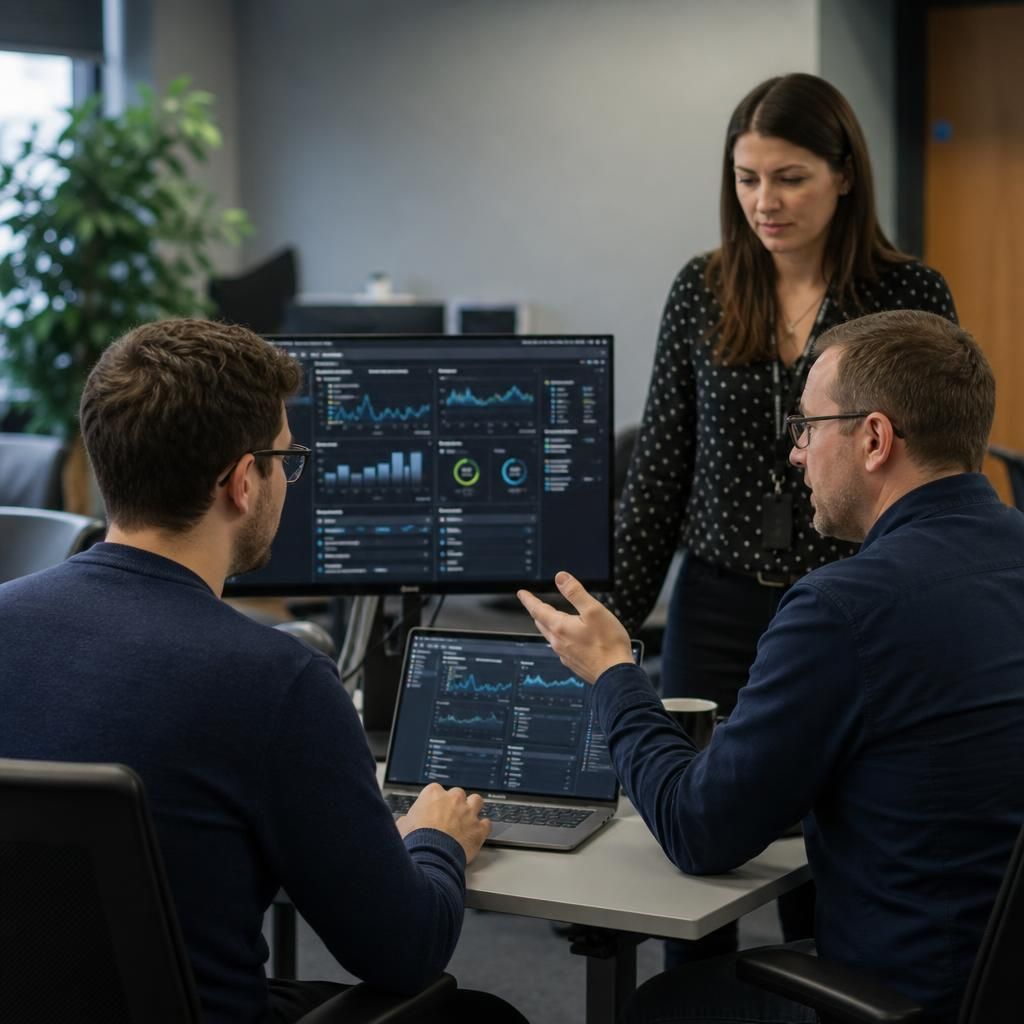
An outsourced IT department can complement an internal team in several ways, depending on the capability gap the business needs to address. The arrangement should be described clearly so staff understand whether the provider is delivering co-managed IT, specialist support or project-based assistance.
- Co-managed IT: Both teams share ongoing operational responsibilities, with the internal team handling functions it knows best and the provider supporting agreed areas.
- Specialist support: The internal team remains the main service owner while the provider contributes expertise in areas such as cyber security, cloud architecture or complex infrastructure.
- Project support: The provider is brought in for a defined technology change, such as a migration, site deployment or infrastructure upgrade, then hands the resulting systems back to the internal team.
These models can be combined, but each engagement should state its scope, expected outputs and point at which responsibility returns to the internal team. This prevents a temporary project role from becoming an unplanned permanent dependency, while allowing the organisation to use external expertise where its own team has limited capacity or specialist knowledge.