

Are software licences included in outsourced IT pricing?
Software licences are not automatically included in outsourced IT pricing; whether they are covered depends on the agreed service scope and licensing model. A clear quotation should identify which licences are included, which are charged separately, and whether costs are billed per user, device or subscription.
Software licences may form part of an outsourced IT charge, but they should be treated as a distinct cost within the agreement rather than assumed to be included in the support fee. The important distinction is between paying for the right to use software and paying for the IT services that configure, manage and support it.
Licences commonly included in a managed service
An outsourced IT package may incorporate licences needed to deliver the defined service. These could include tools used for endpoint management, monitoring, remote administration, backup, security or identity management. In this arrangement, the provider normally specifies what the licence enables, who owns the subscription and how the charge changes when the environment changes.
Including a licence in a package does not necessarily mean that every application used by the business is covered. Business software, specialist applications and subscriptions purchased directly by the client may remain outside the managed service. The quotation should distinguish between:
- software required to deliver the outsourced IT service;
- standard productivity or collaboration subscriptions;
- specialist software used by a particular department or industry;
- security, backup and continuity products; and
- software that the business already owns or licences through another supplier.
Why licensing arrangements affect the price
Software licensing is often based on a metric such as named user, active account, managed device, server, storage capacity or feature level. A business can therefore incur a change in cost when it adds users, replaces devices, enables additional functionality or adopts a higher service tier. The licensing metric should be recorded for each relevant product so that a price change can be traced to a specific change in usage.
Some subscriptions have minimum quantities, annual commitments or renewal dates. This can make the financial treatment different from a flexible monthly support charge. For example, removing a user may reduce future consumption without immediately cancelling an already committed subscription. The agreement should explain whether unused licences can be reassigned, whether reductions take effect at the next renewal and who is responsible for monitoring those commitments.
Existing licences and bring-your-own arrangements
A business may retain ownership of existing licences while asking an IT provider to administer them. This can be appropriate where subscriptions are already contracted directly, where the organisation must control its own tenant or account, or where a specialist application is tied to a particular supplier. The provider may then charge for administration and support without including the underlying licence in its recurring price.
Before accepting this arrangement, check that the licences are valid for the intended users and devices, that the provider has the access needed to manage them, and that renewal responsibility is clearly assigned. A low support price can be misleading if important subscriptions are excluded and must be purchased separately.
Renewals, upgrades and replacement products
Licensing terms should cover what happens when a product changes. A supplier may retire a licence type, alter its features or require migration to a different subscription. The outsourced IT agreement should state whether the provider will recommend an alternative, carry out the technical work, and charge separately for migration or configuration. It should also identify whether price changes caused by the software publisher are passed through to the client.
Renewal administration is another point to clarify. A provider may manage renewal dates and advise on quantities while the client remains responsible for approving expenditure. Alternatively, the provider may procure and recharge subscriptions as part of the service. Both models can work, provided the quotation shows the treatment of renewals, cancellation periods and any applicable commitment.
What to check in a quotation
- Which named software products, platforms or tools are included.
- Whether the quoted amount covers the licence, administration, support, or all three.
- The unit used for charging, such as user, device, account or subscription.
- Whether licence quantities are reviewed and reconciled as the organisation changes.
- Who owns the accounts and licence agreements.
- Who approves purchases, renewals, upgrades and cancellations.
- Whether publisher price changes are included or charged separately.
- What happens to licences when a user leaves, a device is retired or the contract ends.
- Whether implementation, migration or configuration work is outside the recurring charge.
For an organisation comparing proposals, the most useful approach is to request a licensing schedule alongside the service description. This makes it possible to compare like for like and prevents a package with a lower headline fee from appearing cheaper simply because key subscriptions have been omitted. S2 Technology Group can use this type of breakdown when discussing managed IT requirements, helping separate recurring support, software subscriptions and project work in the overall budget.
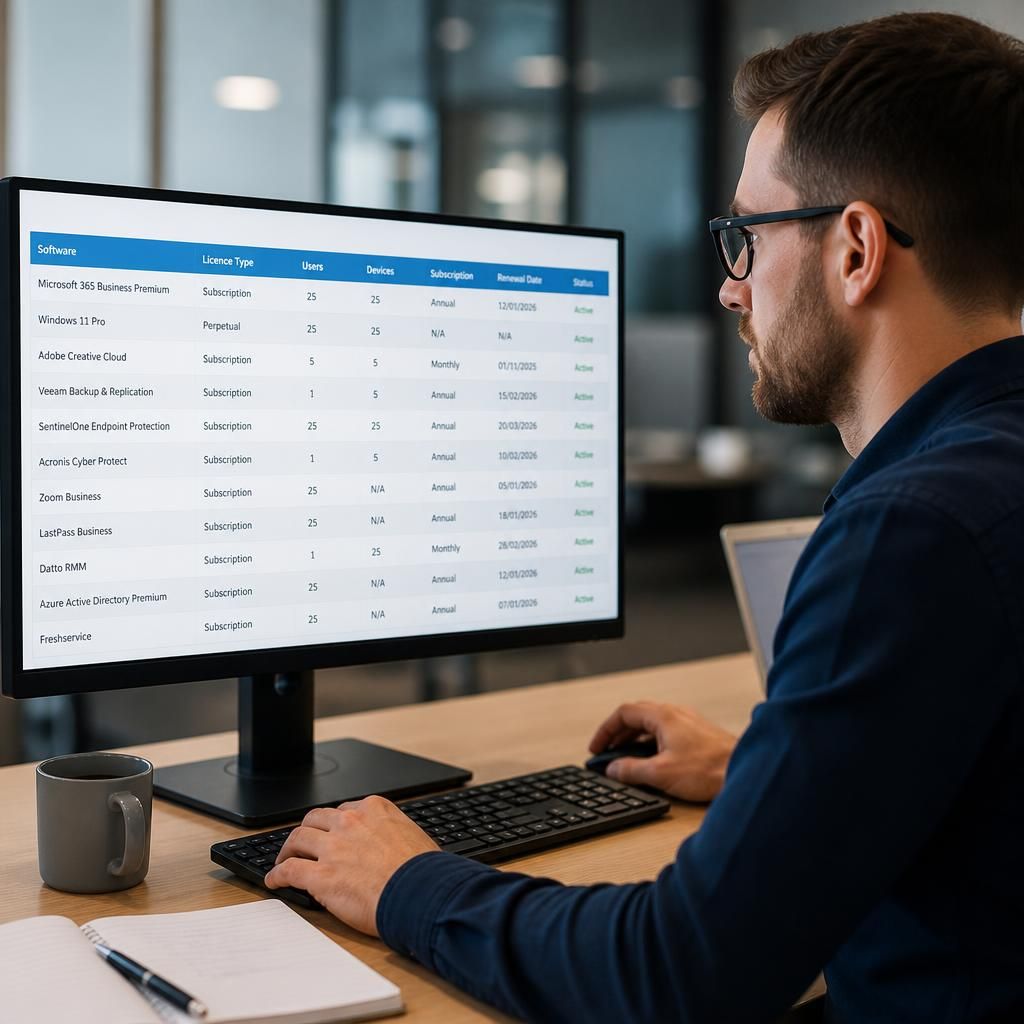
Perpetual licences and subscriptions should be priced differently. A perpetual licence may provide an ongoing right to use a particular software version, while updates, maintenance or vendor support can attract a separate charge. A subscription usually provides access only while the recurring payment remains active. These differences affect what an outsourced IT quotation is actually covering.
Ask whether the quoted amount includes the licence itself, software maintenance, technical administration and support. If a subscription is cancelled, clarify what happens to the data, configuration and user access. If a perpetual product is retained, confirm whether the provider will continue supporting that version or whether an upgrade will be treated as separate project work.
Discuss your software licensing requirements
Discuss your current software estate with S2 Technology Group to establish which licences should be included in the outsourced IT pricing and which are best handled separately. A documented licensing schedule can then support clearer budgeting and contract comparisons.