

How does an IT outsourcing company handle technology changes and upgrades?
An IT outsourcing company manages technology changes and upgrades through a structured process of assessing requirements, planning the work, testing proposed changes and implementing them in a controlled way. It coordinates communication, risk management and post-change checks to reduce disruption and confirm that systems continue to support the business.
An IT outsourcing company handles technology changes and upgrades by combining technical assessment with business planning, governance and controlled delivery. Its role is not simply to install newer hardware or software; it must determine whether a change is suitable, understand its effect on connected systems and users, and ensure the resulting environment remains secure, supportable and aligned with the organisation’s objectives.
It begins with a clear definition of the change. This may involve replacing ageing infrastructure, moving a service to the cloud, updating operating systems, improving connectivity, introducing stronger security controls or expanding capacity for growth. The provider should document the reason for the change, the expected benefits, the systems involved and any constraints such as regulatory duties, contractual requirements or compatibility with existing applications.
A current view of the IT environment is essential before an upgrade is approved. The provider will normally review hardware, software, networks, user accounts, integrations, data dependencies and support arrangements. This can identify assets that are approaching the end of their supported life, applications that may not work with a newer platform, or single points of failure that could make the change more complex than it first appears.
Changes are usually classified according to their risk and scope. A routine update with a known procedure may follow an established approval route, while a major platform migration or infrastructure replacement requires more detailed governance. The classification helps determine who must approve the work, what evidence is required before implementation and whether the change should be introduced in stages rather than across the whole organisation at once.
- Routine changes: repeatable, lower-risk updates that can be managed using an agreed procedure.
- Significant changes: work affecting important systems, multiple departments or several locations, requiring more extensive validation.
- Strategic changes: major upgrades, migrations or replacements that need business-case consideration, financial planning and senior approval.
Before delivery, the provider should establish acceptance criteria. These describe what must be working for the change to be considered successful, such as application compatibility, user access, performance, security settings, data integrity or connectivity between sites. A suitable fallback position is also defined. This may involve retaining the previous configuration, restoring data from a verified backup or reversing a software deployment if the agreed criteria are not met.
Testing should reflect the way the organisation actually operates. A provider may use a test environment, a representative group of users or a pilot location to identify problems before wider deployment. Testing can include authentication, permissions, integrations, printing, remote access, reporting, backup jobs and security controls. For an upgrade involving business-critical data, the ability to recover that data should be checked rather than assumed.
Implementation is normally controlled through a documented runbook. This sets out the technical actions, responsibilities, prerequisites, decision points and checks required during the change. It should also identify dependencies, such as a network configuration that must be updated before an application can be used. Where the work affects several teams or locations, deployment may be sequenced so that lessons from an early stage can be applied to later stages.
Communication is part of the operational work, not an optional addition. Users may need to know about altered procedures, new sign-in methods, temporary restrictions or training requirements. Managers should understand which services are affected, what decisions they need to make and how issues are reported. Clear communication also helps separate a genuine fault caused by the change from a request for help with a new feature.
After implementation, the provider checks the agreed technical and business outcomes. This can include reviewing alerts and system logs, confirming that backups and security policies still operate correctly, checking access for different user roles and gathering feedback from the teams affected. The change record is then updated with the final configuration, any exceptions and outstanding actions. This documentation gives the support team an accurate basis for future troubleshooting and further upgrades.
Technology upgrades also need to account for adoption and ongoing support. A technically successful deployment may still create problems if users do not understand a changed workflow or if internal procedures have not been updated. Depending on the scope, an outsourcing company may provide guidance, administrative documentation, user instructions and knowledge transfer for an existing IT team. It should also clarify which elements it will manage after the change and which remain the client’s responsibility.
For larger organisations, upgrade decisions are often managed through a technology roadmap rather than as isolated projects. The roadmap can bring together hardware and software lifecycles, security improvements, cloud plans, connectivity requirements and expected business growth. This allows related work to be coordinated, avoids unnecessary duplication and helps the business distinguish urgent remediation from desirable modernisation.
A well-managed outsourcing arrangement should therefore make technology changes traceable and reviewable. The business should be able to see why an upgrade was proposed, what risks were considered, who approved it, how it was validated and what the environment now looks like. This provides a practical basis for deciding whether future changes should be maintained, expanded, replaced or deferred.
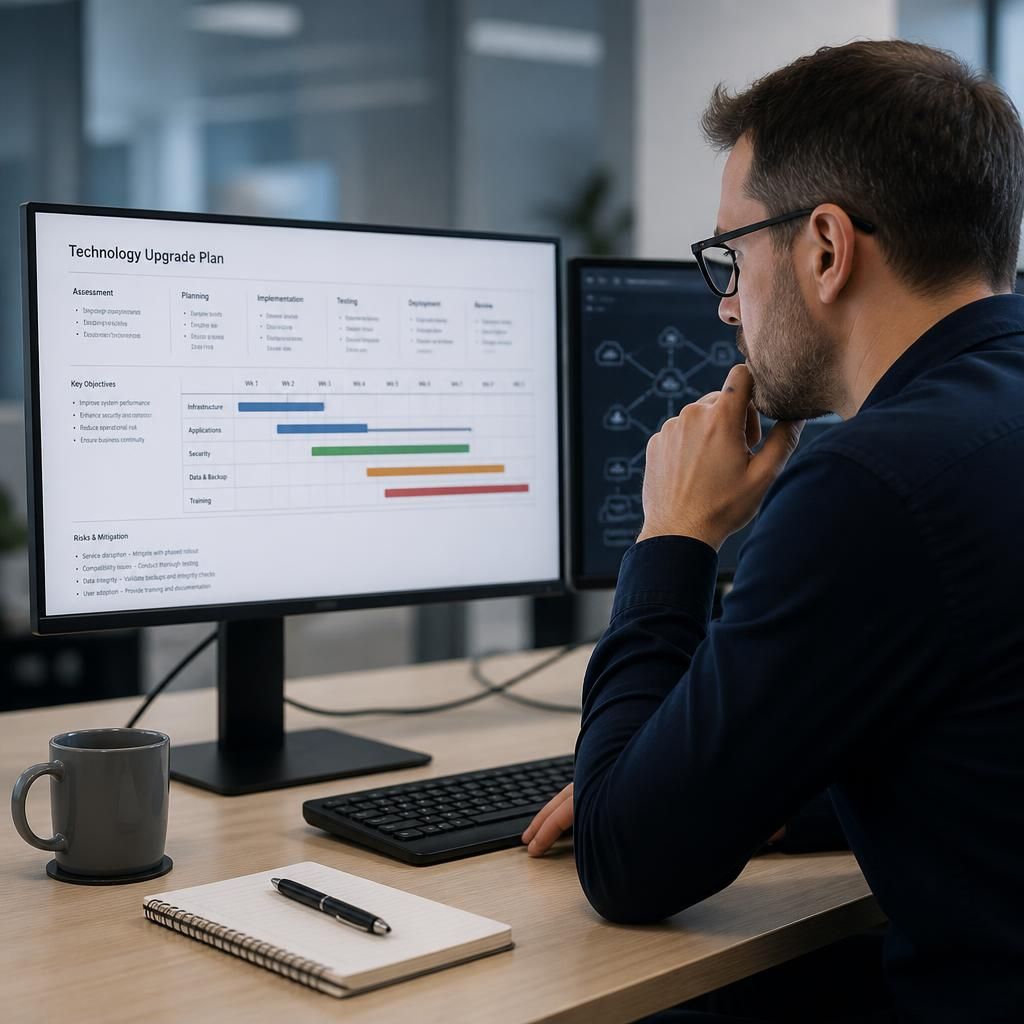
An IT outsourcing company also evaluates the operational and commercial implications of a technology upgrade before recommending it. A technically suitable product may still create problems if licensing terms, supplier support, data-handling requirements or existing contracts are not considered.
The provider can review renewal dates, licence models, compatibility requirements and the level of support available for the proposed technology. It should also identify whether an upgrade changes the organisation’s administration duties, user access model or ongoing management requirements. These findings help the business compare options on more than technical capability alone.
This review is particularly important where systems are connected. A change to one platform may affect authentication, reporting, integrations or the way data is exchanged with another service. Recording these relationships before approval helps the outsourcing company coordinate the upgrade with relevant suppliers and avoid introducing a solution that is difficult to maintain.
Discuss Your Technology Upgrade Requirements
If your organisation is reviewing its technology roadmap or planning a significant upgrade, discuss the requirements, dependencies and governance involved with S2 Technology Group. This can help establish whether IT outsourcing is a suitable way to manage the change.