

What are the risks of IT infrastructure outsourcing?
IT infrastructure outsourcing can introduce risks including security gaps, unclear accountability, service disruption, hidden costs, compliance issues and dependency on a third party. These risks can be reduced through careful supplier due diligence, clearly defined contracts, access controls, documented responsibilities and regular performance reviews.
IT infrastructure outsourcing can create operational, strategic and commercial risks even when a supplier has strong technical capability. The main concern is not simply whether an outsourced provider can run the infrastructure; it is whether the arrangement preserves the organisation’s control, visibility, flexibility and ability to make sound technology decisions.
Loss of internal understanding
When infrastructure knowledge moves largely outside the organisation, internal teams may become less able to assess technical decisions, challenge recommendations or identify the cause of a problem. This can affect budgeting, project planning and risk assessment. A business does not necessarily need to retain the ability to perform every technical task itself, but it should retain enough understanding to govern the service effectively.
This means keeping an informed internal service owner, maintaining accessible architecture and asset information, and ensuring that important decisions are explained in business terms rather than recorded only as supplier-specific technical notes.
Strategic misalignment
An outsourced provider may optimise for standardisation, operational efficiency or its own delivery model, while the customer is prioritising rapid expansion, specialist applications, acquisition activity or changes to its working practices. If these priorities are not aligned, infrastructure decisions can support the supplier’s preferred approach without supporting the organisation’s longer-term objectives.
A useful safeguard is to connect infrastructure planning to business plans. Reviews should consider upcoming office changes, new sites, workforce growth, application projects and changes in operational risk, rather than examining technical performance in isolation.
Integration and migration risk
Outsourcing often involves connecting existing networks, cloud environments, identity systems, applications and security tools to the provider’s processes. Incomplete discovery can expose undocumented dependencies, unsupported systems or incompatible configurations. Migration work can then produce authentication failures, application downtime, data synchronisation problems or unexpected technical debt.
Before implementation, the parties should document the current environment, identify dependencies and define acceptance criteria for each transition stage. Testing should cover normal operations as well as restoration, failover, user access and integrations between critical systems. A phased transition is generally easier to control than a single change affecting the whole environment.
Reduced visibility and slower decision-making
Outsourcing can create an information gap if the customer receives only summary reports. A service may appear healthy while recurring incidents, ageing equipment, capacity constraints or unresolved technical risks remain hidden in operational detail. Limited visibility also makes it harder to distinguish a one-off fault from a developing pattern.
Reporting should therefore provide information that supports decisions, such as recurring incident themes, outstanding technical risks, capacity trends, planned changes, unresolved problems and actions requiring customer input. The format should be understandable to both technical stakeholders and business leaders.
Subcontracting and supply-chain exposure
The named provider may rely on hosting companies, connectivity carriers, specialist engineers or other technology partners. This extends the chain involved in delivering the service and can introduce additional dependencies, different operating practices and less direct control over sensitive processes.
Customers should establish which activities may be subcontracted, how those parties are assessed, who remains responsible for their work and how the customer will be informed of material changes. The same principle applies to access, data handling and operational records across the wider delivery chain.
Capacity and priority conflicts
A shared provider may support many customers at once. During periods of competing demand, the customer’s project or technical issue may not receive the attention its business importance requires, particularly if the arrangement does not distinguish routine work from strategically important activity.
This risk is reduced by defining how priorities are set, who can authorise urgent work, how project resources are allocated and how conflicts are escalated. Business criticality should be based on the effect on operations, customers and legal obligations, not merely on the number of affected devices or users.
Commercial incentives that encourage the wrong behaviour
Pricing structures can influence technical decisions. A model based mainly on consumption may encourage tighter usage controls, while a fixed service scope may make additional work difficult to accommodate. Neither model is automatically unsuitable, but ambiguity can lead to deferred maintenance, disagreement about what is included or decisions that favour short-term cost over long-term suitability.
The commercial model should be tested against likely changes, including acquisitions, new applications, office moves, increased storage and infrastructure modernisation. Assumptions about volumes, projects and optional services should be documented so that future decisions are based on known rules rather than informal negotiation.
Reduced flexibility and technology lock-in
An outsourced environment may become closely tied to a provider’s tools, processes or preferred architecture. Over time, changing provider, bringing selected functions back in-house or adopting a different technical approach may require specialist rework and additional investment. This is distinct from ordinary supplier dependency: the risk is that the design itself limits future choices.
To preserve flexibility, the organisation should understand which components are portable, which interfaces are open and which information is needed to operate or move the environment. Technology decisions should be evaluated for their long-term reversibility, not just their suitability at the point of implementation.
People and communication risks
Infrastructure outsourcing changes working relationships for internal staff, managers and end users. Poorly defined roles can cause requests to be sent to the wrong team, important business context to be lost or changes to be made without the involvement of affected departments. These problems are often organisational rather than technical.
Clear service ownership, agreed communication routes and documented responsibilities for business applications, users, suppliers and facilities help reduce this risk. Staff should also understand which decisions remain with the business and how to raise concerns about technology that affects their work.
Outsourcing is therefore safest when it is treated as a governance and operating-model decision, not merely as the transfer of technical tasks. A structured assessment should consider internal capability, architectural portability, supply-chain exposure, commercial incentives, business priorities and the information needed to oversee the arrangement. Specialist advice from a managed IT services provider such as S2 Technology Group can help a business examine these factors before committing to an outsourcing model.
Outsourcing IT infrastructure can create compliance and liability risks if responsibilities for regulated data and technical controls are not clearly allocated. Using a third-party provider does not remove the organisation’s responsibility for understanding how its data is stored, accessed, protected and transferred.
Before outsourcing, the business should identify the information handled by the infrastructure and establish which legal, contractual or sector-specific requirements apply. The agreement should define responsibilities for access management, security records, incident handling, data retention, secure disposal and cooperation with audits or regulatory enquiries. It should also specify what evidence the provider must supply, such as control records, access histories or summaries of relevant security events.
These arrangements should be reviewed when systems, suppliers or legal obligations change. Clear accountability helps prevent a situation where the business assumes the provider is responsible for a requirement that remains its own obligation.
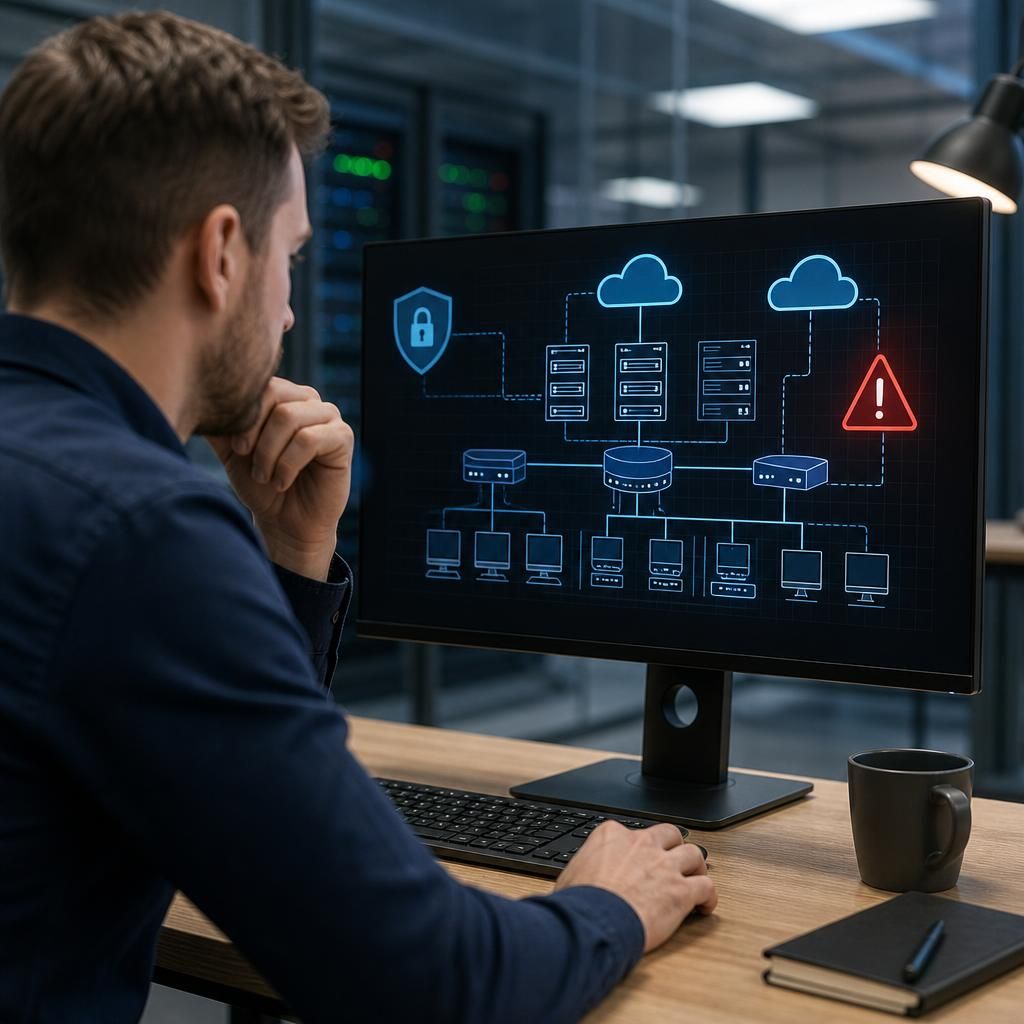
Assess Your IT Infrastructure Outsourcing Risks
Speak to S2 Technology Group about assessing your proposed IT infrastructure outsourcing arrangement, including supplier responsibilities, contractual safeguards and exit considerations. Use the findings to determine whether the model provides appropriate control and flexibility for your organisation.