
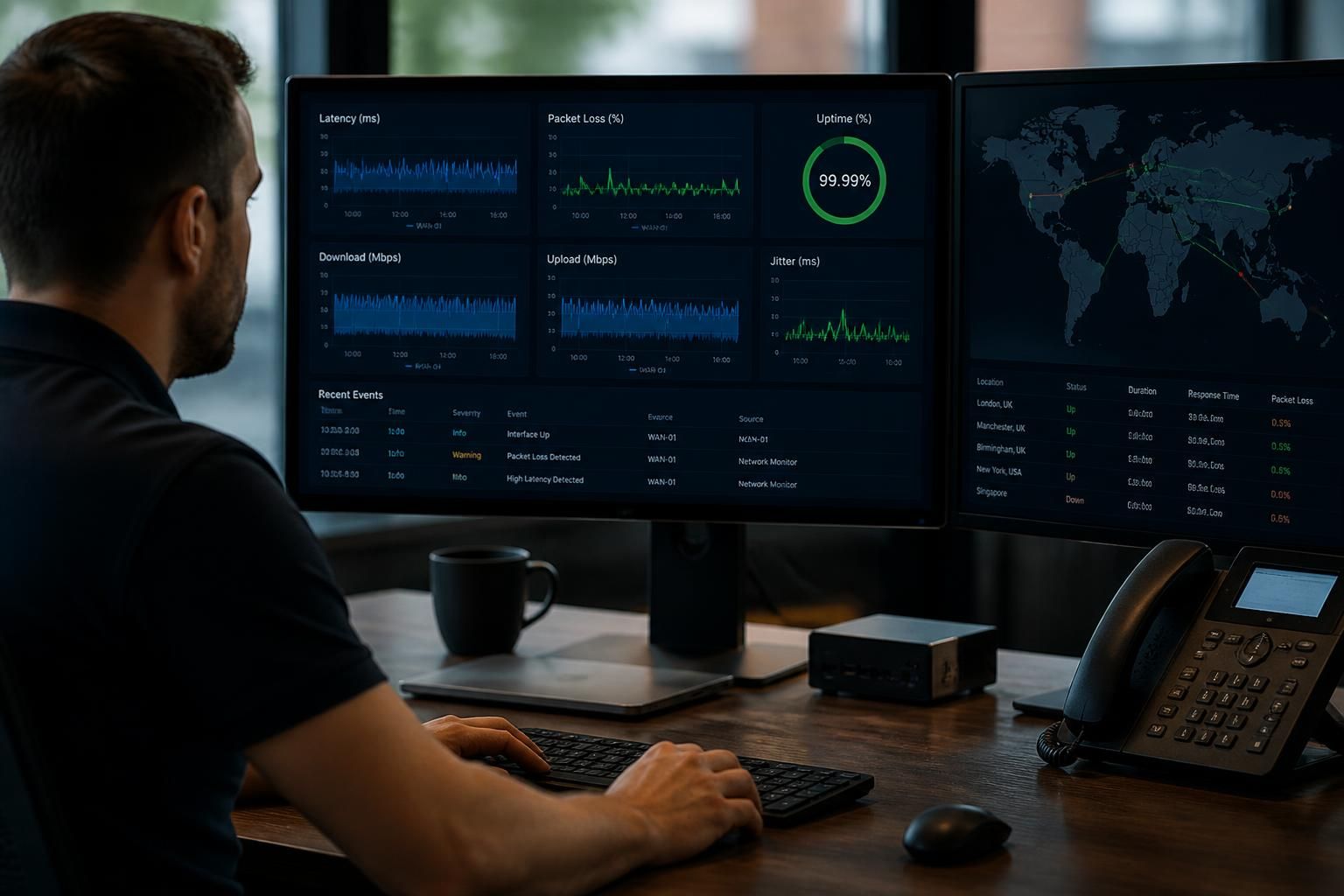
How do businesses monitor broadband performance?
Businesses monitor broadband performance by tracking uptime, download and upload speeds, latency, jitter and packet loss over time rather than relying on a single speed test. Automated monitoring can identify recurring congestion, connection failures and performance changes, while records of incidents and user impact help determine whether the issue is the broadband service, internal network or a specific application.
Effective broadband performance monitoring combines automated testing, network-device data and user-impact records to show how a connection behaves during normal operation and under load. The aim is not simply to produce a test result, but to establish what acceptable service looks like, identify deviations and provide evidence for corrective action.
Start with a representative monitoring point. Tests should run from the business network rather than from an unrelated home or cloud connection. A monitoring appliance, firewall or dedicated probe can measure the service at the point where users access it. For larger or multi-site organisations, each important location should be monitored separately because a fault affecting one circuit may not appear in another.
Where possible, use more than one test destination. A problem reaching a particular application or hosted platform does not necessarily indicate a fault with the broadband circuit. Comparing a general internet test with selected business services, DNS resolution and the provider’s own diagnostic endpoint helps separate an internet routing issue from a problem affecting one destination.
Build a baseline before setting alerts. Collect readings during ordinary working periods, busy periods and known high-demand activities such as cloud backups, video meetings or large file transfers. The baseline should account for normal variation rather than treating every brief change as a service failure. It can then be used to identify unusual behaviour, recurring busy-period degradation and gradual deterioration.
Monitoring should record the time, duration and scale of an event. A single measurement gives limited operational context; a continuous history can show whether an issue is isolated, follows a daily pattern or affects several locations simultaneously. Retaining this information also makes it easier to compare performance before and after a circuit change, network upgrade or configuration adjustment.
Measure the connection from several perspectives. Useful monitoring arrangements combine:
- Active probes that send controlled test traffic at regular intervals.
- Firewall, router or secure access device telemetry showing interface errors, dropped traffic and link-state changes.
- Application and service checks that confirm whether important cloud or hosted systems can be reached.
- Usage data showing how much of the available capacity is being consumed and by which traffic categories.
- User or service-desk reports recording symptoms, affected sites, devices and business activities.
These sources should be correlated rather than reviewed in isolation. For example, a high utilisation reading during a scheduled backup may be expected, whereas the same condition during ordinary office work could indicate insufficient capacity or an uncontrolled transfer. A link-state event at the same time as widespread user disruption provides stronger evidence of a circuit problem than a report from one device alone.
Set practical alert rules. Alerts are most useful when they reflect business impact and persistence. A short-lived deviation may warrant recording without generating an urgent notification, while a sustained fault, repeated instability or a failed check for an important service may require investigation. Rules should include sensible delay periods, repeat-event handling and escalation paths so that staff are not overwhelmed by duplicate alerts.
Different services may need different thresholds. A business using hosted telephony or interactive cloud applications will usually be more sensitive to variation and disruption than an organisation whose main activity is occasional web browsing. Monitoring policies should therefore identify which services are critical, which sites are affected and what level of degradation requires action.
Use the data to locate the fault domain. A structured investigation can compare the broadband handoff, internal switching, wireless access, security appliance, endpoint and application path. Testing from a wired device can help exclude local wireless conditions. Comparing several devices can reveal whether the problem is confined to one workstation. If internal devices are healthy but the external path shows a simultaneous change, the evidence can be presented to the connectivity provider.
Provider reports should include timestamps, affected circuit details, test locations, relevant graphs and the business effect. Clear evidence is more useful than a general statement that the internet feels slow. It also creates a record for reviewing whether a fault has been resolved and whether similar events recur.
Review trends as well as incidents. Monthly or quarterly reviews can identify increasing demand, changes in peak usage, repeated faults and services that are becoming more dependent on the connection. This supports decisions about capacity, traffic prioritisation, secondary connectivity or changes to application design. Monitoring data should be retained for long enough to compare seasonal patterns and significant infrastructure changes, subject to the organisation’s retention and privacy requirements.
Monitoring systems should themselves be secured. Restrict access to dashboards, protect credentials, keep probe software and network devices maintained, and avoid collecting unnecessary content from user traffic. Where monitoring involves identifiable information or detailed browsing records, define who can access it and why.
A managed IT provider can help select suitable probe locations, establish a baseline, tune alerts and interpret evidence alongside the wider network configuration. The result should be an operational process that links technical measurements to business impact, rather than a dashboard that is checked only after users report a problem.

Broadband monitoring should measure performance without materially affecting the connection it is assessing. Automated probes therefore need to use controlled, proportionate test traffic, particularly on circuits with limited capacity or usage-sensitive charging. Large transfers can create artificial congestion and make the results less representative of normal business activity.
Use lightweight checks for continuous monitoring, such as reachability, latency and packet loss, and reserve larger throughput tests for planned diagnostic periods. Record whether each result came from a synthetic test or from actual network use, because the two sources answer different questions. Synthetic tests show whether the connection can meet a defined requirement, while real-traffic data shows how employees, applications and services experience it in practice.
Testing conditions should also be recorded with each result, including the monitoring location, connection type and any deliberate load placed on the network. This context prevents isolated readings from being treated as conclusive evidence and makes performance reports easier to interpret.