
How does the provider document and review changes to our IT environment?
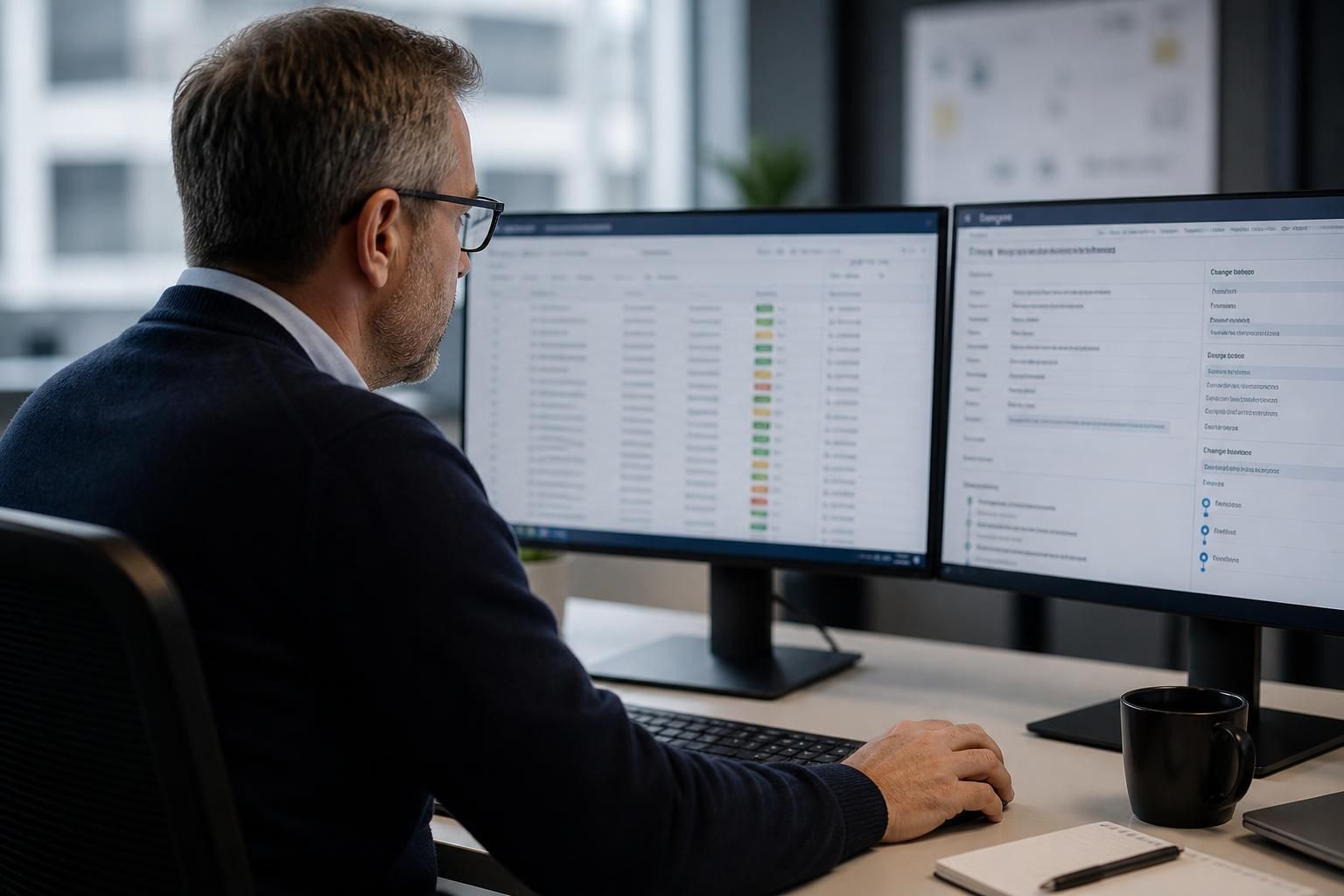
S2 Technology Group documents changes to your IT environment in a controlled record covering what was changed, why it was needed, who approved it and any associated risks. Changes are then reviewed against security, performance, configuration and business requirements, with relevant documentation updated so the environment remains accurate and supportable.
Documenting and reviewing changes to an IT environment is a change-management process that creates a reliable history of how systems have evolved and verifies that each change has been completed properly. It combines a current technical baseline with implementation evidence, testing results and follow-up checks, so future support decisions are based on accurate information rather than assumptions.
A useful process starts with a clear baseline. The provider should maintain an up-to-date view of relevant infrastructure, including devices, servers, cloud services, network arrangements, software configurations, identities and important dependencies. When a change is proposed, it can then be compared with the known environment. This helps identify affected systems, avoid conflicting work and distinguish an intentional modification from an unexpected configuration drift.
Each change should be assigned a suitable classification, such as standard, normal or emergency. A routine, repeatable task may follow a pre-approved procedure, while a significant infrastructure alteration may require more detailed planning. Emergency work should still be recorded retrospectively, with the reason for the exception and the actions taken captured once the immediate issue has been addressed.
Good records contain implementation evidence, not just a brief description. Depending on the change, this may include:
- the affected asset, service, site or user group;
- the planned implementation steps and expected dependencies;
- the maintenance window or sequence in which tasks were performed;
- configuration exports, screenshots, command output or other relevant evidence;
- validation checks completed after implementation;
- any deviation from the original plan;
- the recovery or rollback procedure and whether it was required; and
- the person who completed the technical work.
This evidence makes the record useful to someone who was not involved in the original work. It also supports fault investigation, handovers and audits by showing not only that a change was requested, but how it was carried out and what happened afterwards.
Review should take place at more than one point in the lifecycle. Before implementation, the proposed approach can be checked for dependencies, maintenance sequencing and recovery options. During implementation, progress and deviations can be recorded. Afterward, validation should confirm that the intended service operates correctly and that related controls, monitoring and support information still apply. A later review may also be appropriate for changes whose effects are not immediately visible, such as alterations to identity permissions, network routing or data protection settings.
Where a change introduces an unexpected result, the record should link to the resulting incident, problem investigation or follow-up task. This prevents temporary workarounds from becoming invisible permanent settings. It also allows recurring issues to be identified and may indicate that a procedure, standard configuration or testing approach needs to be revised.
Documentation should be maintained in the systems used for IT service management and configuration control, with access limited according to its sensitivity. Older versions should not simply be overwritten where historical comparison matters. Version history, change references and related diagrams or operating procedures provide an audit trail and help engineers understand when a setting changed.
For a small or medium-sized business, the process does not need to be unnecessarily bureaucratic. The level of evidence should reflect the change’s scope and potential impact. A repeatable workstation adjustment may need a concise record, whereas a migration, firewall alteration, identity-system change or new cloud integration warrants more detailed planning and post-implementation checking. S2 Technology Group can apply this structured approach as part of managed IT support, helping keep the technical record usable for both day-to-day support and longer-term infrastructure planning.
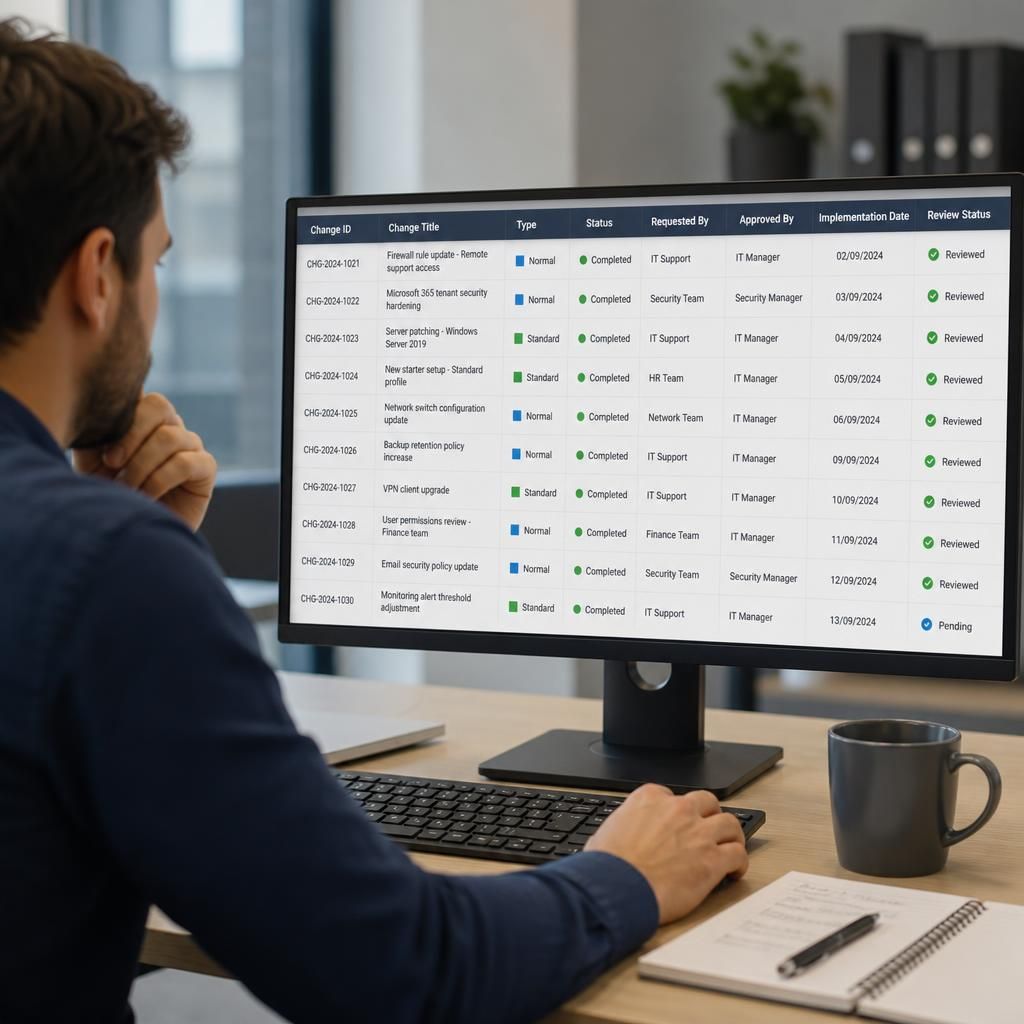
A useful change review examines the quality and wider implications of completed work, not just whether the original task was closed. Reviewing change records as a group can reveal recurring emergency changes, repeated configuration exceptions, unclear ownership or documentation that no longer reflects the live environment.
These reviews can produce practical actions such as:
- updating standard change procedures where the same issue occurs repeatedly;
- removing obsolete configuration guidance and replacing it with the current approved position;
- adding follow-up work to a risk register or infrastructure plan;
- checking that recurring changes have appropriate approval and separation of duties; and
- identifying patterns that should be discussed during service reviews or technical planning.
This turns change documentation into an ongoing source of operational insight. S2 Technology Group can use the findings to keep support information aligned with the systems it manages and to inform future recommendations about security, resilience and infrastructure improvement.