
How does a managed IT support provider measure service quality?
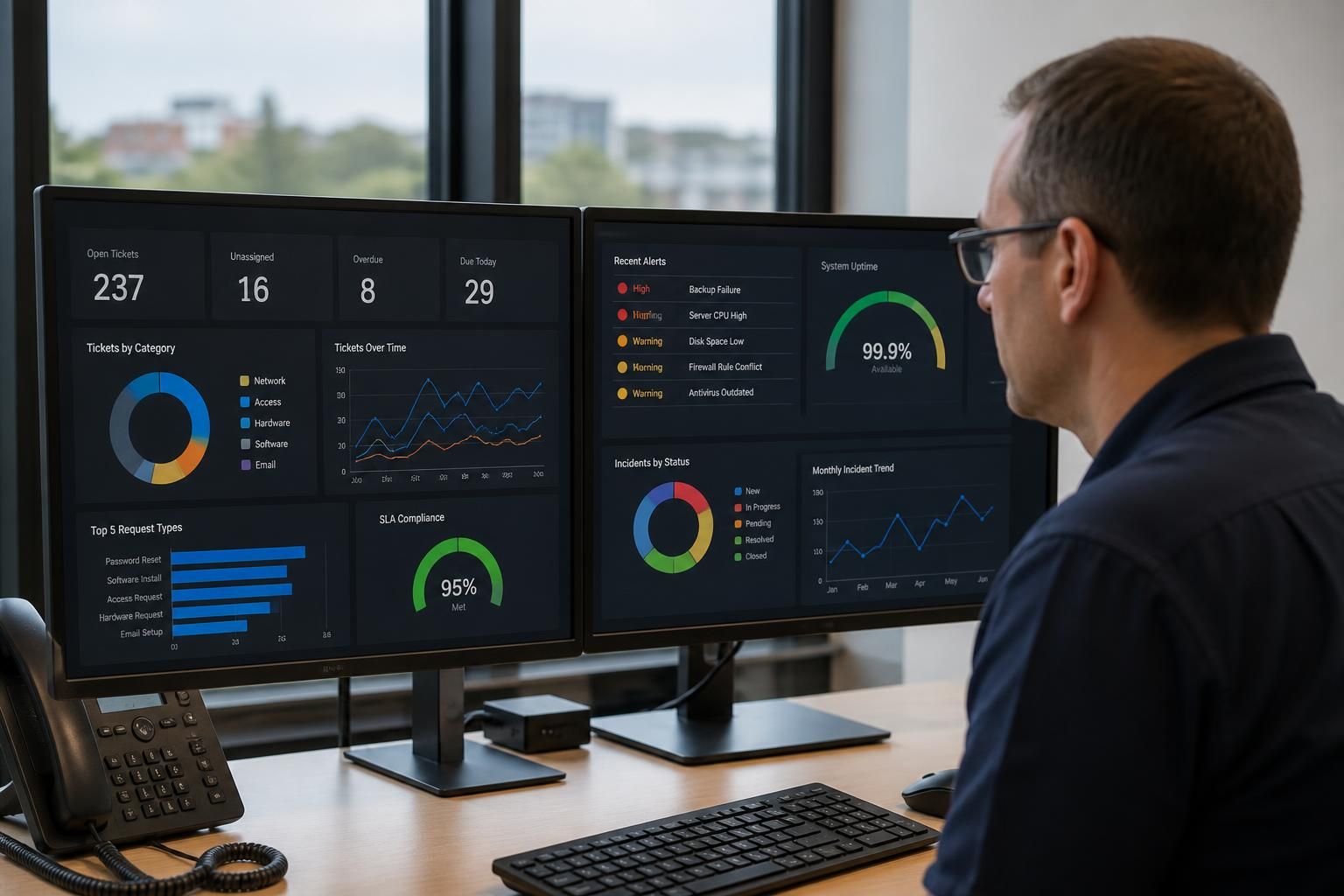
A managed IT support provider measures service quality using agreed service levels, response and resolution performance, system availability, incident trends, security outcomes and customer feedback. Reviewing these measures over time shows whether support is meeting the organisation’s operational needs and where processes or technology require improvement.
Service quality is measured by how consistently an IT support provider keeps technology usable, controlled and aligned with the organisation’s needs. A meaningful assessment combines operational records, process quality, risk management, change performance and structured reviews, rather than relying on the number of tickets closed alone.
Operational measures should show the quality of the work, not just its volume. Useful measures include whether tickets are categorised correctly, whether they are assigned to the appropriate technical level, how often they are reopened, and whether unresolved work is ageing without a clear next action. A high closure count can be misleading if issues are closed prematurely, repeatedly passed between teams or returned by the user. Reviewing the age and composition of the outstanding workload gives a clearer view of service control.
Providers may also assess the quality of request fulfilment. Routine requests should follow an understood process, contain the necessary approvals and leave an accurate record of what was changed. This helps distinguish a controlled service from one that depends on informal conversations, undocumented fixes or individual staff members’ memory.
Trend analysis is more useful than a single reporting period. A monthly or quarterly report should identify recurring problems, seasonal changes, repeated requests and areas where demand is increasing. For example, several apparently separate tickets may be symptoms of one faulty configuration, weak process or unsuitable piece of equipment. A provider demonstrating service quality will investigate these patterns and record corrective actions rather than treating every occurrence as an isolated task.
Incident reviews are particularly important for significant or recurring faults. The review should establish what happened, which systems or users were affected, how the issue was contained, and whether further action is needed. A useful review separates the immediate fix from the underlying cause. It should also assign ownership for preventative work and track that work to completion.
Change management provides another important test. Changes to devices, cloud services, networks, access permissions and security controls should be assessed before implementation, approved at the appropriate level and recorded afterwards. Quality indicators include the completeness of the change record, the suitability of testing, the clarity of the back-out plan and the accuracy of related documentation. Failed or emergency changes should be reviewed for lessons, while successful changes should still leave the environment in a known and supportable state.
Documentation is part of service quality because it determines how well the provider and the organisation can understand the environment. Records may include an asset register, network information, system dependencies, administrative ownership, backup arrangements and supplier details. These records should be kept current after relevant changes. Poor documentation can create avoidable risk even where individual tickets appear to have been handled correctly.
Security quality should be assessed through the operation of agreed controls. This can include the consistency of account and access reviews, patch and vulnerability management, backup monitoring, security alert handling, staff guidance and evidence that exceptions are being tracked. The assessment should consider whether actions are completed, documented and followed up, rather than simply confirming that a security tool or policy exists.
Providers can measure resilience by examining whether important services have suitable recovery arrangements and whether those arrangements have been tested. Relevant evidence may include backup verification, recovery exercises, documented dependencies and records of lessons from testing. A backup that has never been checked for usable restoration provides less assurance than a tested process with clear responsibilities.
Business context must be included in the measurement process. The same technical issue can have different significance for different organisations. A lost connection may delay production in a manufacturing business, prevent access to case information in a professional services firm or disrupt coordination across a logistics operation. Service reviews should therefore consider the importance of affected systems, critical business periods, regulatory obligations and the agreed priorities of the organisation.
A provider should present evidence in a form that decision-makers can use. Good reporting normally distinguishes between current workload, recurring causes, completed improvement actions, open risks, planned changes and decisions required from the client. It should explain exceptions rather than hide them in an average. Averages can conceal a small number of serious incidents, a growing backlog or problems affecting one office, department or user group.
Governance reviews turn measurement into improvement. The provider and client can use regular service reviews to agree which trends require action, whether priorities have changed and whether the support arrangement still matches the organisation’s structure. Actions should have an owner, a target date and a way of confirming completion. Without this follow-through, reporting becomes a record of problems rather than a method for improving the service.
When comparing providers, a business should ask what is measured, how the data is collected, what is excluded, how exceptions are handled and whether the client can see the underlying records. It is also worth checking whether measures cover preventative work and documentation, not only user-reported faults. The strongest evidence is consistent, traceable and connected to business impact, allowing the organisation to judge both the day-to-day service and the provider’s contribution to a stable technology environment.

Customer feedback measures the user experience of managed IT support, but it is most useful when collected systematically and considered alongside service records. A provider can use short post-incident surveys, periodic interviews with key users and structured reviews with department leads to identify whether support is clear, consistent and appropriate to the organisation’s needs.
Useful feedback questions may cover the clarity of communication, whether the user understood the next steps, whether the resolution addressed the underlying need and how much disruption the issue caused. Comments should be grouped into themes rather than treated as isolated opinions. For example, repeated concerns about updates may indicate a communication process issue, while recurring complaints from one department may point to a system or training requirement.
Feedback should not be reduced to a single satisfaction score. Response rates, the types of users responding and the severity of the incidents involved can affect the result. A sound assessment compares feedback with ticket history, repeat incidents and resolution records, then assigns actions where a pattern is identified. This makes user experience evidence part of service improvement rather than a standalone measure.