

How do managed IT support providers support technology planning?
Managed IT support providers support technology planning by assessing your current systems, identifying risks and limitations, and creating a practical roadmap aligned with business requirements. This may include prioritising infrastructure upgrades, cyber security improvements, cloud solutions and connectivity changes so technology remains secure, scalable and fit for future needs.
Technology planning is the structured process of deciding what a business’s IT environment needs to support its operations, how those needs should be met, and when changes should be made. A managed IT support provider contributes technical analysis, business context and practical implementation planning, helping ensure that technology decisions are coordinated rather than made in response to isolated problems.
Planning starts with business objectives. Technology should be considered in relation to the organisation’s direction. A provider may work with business leaders and department managers to understand planned growth, new locations, changes to staffing, customer requirements, compliance obligations and operational priorities. For example, a manufacturing business may need dependable systems for production and stock control, while a professional services firm may place greater emphasis on secure access to documents and client information. These requirements affect the shape and order of the technology plan.
The provider then establishes a baseline. This is more than listing devices and software. It can include documenting users, sites, servers, networks, cloud services, connectivity, backup arrangements, access controls, suppliers and important business applications. Mapping relationships between these components is particularly useful because a change to one part of the environment can affect several others. A proposed cloud migration, for instance, may also require changes to identity management, connectivity, permissions, staff processes and data protection arrangements.
A well-maintained baseline helps identify:
- systems that are approaching the end of their useful or supported life;
- duplicated services or tools that perform overlapping functions;
- dependencies between applications, users, sites and suppliers;
- capacity constraints that could affect planned growth;
- areas where documentation, ownership or configuration information is incomplete; and
- technology that is not aligned with the organisation’s current operating model.
Good planning separates need from preference. Staff may request a particular tool because it appears familiar or convenient, but the planning process should consider its compatibility, administration requirements, information security implications, licensing model and long-term suitability. Providers can compare options against agreed criteria and explain the operational consequences of each one. This gives decision-makers a basis for choosing an approach rather than selecting technology solely because it is popular or readily available.
Plans are usually organised by priority and dependency. Not every desirable improvement can or should happen at the same time. A provider may classify proposed work according to business importance, technical dependency, lifecycle position, operational disruption and available resources. Some tasks must happen first: improving identity controls may be necessary before introducing a new remote access arrangement, while replacing an ageing network component may be a prerequisite for expanding a site. Sequencing work in this way reduces avoidable rework and makes investment easier to manage.
The resulting plan may contain several time horizons:
- Immediate actions: tasks needed to address known weaknesses, unsupported components or pressing operational constraints.
- Planned improvements: changes that can be scheduled around business activity, budgets and staff capacity.
- Strategic decisions: longer-term choices about infrastructure, cloud adoption, connectivity, locations, applications and the way IT is managed.
This does not mean every future detail must be fixed in advance. Effective planning records assumptions and identifies decisions that need to be revisited when circumstances change. A business may acquire another organisation, open a new site, introduce a new service or change its working practices. The plan should therefore be treated as a managed reference point, not a document that becomes obsolete after its first version.
Financial planning is another important part of the process. A provider can help distinguish routine operating costs from project expenditure and identify the likely ownership costs of a proposed change. These may include implementation, migration, training, support, licensing, replacement cycles and disposal. Looking beyond the initial purchase price helps businesses compare options more accurately and avoid committing to a solution that is difficult or expensive to maintain.
Technology planning also assigns responsibility. A useful plan states who owns each decision, who supplies or implements the change, which internal staff need to contribute, and how completion will be confirmed. It should also identify dependencies involving telecommunications providers, software suppliers, building works or specialist contractors. Clear ownership reduces the risk of tasks being delayed because each party assumes that another party is responsible.
Implementation should be accompanied by change control. Before a significant alteration is made, the provider and the business should agree the scope, affected users, testing requirements, communication arrangements, fallback position and approval route. For larger changes, a staged rollout or pilot may provide an opportunity to identify configuration or usability issues before the change reaches the whole organisation.
Security and resilience should be built into each decision rather than added afterwards. Planning may consider how users and systems are authenticated, how access is removed when roles change, where business data is held, how it can be restored, and how important operations would continue if a service became unavailable. These considerations apply to infrastructure upgrades, cloud solutions, connectivity and third-party applications alike. They should be assessed alongside functionality and cost.
Finally, the provider should review the plan against evidence from the managed environment. Service records, recurring faults, capacity information, asset changes, security findings and feedback from users can all indicate whether the current priorities remain appropriate. Regular review allows the business to adjust its technology programme when its objectives, risks or operating conditions change.
For a small or medium-sized organisation without a full internal IT planning function, a managed IT support provider can supply this structure while working with the people who understand the business. The value is not simply a list of technical recommendations; it is a documented, prioritised and reviewable approach that connects technology decisions with operational requirements.
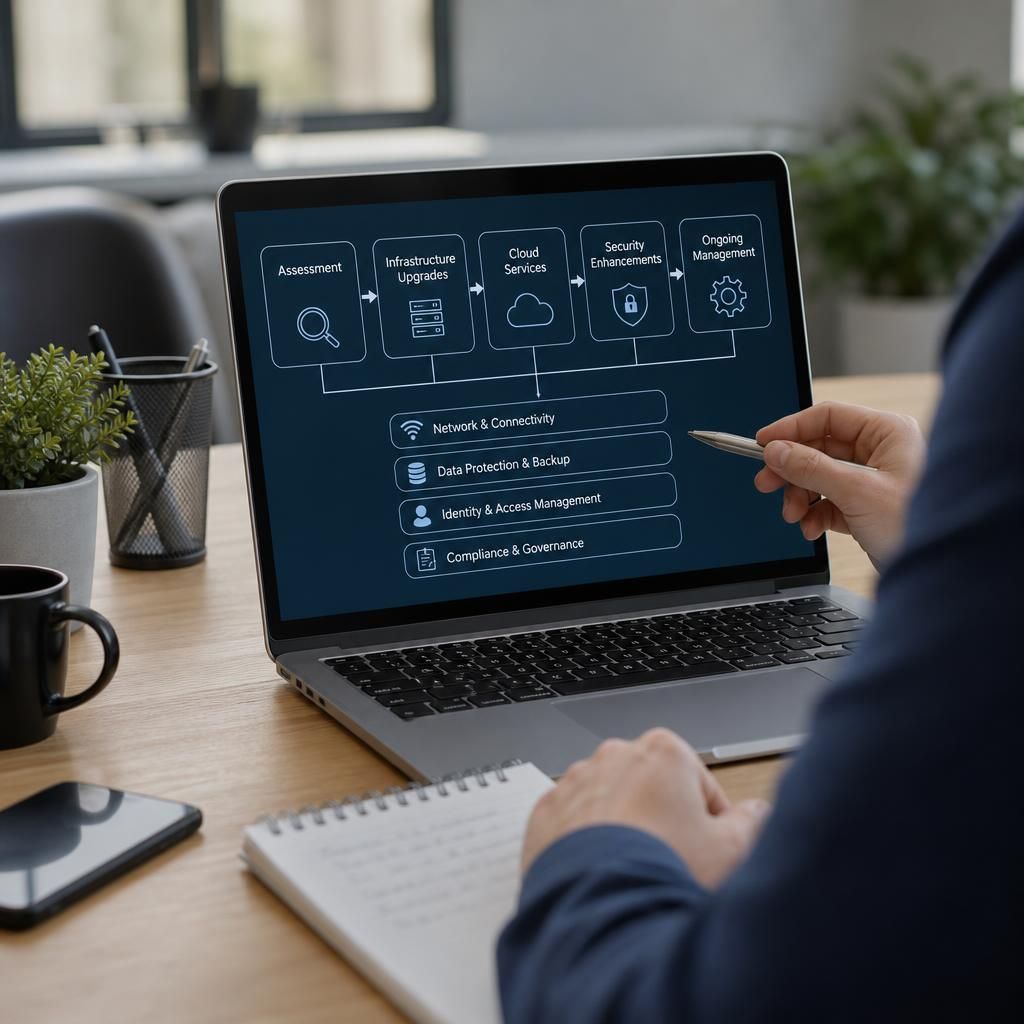
Managed IT support providers can support technology planning by translating compliance and governance requirements into practical technology decisions. This means considering not only whether a system works, but also whether the business can demonstrate appropriate control over access, data, suppliers and changes.
For example, a provider may help identify which systems contain sensitive business information, who should be permitted to access it, how access decisions are recorded and what evidence should be retained. These requirements can influence the choice of cloud services, identity controls, backup arrangements and supplier agreements. Addressing them during planning reduces the risk of selecting an operationally suitable system that later creates avoidable governance or audit difficulties.
The provider can also document the reasoning behind significant decisions, including the requirement being addressed, the options considered, the risks accepted and the person responsible for approval. This creates a clearer reference for future reviews and helps the business assess whether its technology remains appropriate as its obligations and operating model develop.