

How does fully managed IT support differ from co-managed IT support?
Fully managed IT support gives an external provider responsibility for the organisation’s day-to-day IT management, whereas co-managed IT support shares that responsibility between the provider and an internal IT team. The main difference is the division of ownership: fully managed support is designed for businesses without a full in-house IT function, while co-managed support extends the capacity or expertise of an existing team.
Fully managed IT support transfers the primary operational responsibility for technology to an external provider, while co-managed IT support adds an external team alongside an organisation’s existing IT staff. The difference is not simply the number of people involved. It affects who makes decisions, who handles routine work, how incidents are escalated and where accountability sits when an issue affects the business.
In a fully managed arrangement, the provider usually oversees the agreed IT estate as a complete service. This can include user support, device management, network administration, cloud platforms, security controls, backups, software administration and technology planning. The exact scope should be defined in writing, including which systems are covered, which responsibilities remain with the customer and how significant changes are approved.
Co-managed support is more modular. The internal IT team continues to own some activities, while the external provider supports defined areas. For example, the provider might assist with cyber security, cloud administration, infrastructure projects or out-of-hours escalation, while internal staff retain responsibility for user relationships, application support or day-to-day decision-making. Alternatively, the provider may handle routine service desk work while the internal team concentrates on strategic projects.
The practical differences can be compared across several areas:
- Accountability: Fully managed support generally provides one principal point of responsibility for the agreed IT service. Co-managed support requires clear boundaries between the internal team and external provider to prevent duplicated work or overlooked tasks.
- Control: An internal team usually retains more direct control in a co-managed model. A fully managed model involves delegating more operational decisions, subject to agreed policies, approval processes and reporting.
- Internal capability: Fully managed support is suited to organisations with limited internal IT capacity or no dedicated IT department. Co-managed support is more appropriate where an internal team exists but needs additional skills, capacity or cover for particular technologies.
- Service scope: Fully managed support is commonly designed around the complete technology environment. Co-managed support can be restricted to selected systems, locations, users or specialist responsibilities.
- Knowledge and documentation: Both models require accurate records of systems, suppliers, permissions, configurations and business-critical processes. In co-managed support, documentation must also make ownership boundaries clear so that each team understands what it can change and what must be escalated.
- Planning: A fully managed provider may take a broader role in developing the IT roadmap. In a co-managed arrangement, strategic planning may remain with the internal IT lead, with the provider contributing advice or specialist delivery.
Co-managed support can be useful when an organisation wants to retain an internal IT presence but cannot reasonably cover every technical discipline. A small internal team may understand the business, applications and users particularly well, but need external assistance with security monitoring, network design, cloud configuration, infrastructure upgrades or complex troubleshooting. The arrangement can also provide additional capacity during a project without requiring the organisation to build every skill permanently.
Fully managed support can be the clearer option where technology is important to the organisation but employing and retaining a broad internal IT function would be impractical. It can consolidate routine management, security administration, maintenance and technical planning under an agreed operating model. This does not remove the need for business involvement: senior staff still need to approve priorities, access policies, budgets and changes that affect operations.
The main risk in co-managed support is ambiguity. If both teams assume that the other is monitoring alerts, applying updates, managing backups or responding to a security event, an important task can be missed. A sound co-managed agreement should therefore define:
- which team owns each system and process;
- who can approve and implement changes;
- how incidents are logged, escalated and handed over;
- which team manages accounts, permissions and leavers;
- who reviews security alerts, backups and vulnerabilities;
- how suppliers and licences are administered;
- which performance information is reported and to whom; and
- how disagreements or competing priorities are resolved.
When choosing between the models, assess the organisation’s current internal skills, the complexity of its systems, its regulatory and security requirements, the amount of project work planned and the level of management involvement available. Also consider whether the preferred arrangement can change as the organisation grows. A business may start with co-managed support to strengthen a small internal team, then move towards a fully managed model if responsibilities become difficult to coordinate. Equally, an organisation using fully managed support may later develop internal capability and adopt a shared model.
The best choice is therefore determined by the required operating model rather than by the label alone. S2 Technology Group can help organisations around Stourbridge and neighbouring areas assess whether a complete managed service or a defined co-managed arrangement better fits their people, systems and technology priorities. The important outcome is a documented division of responsibility that supports secure, consistent and accountable IT management.
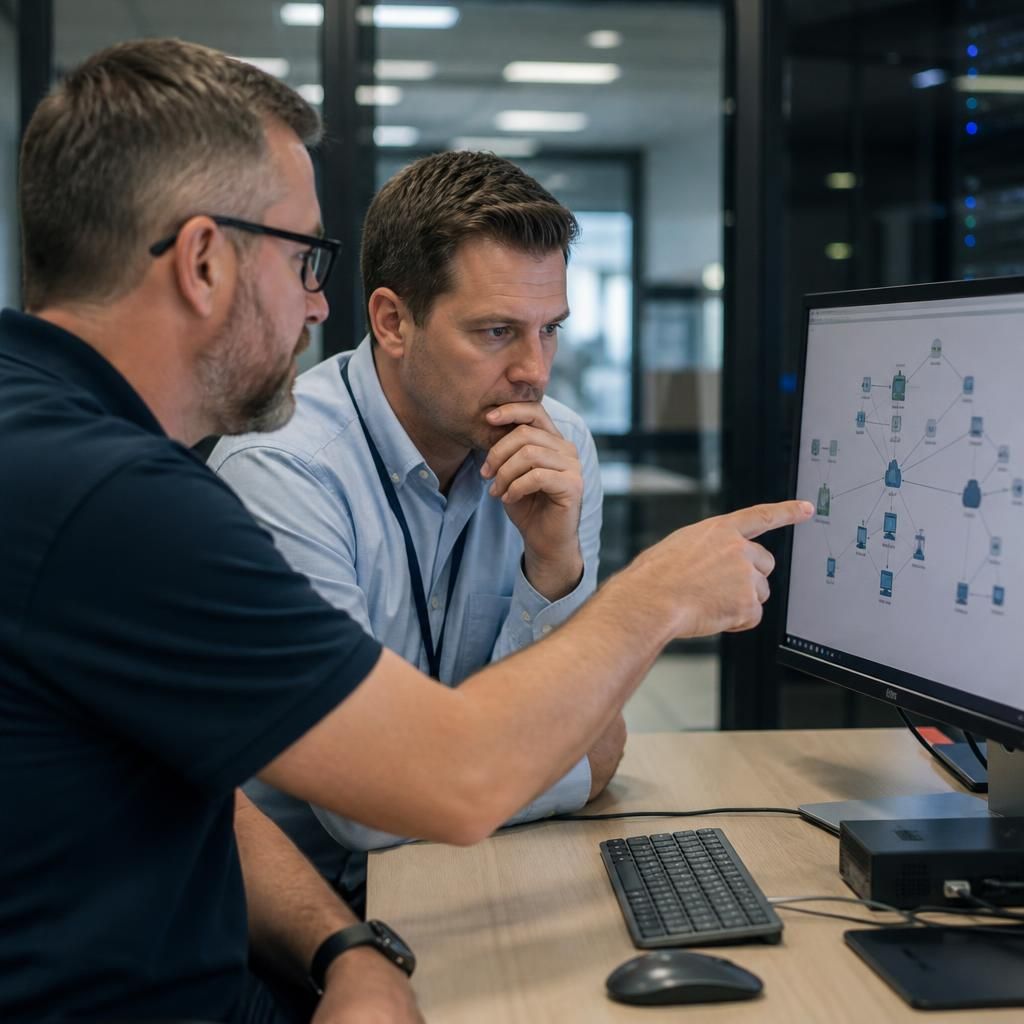
A key difference between fully managed and co-managed IT support is how the total cost of running the IT function is assessed. A fully managed service usually groups the agreed operational responsibilities into one external service, while a co-managed arrangement may combine an external contract with internal salaries, tools, training, specialist consultancy and project work.
This means the lower quoted service price is not necessarily the lower overall cost. When comparing models, assess the resources retained internally as well as the provider’s fees. Consider the time spent coordinating suppliers, maintaining technical knowledge, covering specialist systems, managing security tasks and completing routine administration. The comparison should also identify which activities are included in the core service and which are charged separately, such as major infrastructure changes or additional project work.
A useful evaluation is to map the organisation’s recurring IT activities against the people, skills and tools required to deliver them. If a co-managed model is chosen, include the cost of maintaining sufficient internal capacity for the responsibilities that remain in-house. If fully managed support is considered, check that the service scope reflects the organisation’s actual systems and operational requirements rather than paying for an unsuitable standard package.
Assess Which IT Support Model Fits Your Business
Review your current IT responsibilities and identify where internal capacity, specialist expertise or clear ownership is lacking. Contact S2 Technology Group to discuss whether fully managed or co-managed IT support is the more suitable operating model for your organisation.