How can remote monitoring support compliance requirements?
Remote monitoring can support compliance requirements by providing continuous oversight of systems, recording relevant events and identifying changes that may require investigation. When monitoring data is access-controlled, securely retained and reviewed through defined processes, it can contribute to audit evidence and ongoing policy enforcement.
Remote monitoring supports compliance requirements by turning technical activity into structured, reviewable evidence. It can show whether defined controls are operating, identify exceptions for follow-up and provide records that help an organisation demonstrate how its IT environment is managed. It does not create compliance on its own; the monitoring must be linked to documented policies, responsibilities and the specific obligations that apply to the organisation.
The first step is to map monitoring activities to relevant requirements. Depending on the organisation, these may include data protection duties, contractual security terms, cyber security frameworks, insurance conditions or sector-specific controls. A monitoring plan should identify:
- which devices, servers, services and environments are within scope;
- which conditions indicate that a control is working or failing;
- who is responsible for investigating exceptions;
- what evidence must be produced for internal or external review; and
- how often each control and its monitoring rule should be reassessed.
This prevents monitoring from becoming a collection of disconnected technical alerts. For example, a requirement relating to secure system maintenance may be supported by records showing device health, update status, endpoint protection status and unresolved technical exceptions. A requirement concerning business continuity may be supported by monitoring of backup jobs, storage capacity and the availability of key infrastructure. The evidence is useful because it connects an operational state to a defined control rather than simply reporting that an alert occurred.
Monitoring can also support accountability. Records can show when a condition was detected, what assessment was made, which action was assigned and whether the issue was resolved or accepted as a documented risk. This creates a clearer chain between detection and management decision-making. Where an exception cannot be corrected immediately, recording its owner, rationale and review date helps prevent it from disappearing into an untracked queue.
Data protection requirements need particular care. Monitoring may collect device identifiers, user account details, IP addresses, system activity or other information that can relate to an identifiable person. Organisations should establish a lawful and proportionate purpose, limit collection to what is necessary, define retention periods and explain relevant monitoring practices to staff. A data protection impact assessment may be appropriate where monitoring is extensive or likely to create a higher risk to individuals. Technical monitoring should therefore be designed around the compliance need, rather than collecting every available data point.
The quality of compliance evidence depends on reliable configuration and consistent operation. Monitoring rules should have defined thresholds, consistent naming and documented ownership. Changes to those rules should be recorded, particularly where a change could affect whether a control is detected. Unsupported devices, excluded systems and periods of incomplete data should also be visible in reports, since undisclosed gaps can give a misleading impression of coverage.
Useful compliance reporting normally combines current status with historical context. A report may include:
- the systems and controls included in the reporting period;
- exceptions raised and their current status;
- recurring or unresolved conditions;
- changes that affected monitoring coverage or control operation;
- actions allocated to named roles or teams; and
- management decisions relating to accepted risks or planned remediation.
Reports should be interpreted alongside other evidence, such as policies, access reviews, risk assessments, incident records and supplier information. Remote monitoring can confirm aspects of the technical environment, but it cannot prove that staff followed a policy, that a risk assessment was suitable or that every business process met its obligation. Treating monitoring records as one part of a wider assurance process produces a more accurate compliance position.
A managed IT provider such as S2 Technology Group can help businesses define suitable monitoring coverage, connect technical findings with operational procedures and prepare understandable evidence for service or compliance reviews. The organisation remains responsible for deciding which requirements apply and approving its policies, risk decisions and remediation priorities.
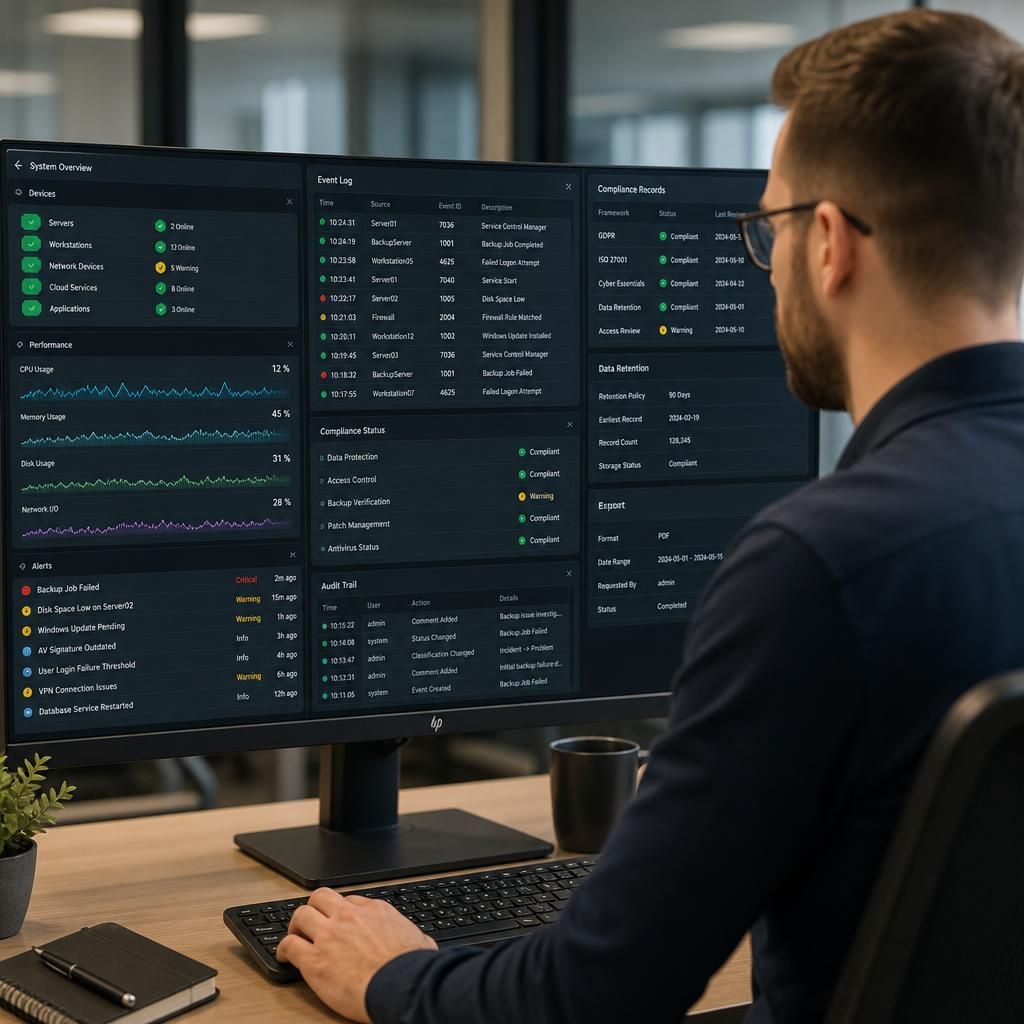
The compliance value of remote monitoring depends on the integrity of its evidence. Records should be attributable to a defined system, contain dependable timestamps and preserve the original event separately from later comments, classifications or corrective actions.
This distinction helps an organisation demonstrate what the monitoring system actually detected, rather than presenting only a revised summary. For example, an original failed backup event should remain available even after the issue is investigated and marked as resolved. Any amendments, annotations or status changes should have their own audit trail, showing what was changed and why.
Evidence should also be exportable in a consistent format for review, with the reporting period, data sources and known limitations clearly stated. Before relying on monitoring records, the organisation should test that timestamps are aligned, events can be traced to the relevant device or service, and records remain available throughout the required retention period. These checks make remote monitoring evidence more dependable when controls are reviewed by management, customers or an external assessor.