

How do managed IT services support compliance for small businesses?
Managed IT services support small business compliance by applying and documenting practical controls such as access management, software patching, backups, security monitoring and data-handling procedures. A managed IT provider can also help identify gaps, maintain evidence of these controls and align technology practices with the requirements relevant to the organisation.
Managed IT services support small business compliance by turning regulatory and contractual expectations into defined responsibilities, repeatable processes and auditable records. The provider helps connect business requirements with the way technology is managed, while the organisation remains responsible for deciding which rules apply and confirming that its wider operations meet them.
Compliance begins with understanding the business context. Different organisations may have obligations arising from data protection law, industry regulation, customer contracts, insurance requirements or recognised security standards. A managed IT provider can help map the technology-related parts of these obligations, identify who owns each activity and distinguish essential requirements from sensible improvements. This avoids treating compliance as a generic checklist that may not reflect the organisation’s actual risks or services.
A useful compliance review normally considers:
- what information the business holds and which systems process it;
- which employees, contractors and suppliers interact with those systems;
- where technology decisions are made and approved;
- which customers, regulators or insurers require evidence of particular controls;
- how incidents, exceptions and changes are escalated; and
- which records must be retained, reviewed or securely disposed of.
Clear policies make technical activity accountable. Small businesses often have informal technology practices because decisions have historically been made by a director, office manager or technically minded employee. Managed IT support can help formalise those practices into documented policies and operating procedures. These might cover acceptable use, device ownership, remote working, supplier access, data classification, software approval, incident reporting and the process for making material technology changes.
Documentation is valuable because it shows not only what the business intends to do, but also who is responsible for doing it and how exceptions are handled. Policies should be proportionate to the organisation. A short, maintained procedure that staff understand is generally more useful than a lengthy document that does not reflect day-to-day operations.
Managed services can create a more consistent operating environment. Compliance is harder to demonstrate when every employee, device or site is managed differently. A provider can establish standard configurations, approved processes and defined escalation routes across the systems within its remit. It can also record changes, review exceptions and flag situations where a system or user falls outside the agreed standard.
This consistency helps the business answer practical questions during an internal review or customer assessment, such as which systems are in scope, who can approve a change, how a suspected incident is reported and what happens when an employee or supplier no longer needs access. It also reduces reliance on individual knowledge that may not be recorded elsewhere.
Evidence is an important part of compliance support. An organisation may have a suitable process but still struggle to prove that it is followed. A managed IT provider can maintain relevant service records, review summaries, change histories, incident records, policy acknowledgements and other documentation generated through normal IT operations. The exact evidence depends on the requirements being addressed and the services included in the agreement.
Evidence should be understandable to someone who was not involved in the original activity. It should identify the date, scope, responsible party, outcome and any follow-up action where appropriate. Regular reporting can help management see unresolved exceptions rather than receiving information only when an audit or customer questionnaire arrives.
Incident handling links compliance with day-to-day decision-making. When a security or technology incident occurs, the business may need to determine what happened, which information or services were affected, who must be informed and what remedial action is required. Managed IT support can define an escalation process, preserve relevant records and provide technical information for the organisation’s decision-makers.
The provider does not normally decide the legal notification position on the business’s behalf. That judgement may require the involvement of a data protection officer, solicitor, insurer or other specialist. However, accurate technical records and a clearly understood escalation route can help the organisation assess the situation on a more informed basis.
Compliance also depends on people and suppliers. Technical controls are only one part of an effective programme. A managed provider can support staff guidance, induction material and periodic reminders about handling business information, reporting suspicious activity and using approved systems. It can also help document the responsibilities of third-party suppliers whose services connect to the organisation’s systems or process information for it.
Supplier oversight should establish what access a third party has, why that access is needed, what security commitments apply and how the relationship will be reviewed or ended. This is particularly relevant to small businesses that use cloud applications, outsourced payroll, hosted platforms or specialist operational software.
Regular reviews keep compliance aligned with business change. New staff, premises, applications, customers and services can alter the organisation’s obligations and its exposure to risk. A managed IT service can provide a structured point at which technology, documentation and responsibilities are reviewed. The review may result in updated policies, revised service requirements, additional staff guidance or a decision to obtain specialist legal advice.
It is important to define the boundary of the service clearly. Managed IT support can provide technical management, records and practical guidance, but it does not automatically make a business compliant or replace legal, regulatory or governance expertise. The organisation must identify its obligations, approve its policies, make risk decisions and ensure that non-technical parts of its operation meet the same standards.
For a small business, the most useful approach is usually a documented compliance plan that links each relevant requirement to an owner, a process, supporting evidence and a review point. Managed IT services can maintain the technology-related elements of that plan, making compliance a continuing management activity rather than a last-minute response to an audit or customer request.
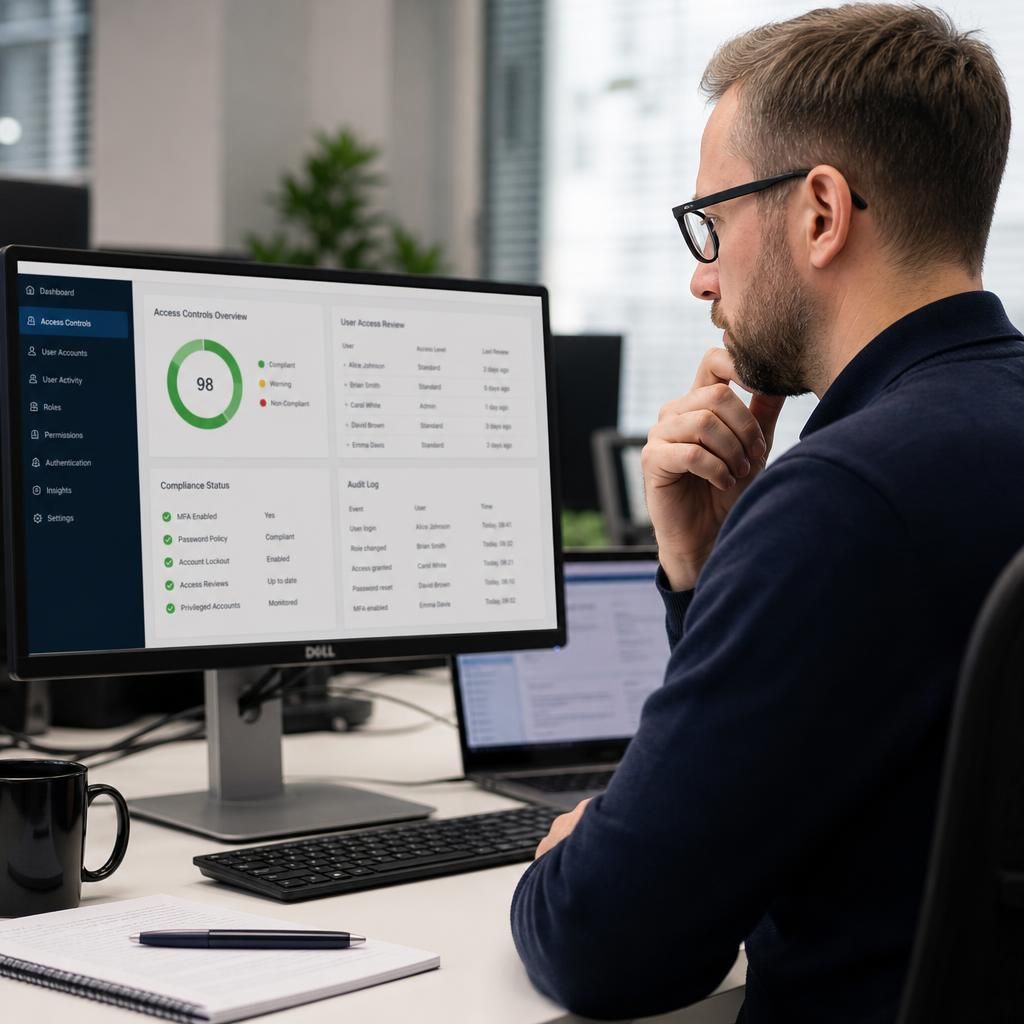
Managed IT services can support compliance by testing whether technical controls work in practice, rather than simply recording that a policy exists. A documented backup process, for example, provides limited assurance unless the organisation also verifies that data can be restored. Similarly, a software management process should identify devices that remain unpatched or use unsupported applications.
Control checks can be built into the service review process and assigned to a responsible person. Useful checks may include:
- confirming that backups complete and restoration procedures remain usable;
- checking that security settings match the approved configuration;
- identifying devices, accounts or applications outside the agreed standard; and
- recording corrective action and confirming when an identified issue has been resolved.
This approach gives management a clearer view of residual compliance risk. It also prevents a control from being treated as effective indefinitely when the business, its systems or the threat environment have changed.
Review your small business IT compliance requirements
Review your small business IT compliance requirements with S2 Technology Group to identify which technology controls, responsibilities and records need attention. Contact the team to discuss a practical approach suited to your organisation’s systems and obligations.