
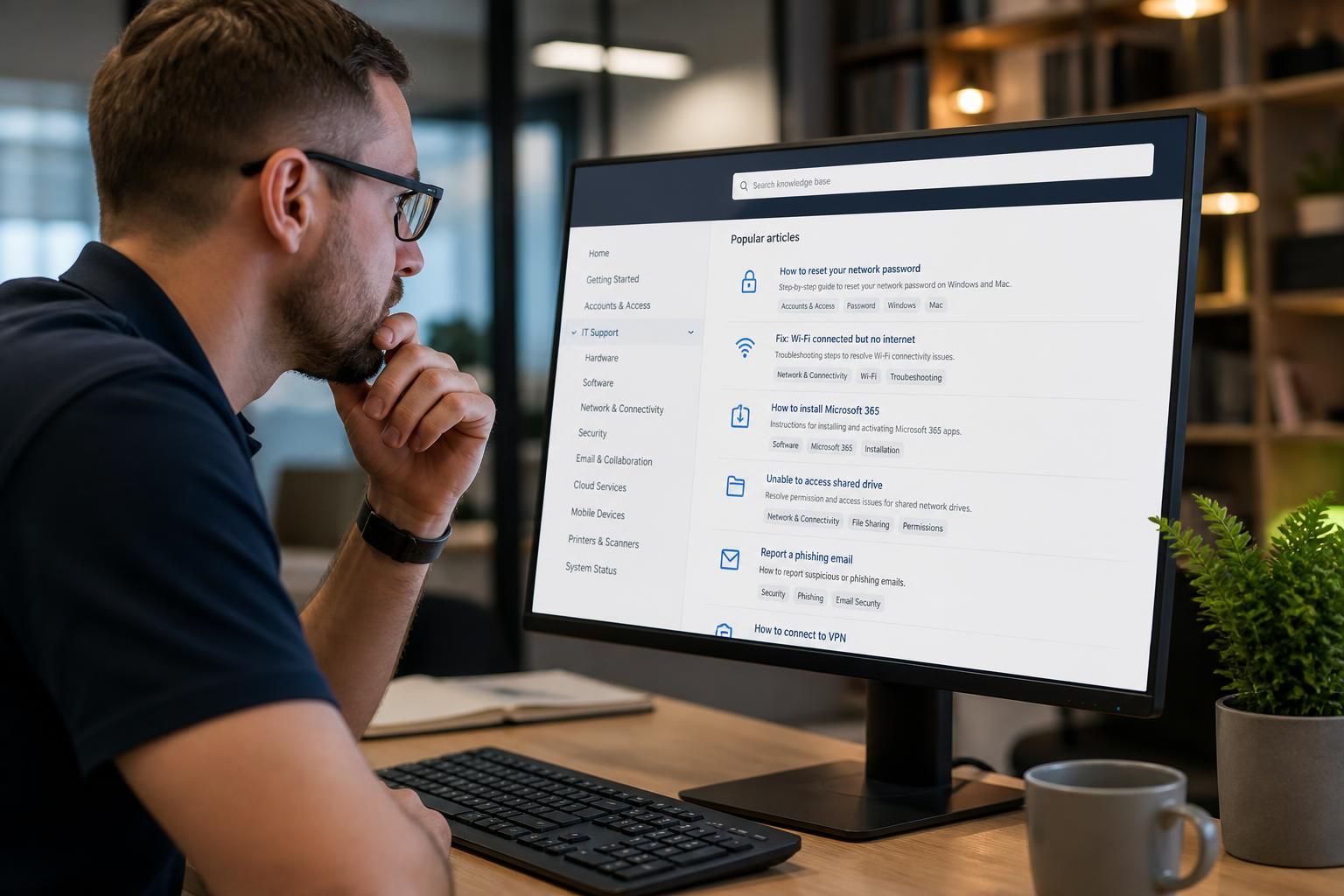
What should an IT service desk knowledge base contain?
An IT service desk knowledge base should contain clear, searchable guidance for resolving common technical issues without raising a ticket. It typically includes step-by-step troubleshooting articles, frequently asked questions, user instructions, known-error workarounds, service information and documented solutions from previously resolved incidents.
An effective IT service desk knowledge base is a controlled source of practical, accurate and searchable information. Alongside instructions for resolving issues, it should explain who each article is for, when the guidance applies, what risks or dependencies exist, how success is confirmed and what to do when the recommended action does not work.
Each article should have a consistent structure. A useful template can include:
- A precise title that reflects the user’s likely search terms.
- The symptoms, error message or task that the article addresses.
- The affected service, device, application or user group.
- Any prerequisites, permissions, equipment or information needed before starting.
- Instructions in the correct order, with one action per step where possible.
- The expected result after each significant action.
- Warnings about data loss, security implications or actions that should not be attempted by ordinary users.
- Validation steps to confirm that the issue has been resolved.
- A clear next action if the guidance is unsuccessful, including the information to provide when requesting further assistance.
This structure makes articles easier to follow and helps service desk analysts assess whether a procedure is suitable for a particular situation. It also reduces the risk of users applying technically correct guidance in the wrong context.
The knowledge base should serve different audiences separately. End-user articles should use plain language, avoid unnecessary technical detail and make permissions clear. Analyst-facing content can include diagnostic commands, configuration references, decision trees and technical dependencies that would be unsuitable for general users. Administrative procedures should be restricted to authorised personnel where they could expose confidential information or affect multiple systems.
Search and classification data are essential. Articles should include relevant synonyms, common misspellings, product or service terms used internally, and the wording users are likely to enter when describing a problem. Categories, tags and ownership fields can support filtering, but they should not replace a descriptive title or clear article content. A sensible structure might classify knowledge by service, user task, symptom, audience and risk level, provided the number of categories remains manageable.
Search results should also distinguish between current guidance, retired material and content that is relevant only to a particular environment. Duplicate articles create uncertainty, so similar entries should be combined or clearly differentiated by scope. Where several procedures are related, the articles should identify their relationship rather than copying the same instructions into multiple places.
Every article needs ownership and review information. The record should identify the person or team responsible for maintaining it, the date it was last checked, the date of the next review and the change or system version to which it relates. Review triggers may include a platform change, a security update, a recurring incident, a process change or feedback that the instructions are unclear. Content should be removed or marked as retired when it no longer reflects the live environment.
Ownership should not end with publication. The responsible team should monitor whether analysts and users can apply the guidance successfully, whether articles are producing avoidable follow-up questions and whether a procedure is being used outside its intended scope. Feedback can be captured through a simple usefulness option, a comment process or a link from the article to the relevant service desk record.
Security controls must be built into the knowledge base. Articles should never contain live passwords, private keys, authentication tokens or other secrets. Sensitive configuration details should be stored only in an appropriately protected system, with the knowledge article explaining the approved method for accessing them. Access permissions should reflect the distinction between public internal guidance, service desk material and restricted administrative procedures. Audit records can help establish who changed an article and when.
Security content should also explain safe handling of suspicious messages, unexpected access requests, data exposure and other events that need careful treatment. The article should make clear when a user must stop following the procedure and report the matter through the appropriate route. This prevents a troubleshooting process from causing further risk.
Good content records organisational context, not just technical steps. An article can state which business process or service is affected, whether workarounds have operational consequences, and which teams or suppliers may need to be involved. For important services, it may also refer to dependencies, approval requirements and recovery considerations. This helps the service desk judge whether a seemingly minor fault has wider business impact.
The knowledge base should connect with the service desk’s working processes. Resolved tickets can identify opportunities for new or improved articles, while articles can provide standard references for ticket notes. When an article is used during an incident, the record should show which guidance was followed and whether it was effective. Repeatedly unresolved tickets may indicate that the article is incomplete, difficult to find or no longer accurate.
Accessibility and readability are part of content quality. Use short paragraphs, descriptive labels, consistent terminology and clear formatting. Avoid relying on colour alone to convey meaning, and provide text alternatives for important information shown in images. Screenshots should be kept current and should not reveal personal data or confidential system details. Where an organisation has different locations, roles or working practices, the article should identify which instructions apply to each context.
A knowledge base is therefore more than a collection of technical notes. It should combine actionable guidance with search metadata, audience controls, security safeguards, ownership, review processes and links to service desk records. These elements keep the content trustworthy and make it useful both to people trying to resolve a straightforward issue and to analysts handling more complex support work.

A reliable knowledge base should record the source and scope of each article, not just the instructions themselves. This shows whether the guidance comes from an approved internal procedure, a supplier document, a change record or an incident investigation, and helps readers judge how it should be applied.
Useful supporting details include:
- the system, configuration or business process on which the guidance is based;
- the assumptions made, such as a particular user role, device setup or network arrangement;
- the related change, problem or incident record where the procedure was established;
- any exceptions that make the instructions unsuitable; and
- the person or team to consult when the situation differs from the documented example.
This information prevents a workaround created for one isolated fault from being treated as a universal solution. It also gives service desk analysts enough context to select the right article before applying its instructions.