How does an IT helpdesk prioritise support requests?
An IT helpdesk prioritises support requests by assessing their urgency, business impact, number of users affected and any applicable service level agreements (SLAs). Issues that prevent critical business operations or create significant security risks are handled ahead of lower-impact requests, while each ticket is reviewed and updated as circumstances change.
An effective IT helpdesk uses a documented triage model rather than handling tickets strictly in the order they arrive. The model assigns a priority based on the type of support needed, the consequences of leaving it unresolved, the availability of a workaround and the operational context. This creates a consistent basis for deciding which ticket should be handled next.
Most helpdesks distinguish between an incident, a service request and a change. An incident is an unplanned interruption or reduction in the quality of an existing service, such as a failed connection or inaccessible application. A service request is a planned requirement, such as access to an approved system or assistance with a standard device setup. A change involves modifying infrastructure or configuration and may require additional assessment before work begins. These categories help prevent routine requests from being treated in the same way as service-affecting faults.
A practical prioritisation process usually considers the following factors:
- Operational consequence: whether the issue is stopping a key process, restricting productivity or affecting a non-essential function.
- Scope: whether the problem affects one user, a team, a site or a shared business system.
- Risk: whether there is evidence of unauthorised access, data exposure, malware or another cyber security concern.
- Workaround: whether users can continue working through an alternative method, even if that method is less efficient.
- Business context: whether the issue affects a time-sensitive activity, operational deadline, customer commitment or regulatory obligation.
- Technical dependency: whether resolving one fault could restore several related services or prevent further incidents.
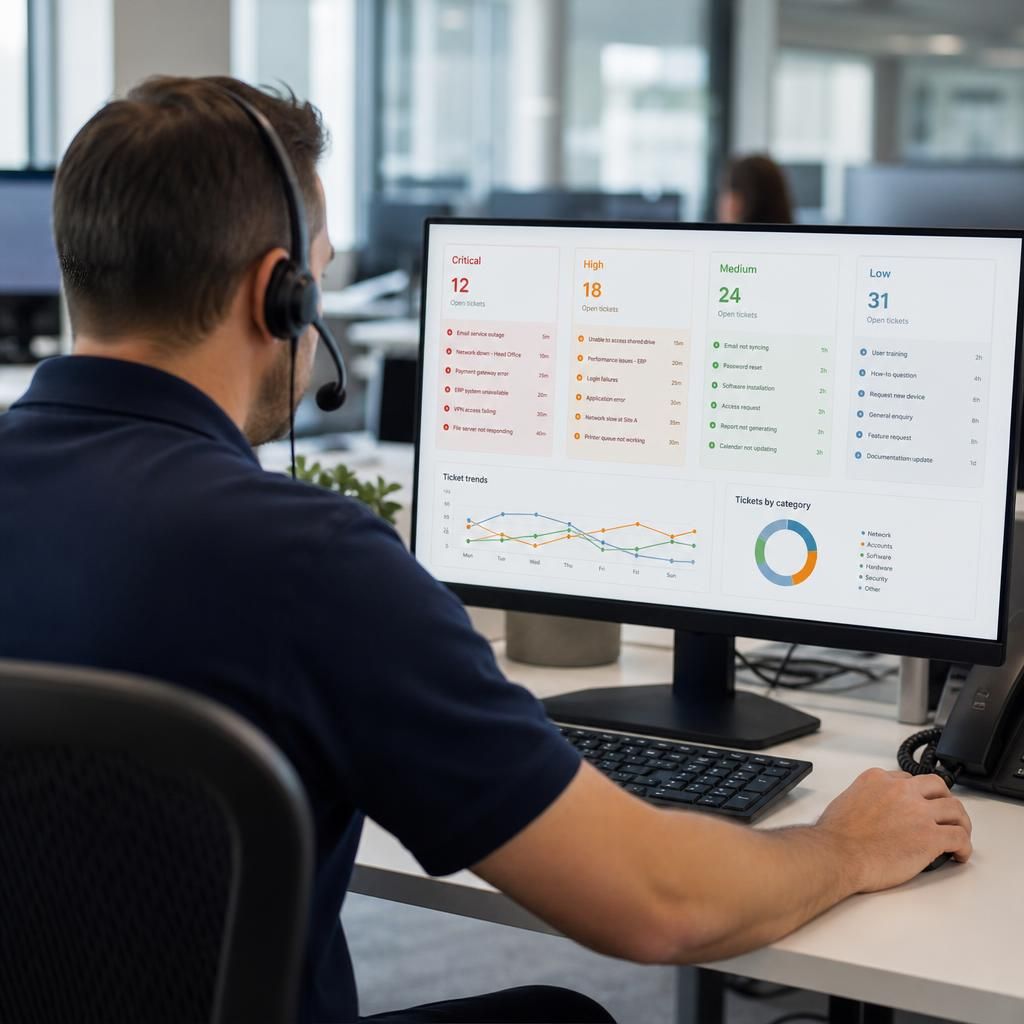
These considerations are commonly translated into priority levels. A critical priority may apply where an essential service is unavailable, a serious security event is suspected or a major business function cannot continue. A high priority may describe substantial disruption with limited alternatives. Medium and low priorities generally cover issues with a workable alternative, individual inconvenience, standard requests or improvements that do not interrupt current operations. The exact definitions should be agreed with the organisation rather than assumed by the helpdesk.
Priority should not be based solely on the wording used in a ticket. A user may describe an issue as urgent because it is inconvenient, while a less visibly disruptive fault could carry greater security or operational risk. Helpdesk staff may therefore verify the affected service, identify who is impacted, check whether the problem is widespread and establish what work has already been attempted before confirming the classification.
Good triage also separates the priority of a ticket from the order in which technical work is performed. A lower-priority task might be addressed alongside a higher-priority investigation if it can be completed without delaying the more significant incident. Conversely, a ticket that initially appears minor may be brought forward when further diagnosis reveals a shared infrastructure fault or a developing security issue.
Priorities should be reviewed throughout the ticket lifecycle. The classification may change when more users become affected, a workaround stops functioning, a deadline moves closer or investigation identifies a wider underlying problem. An effective helpdesk records the reason for a change so that the decision remains understandable to the requester, the support team and any service manager reviewing performance.
Escalation rules form part of prioritisation. A helpdesk may pass a ticket to a specialist when it requires access, expertise or authority that the initial support team does not have. Security-related concerns, repeated failures, complex infrastructure faults and issues involving several services often need a different handling path. Escalation should preserve the original priority and relevant diagnostic information rather than forcing the next team to begin again.
Clear communication supports fair prioritisation. The ticket should record the reported symptoms, affected service, business consequences, troubleshooting already completed, current workaround and agreed next step. If the priority changes, the requester should be told what changed and why. This avoids a common problem in which users interpret a lack of immediate action as evidence that their request has been overlooked.
Organisations should review their prioritisation model periodically. Ticket patterns can show that a supposedly low-impact service is regularly disrupting work, that a recurring fault needs a permanent fix or that users are selecting inconsistent categories. Reviewing these patterns helps the helpdesk improve its service model instead of repeatedly treating the same symptoms as isolated requests.
For businesses without a full in-house IT team, a managed provider such as S2 Technology Group can apply this type of structured triage alongside wider IT support, cyber security and cloud management. The important point is that prioritisation should reflect business risk and service context, with decisions recorded and revisited as the situation develops.
Service level agreements (SLAs) help an IT helpdesk apply agreed handling targets consistently, but an SLA is not the same as the technical severity of a fault. A critical outage may require immediate attention because essential work has stopped, while a lower-impact request may have a separate contractual target for acknowledgement or completion.
A well-defined SLA should state which services and support categories it covers, how priority is assigned, when the service clock starts, and what happens if the ticket is waiting for information or approval. This prevents disagreements about whether a request is being handled appropriately and gives the helpdesk a clear basis for reviewing tickets that are approaching their agreed target.