
How should a business VoIP phone system handle number portability?
A business VoIP phone system should support number portability by allowing existing business numbers to transfer to the new provider without unnecessary interruption. The process should include eligibility checks, accurate account details, coordination between providers, an agreed porting date and temporary call-routing arrangements where needed.
Number portability in a business VoIP phone system is the controlled transfer of existing telephone numbers from one communications provider to another while preserving the numbers that customers, suppliers and staff already use. A suitable system should treat portability as a managed technical and administrative process, not simply as a request to move a number.
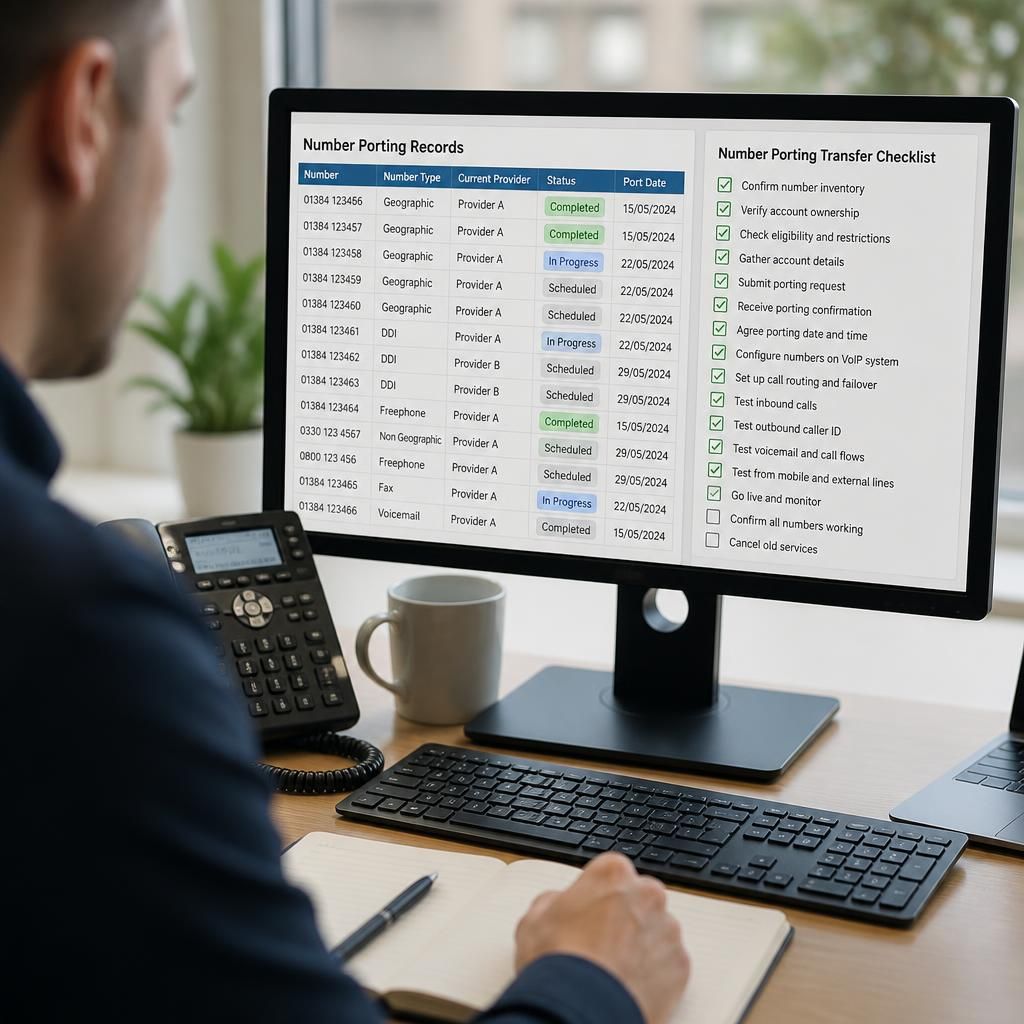
It should begin with a complete number inventory. The business and incoming provider need to identify every number associated with the account, including main reception numbers, direct-dial numbers, hunt groups, voicemail access numbers, fax numbers, non-geographic numbers and any ranges allocated to different sites. This prevents an overlooked number from being disconnected or left with the previous provider. The inventory should also record which numbers are published externally, which are used for inbound routing, and which are linked to alarm, lift, payment or other specialist systems.
Eligibility and account ownership must be verified. Porting information normally needs to match the losing provider’s records. The relevant details can include the account holder’s legal name, service address, billing address, account number and the precise number range being transferred. Small differences in spelling, old company details or an incorrect service address can cause a rejected order. The business should therefore obtain a recent bill or service record and check the information before submitting the request.
Portability depends on the number type, geographic area, contract arrangements and network providers involved. Some numbers may be transferable individually, while others form part of a linked range that has to be moved together. A provider should identify any numbers that cannot be ported and explain the available alternative, such as assigning a new number and arranging a controlled forwarding service where appropriate. Porting a number also does not automatically transfer every feature associated with it; hunt groups, call plans, voicemail settings, recordings and routing rules usually need to be recreated or configured on the new platform.
The transfer should be planned around the business’s call flows. Before the port, the incoming provider should configure users, extensions, hunt groups, auto-attendants, voicemail, caller ID and other destinations in the new system. The ported numbers can then be mapped to tested services rather than arriving on an unprepared platform. Where the system supports it, temporary routing can direct calls to agreed destinations during the changeover, but this should be tested in advance and confirmed with both providers.
A clear porting window and escalation process are important. The business should know when the transfer is expected, which provider owns each stage, how progress will be communicated and who can authorise corrective action if the order is delayed or rejected. The porting date should be treated as a change-control event, with a named internal owner and a record of the numbers, services and contacts involved.
Testing should cover more than a single inbound call. After the transfer, the business should test calls from different networks and locations, calls between the ported number and internal extensions, outbound caller ID, voicemail, call queues, hunt groups, call recording and any published secondary numbers. It should also verify that calls reach the correct site, department or user and that staff can make outbound calls using the intended presentation number. If the organisation relies on text messages, fax services or third-party systems connected to a number, those functions should be checked separately.
The previous provider’s service should not be cancelled prematurely. A number may appear to have transferred while associated services, billing items or unported numbers remain active. The business should reconcile the transferred inventory, confirm that all required numbers work on the new VoIP system and review the old contract’s termination requirements before requesting disconnection. This reduces the risk of losing a number or removing a service that was not included in the port.
Contract terms also matter. A number can be technically portable while the existing agreement still includes minimum-term charges, notice requirements or separate fees for number ranges and related services. The incoming provider should distinguish between porting the number and ending the old contract, because completing one does not necessarily complete the other. The business should retain confirmation of the port, the final number list, the agreed routing design and any rejection or correction records.
For organisations with multiple offices, portability should be planned alongside location and resilience requirements. A number may need to route to a central reception team, a particular site, a distributed user group or an alternative destination if the normal service is unavailable. The new configuration should reflect the organisation’s actual operating structure without assuming that the old provider’s routing design will transfer automatically.
A managed IT provider such as S2 Technology Group can help a business document its number estate, check the technical dependencies, prepare the VoIP configuration and coordinate validation before and after the transfer. The key measure of a well-managed port is not merely that the number changes provider, but that the organisation retains control of its inbound identity, call routing and associated services throughout the change.
Number portability should preserve the organisation’s public telephone identity for both incoming and outgoing calls. Moving a number to a new business VoIP phone system does not automatically guarantee that the correct number will appear when employees make calls.
Outbound caller ID, often called CLI presentation, should therefore be configured separately for each user, department or call queue. A business may want its main reception number to appear for general enquiries, while a direct-dial number or site number is more appropriate for a specific team. The system should restrict users to approved numbers so that callers receive a consistent and recognisable identity.
This is particularly important where customers return missed calls, rely on published departmental numbers or use caller ID to identify a trusted organisation. The configuration should be checked from different external networks, including calls from mobile phones, to confirm that the intended number is displayed and that return calls reach the correct destination.