How should businesses prioritise data for recovery?
Businesses should prioritise data for recovery according to its impact on critical operations, legal or regulatory obligations, customer service and financial continuity. Classify data into recovery tiers, document the required recovery order and align each tier with its recovery time and recovery point objectives.
Businesses should prioritise recovery data by assessing what the organisation must restore first to operate safely, meet obligations and serve customers. The process should consider business processes rather than treating every file, system or database as equally important. A documented recovery sequence helps technical teams make consistent decisions when capacity, access or time is limited.
Begin with a business impact assessment. For each important process, record:
- What the process does and which departments depend on it.
- Which applications, databases, files and configurations enable it.
- What happens if the process is unavailable, including operational, financial, contractual, legal and reputational consequences.
- Which people, suppliers, sites and systems must be available before recovery can be completed.
- How much recent information the process can afford to lose and how soon it must be usable.
This assessment should identify the difference between data that is valuable and data that is immediately necessary. Historical records may be essential for compliance or audit but less important to initial operational recovery. Conversely, a relatively small set of current configuration files, user records or transaction data may be needed before a wider system can function.
A practical classification is to place information into recovery tiers. The names will differ between organisations, but the logic can be similar:
- Initial recovery: information and system dependencies required to establish core operations, identity management, network access and essential administration.
- Critical operational recovery: data needed for activities such as order processing, production control, customer management, payments or the delivery of contracted services.
- Important supporting recovery: information that enables teams to resume wider administrative, analytical and internal processes after core operations are functioning.
- Deferred recovery: archives, duplicated information and lower-impact material that can be restored later without preventing essential work.
The tiers should be based on consequences, not simply on data volume or the preferences of an individual department. A large document repository may be less urgent than a small database that controls a key business process. Equally, a system should not be placed in the highest tier merely because it is prominent; its dependencies and effect on the organisation need to be demonstrated.
Map dependencies before finalising the order. Restoring an application without its authentication service, encryption keys, licences, network configuration or supporting database may not make it usable. Recovery plans should therefore show the sequence in which infrastructure, identity services, core data, applications and user access are brought back. Where several systems depend on the same platform, that shared dependency may deserve a higher priority than any one application.
Separate the recovery priority of data from the priority of the system that stores it. A single platform may contain information with different business values, while one dataset may be replicated into several applications. This distinction can prevent unnecessary restoration work and helps determine whether selective recovery is possible. It also highlights sensitive information that requires additional approval or controlled access during restoration.
Recovery priorities should reflect information lifecycle and data quality. Current working data usually supports immediate operations, whereas old versions, temporary files and duplicate exports may not warrant the same treatment. However, retention, legal hold, contractual requirements and audit needs can make older records important even when they are not required to restart daily activities. These requirements should be documented separately from the order for operational recovery so that they are not overlooked or confused.
Once priorities are agreed, record them in a recovery catalogue. Each entry should identify the data owner, business process, system dependency, classification, required recovery sequence, acceptable data loss, required access controls and validation method. Include the location of backup copies and any special software, credentials or encryption keys needed to use them. Access details should be managed securely rather than written directly into an unrestricted recovery document.
Business owners should approve the classifications and recovery order. IT teams can explain technical dependencies, but they may not know the commercial or regulatory consequences of losing a particular dataset. Finance, operations, legal, HR, customer service and other relevant functions should therefore review the assumptions that affect their areas. A named owner also makes it easier to resolve disagreements when several departments claim the same priority.
Prioritisation is only useful if it is tested. Recovery exercises should follow the documented order and confirm that each restored dataset is complete, usable and available to the right people. Record dependencies that were missed, manual workarounds that were required and any difference between the planned and actual sequence. Update the catalogue after major changes such as a new application, acquisition, site move, process redesign or change in regulatory obligations.
S2 Technology Group can help organisations assess data dependencies, define recovery tiers and turn business requirements into a maintainable recovery plan. The result should be a living document that supports informed recovery decisions rather than a one-off list created only for audit purposes.
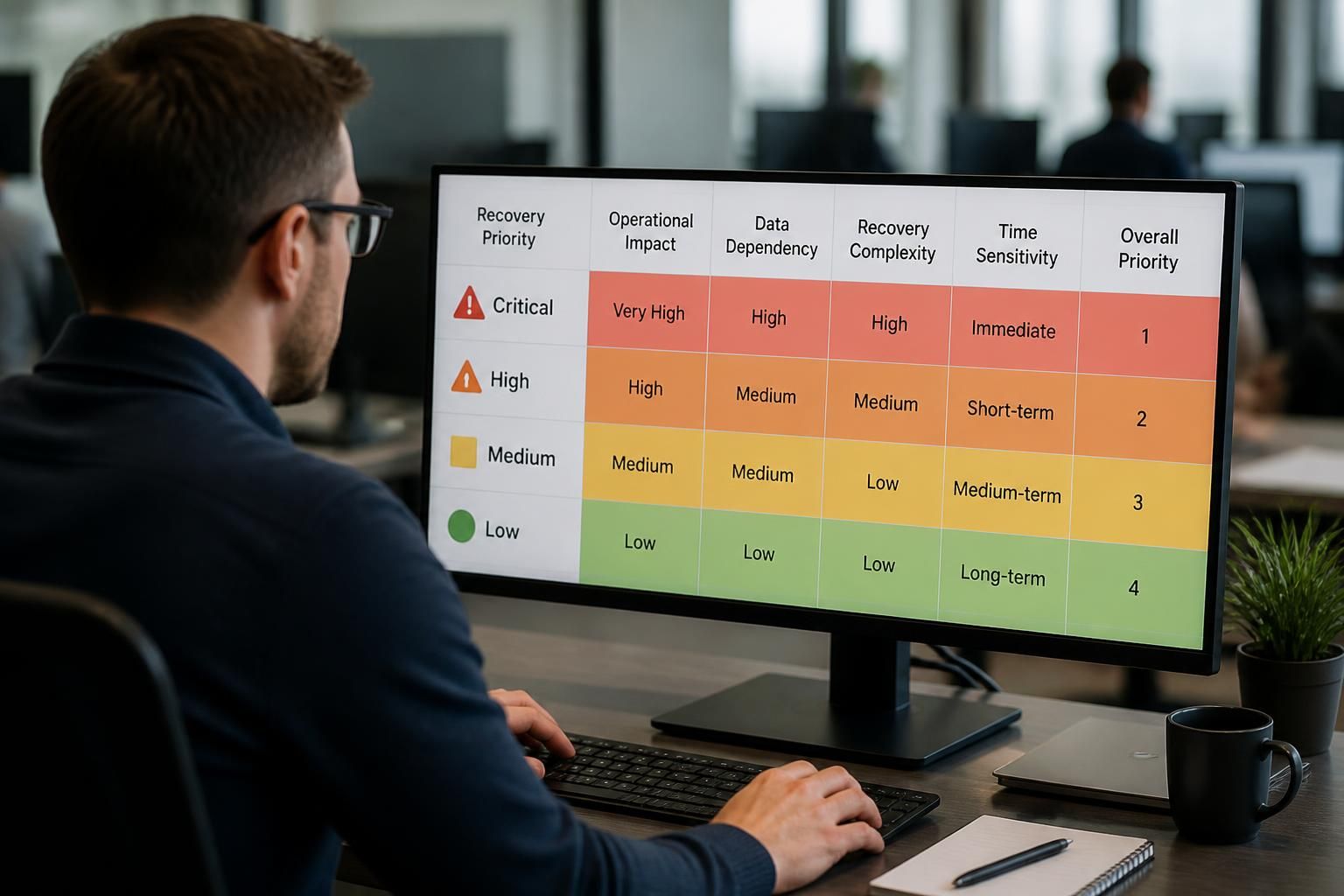
A recovery priority matrix compares the business consequence of losing a dataset with the practical effort required to make it usable again. This helps distinguish information that must be restored immediately from information that is important but can be recovered through a later or more complex process.
Assess each dataset against factors such as operational impact, dependency on unavailable systems, restoration complexity and the availability of a temporary workaround. A small, high-impact dataset may warrant urgent attention even when recovery is technically straightforward. Conversely, a large dataset may require substantial processing but have a lower initial priority if the organisation can continue essential work without it.
Use the matrix to identify partial recovery options as well as complete restoration. For example, a business might first recover current customer and transaction records, while restoring historical documents after core services are usable. Record the reason for each decision so that priorities remain understandable when departments compete for the same recovery resources.