

What does a cyber security risk assessment cover?
A cyber security risk assessment examines the systems, data, devices, users and suppliers that could affect a business’s security, then identifies likely threats, vulnerabilities and potential consequences. It also reviews existing controls, such as access management, backups, monitoring and staff processes, before prioritising improvements according to the level of risk.
A cyber security risk assessment covers the conditions that could allow a security incident to occur, the business consequences of different incident scenarios, and the extent to which existing safeguards reduce those risks. A properly conducted assessment is broader than a vulnerability scan: it combines technical evidence with operational, legal and business information to produce a prioritised view of what needs attention.
The assessment usually begins by defining its scope. This establishes which offices, cloud services, networks, applications, business processes and legal entities are included. It should also identify the organisation’s most important activities, such as processing client information, taking orders, running production systems or accessing financial records. Defining the scope prevents the review from concentrating only on visible IT equipment while overlooking a critical process or dependency.
The assessor will normally establish how information moves through the organisation. This may include reviewing network and cloud architecture, data flows, application relationships, remote working arrangements and connections with external providers. The purpose is to understand where a failure or compromise could spread, which services depend on one another, and which systems would be difficult to replace or operate manually.
Evidence gathering is another significant part of the assessment. Depending on the agreed scope, this can include:
- Interviews with management, technical staff and representatives from relevant departments.
- Review of security policies, access procedures, supplier agreements and acceptable-use rules.
- Examination of configuration settings, update records, audit logs and security alerts.
- Vulnerability scanning and, where separately authorised, targeted technical testing.
- Review of previous incidents, near misses, audit findings and unresolved recommendations.
- Checks on whether documented procedures match what staff and administrators actually do.
Risk scenarios are then considered in the context of the organisation. These may include stolen credentials, phishing-led account compromise, ransomware, malicious or careless insiders, unauthorised changes, exposed services, insecure applications, lost equipment, cloud-service failure and weaknesses introduced by a supplier. The assessment should consider both deliberate attacks and accidental events, since misdirected information, incorrect permissions and configuration errors can create serious exposure without an attacker exploiting a software flaw.
Technical controls are examined for both design and operation. It is not enough to record that a control exists. The assessment should determine whether it is correctly configured, consistently applied and producing useful evidence. Areas commonly examined include:
- How accounts are created, changed, reviewed and removed when a person changes role or leaves.
- Whether privileged activity is restricted, attributable and subject to additional safeguards.
- How devices and applications are updated, hardened and monitored for unusual behaviour.
- Whether sensitive information is protected when stored, transmitted and shared.
- Whether network separation limits the effect of a compromised account or device.
- Whether alerts are recorded, investigated and escalated according to defined procedures.
- Whether copies of important information can be recovered and whether recovery has been verified in practice.
The review should also examine people and governance. This includes security responsibilities, approval routes for access, staff training, reporting arrangements and the process for making technology changes. A technically strong environment can still carry substantial risk if nobody owns a control, exceptions are not recorded, or important decisions depend on one person’s undocumented knowledge.
Business impact is a central part of risk assessment. For each significant scenario, the assessor considers consequences such as operational interruption, loss of confidential information, regulatory action, contractual disputes, fraud, reputational damage and the cost of restoring services. The assessment should distinguish between an event that affects a low-priority system and one that prevents a core business process from operating. It should also consider dependencies, including internet connectivity, hosted platforms, specialist software, key suppliers and external support arrangements.
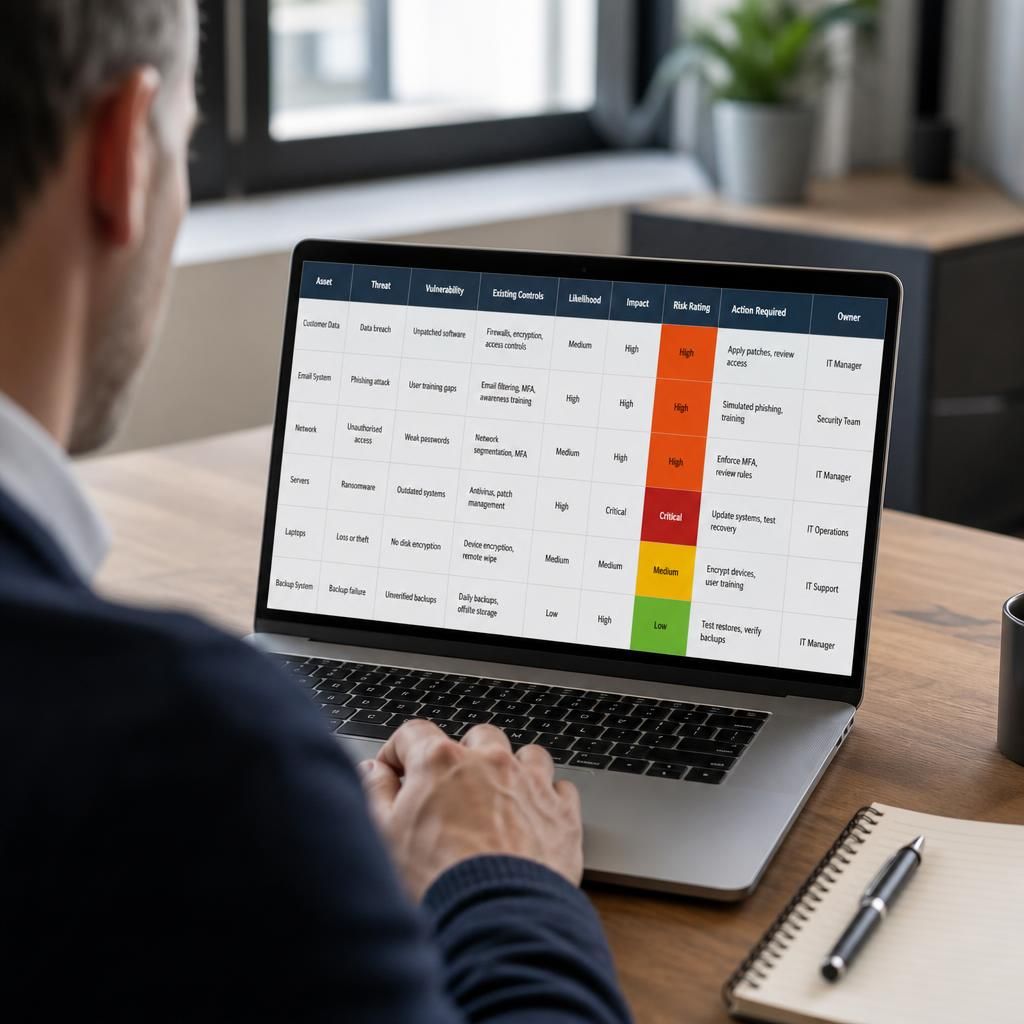
Risks are commonly evaluated by considering the likelihood of a scenario and the severity of its consequences. The result should distinguish between:
- Inherent risk: the exposure before relevant safeguards are taken into account.
- Residual risk: the exposure that remains after safeguards have been considered.
- Risk ownership: the person or management function responsible for deciding how the risk will be handled.
This analysis helps management decide whether a risk should be reduced, transferred, avoided or formally accepted. A useful risk register records the affected service or information, the scenario, the evidence supporting the finding, the existing safeguards, the proposed action, the owner and the intended review point. It should avoid vague recommendations such as “improve security” and instead identify a practical action, such as changing an approval process, separating an administrative function or testing a recovery procedure.
Compliance and contractual obligations are also considered where they apply. The assessment can map controls to relevant data protection duties, industry requirements, customer security clauses, insurance conditions and internal policies. This does not make the assessment a legal opinion or guarantee compliance. It provides evidence of where obligations may not be met and where specialist legal or regulatory advice may be needed.
A completed assessment normally produces a written report, an ordered list of risks and a remediation plan. Senior decision-makers may need an executive summary showing the most material exposures and their business implications, while technical teams need sufficient detail to investigate and correct each finding. The plan should separate urgent risk reduction from longer-term improvements, identify dependencies, and include a method for confirming that corrective work has been completed effectively.
The work is a point-in-time assessment rather than a permanent statement that an organisation is secure. Systems, suppliers, staff roles, threats and business processes change, so findings should be revisited after significant changes, incidents or major technology projects. S2 Technology Group can use this type of structured review to help small and medium-sized organisations understand their exposure and plan security improvements in line with their operational requirements.
A cyber security risk assessment should record its assumptions and limitations as well as its findings. If an assessor cannot inspect a system, verify a supplier’s safeguards or test a recovery process, that gap should be clearly distinguished from a confirmed control. The absence of evidence does not demonstrate that a control is operating effectively.
The report should explain the significance of each limitation. For example, an incomplete device inventory, an unverified backup or outdated supplier assurance may leave uncertainty about the organisation’s actual exposure. That uncertainty can itself require action, such as obtaining further evidence, carrying out a targeted check or applying a temporary safeguard. Documenting these boundaries helps decision-makers understand how much confidence to place in the assessment.