

How should cyber security services handle third-party supplier access?
Cyber security services should control third-party supplier access through verified identities, least-privilege permissions, multi-factor authentication and time-limited access that is removed when work is complete. Access should be recorded and monitored, reviewed regularly, governed by clear security requirements, and revoked promptly when a supplier no longer needs it.
Cyber security services should manage third-party supplier access as a governed business relationship, not simply as a technical login. The process should establish which suppliers create risk, what information or systems they may encounter, what obligations they accept, and how the organisation will verify that those obligations are being met.
Supplier access can arise in several ways. An IT provider may need to administer infrastructure, a software supplier may require support access, a maintenance contractor may connect to operational systems, or a professional adviser may handle confidential documents. Each arrangement should be assessed according to the supplier’s role, the sensitivity of the information involved, the systems affected and the potential consequences of misuse or compromise.
Start with supplier risk classification
Not every supplier presents the same level of exposure. A supplier that only receives public information should not be managed in the same way as one that can view personal data, financial records, source code, production systems or sensitive client information. A practical assessment can consider:
- the type and sensitivity of data the supplier may handle;
- whether the supplier can influence important business processes;
- whether access could affect multiple offices, sites or customers;
- the supplier’s dependence on subcontractors or additional service providers;
- the consequences of a supplier account, device or service being compromised; and
- the organisation’s ability to operate if the supplier becomes unavailable.
The resulting risk tier can determine how much assurance is required before work begins. Higher-risk relationships generally warrant more detailed checks, stronger contractual terms, formal security evidence and closer oversight.
Carry out proportionate due diligence
Before granting access, a business should establish whether the supplier has suitable security arrangements. Evidence may include relevant policies, staff training arrangements, vulnerability management processes, data protection practices, independent assurance reports and details of previous security incidents. The purpose is not to collect documents for their own sake, but to determine whether the supplier’s controls are appropriate for the work being undertaken.
Due diligence should also cover the supplier’s own supply chain. A provider may rely on cloud platforms, contractors or support partners, meaning that information could be processed by organisations the customer has not directly selected. The business should understand where data is stored, who can process it, which subcontractors are involved and how changes to that arrangement are communicated.
Put requirements into the contract
Security expectations should be written into the supplier agreement and supporting schedules rather than left to informal discussions. Suitable terms may address:
- the permitted purpose and boundaries of access;
- the categories of information the supplier may process;
- requirements for protecting, returning and securely deleting information;
- the use of subcontractors and the process for approving material changes;
- the duty to report suspected incidents and provide relevant cooperation;
- security assessments, audit rights or requests for assurance evidence;
- business continuity and recovery arrangements; and
- the steps required when the contract ends.
Contractual wording should be specific enough to be assessed. For example, requiring a supplier to maintain “appropriate security” may be less useful than defining the required standards, evidence and reporting responsibilities for the particular service.
Separate supplier activity from ordinary business use
Where practical, supplier work should take place through a controlled administrative pathway rather than through unrestricted access to the business environment. Technical design can reduce the impact of an error or compromised supplier account by separating management functions from user systems, limiting which services can communicate, and preventing a supplier from moving freely between unrelated parts of the network.
Supplier activity should also be attributable to a named individual or approved service identity. Shared accounts make it difficult to establish who performed an action and can prevent an organisation from investigating a dispute or security event properly. The supplier should be responsible for notifying the business when its personnel or subcontractors change, so that access arrangements remain aligned with the people actually carrying out the work.
Control data exposure
Access to a system does not always require access to all of its information. Where a supplier needs to diagnose a problem, the business should consider whether test data, redacted records or a restricted support environment would meet the requirement. Sensitive files should not be copied to personal devices or transferred through unapproved channels simply because doing so is convenient.
Data handling instructions should cover storage locations, transfer methods, retention, backups and secure disposal. They should also distinguish between information needed to perform the service and information that the supplier merely encounters while working. This distinction helps prevent unnecessary collection and reduces the amount of business information exposed during routine support.
Test and reassess the arrangement
A supplier relationship should be tested against realistic scenarios, including a compromised supplier account, a lost supplier device, a security incident within the supplier’s environment and the sudden loss of the supplier’s service. Exercises can reveal unclear responsibilities, missing contact routes, excessive dependency or an inability to recover information in a usable form.
Reviews should be triggered by meaningful changes, not only by a calendar date. Examples include a new service, a change in the data handled, a merger or acquisition, a new subcontractor, a major technology change, a reported incident or a change in business importance. Cyber security services can support this process by maintaining a supplier risk register, mapping supplier dependencies and providing evidence for management decisions.
Effective third-party access management therefore combines supplier assessment, contractual governance, controlled technical design, disciplined data handling and scenario testing. The objective is to make supplier access necessary, bounded and accountable while ensuring that the business understands the residual risk it is accepting.
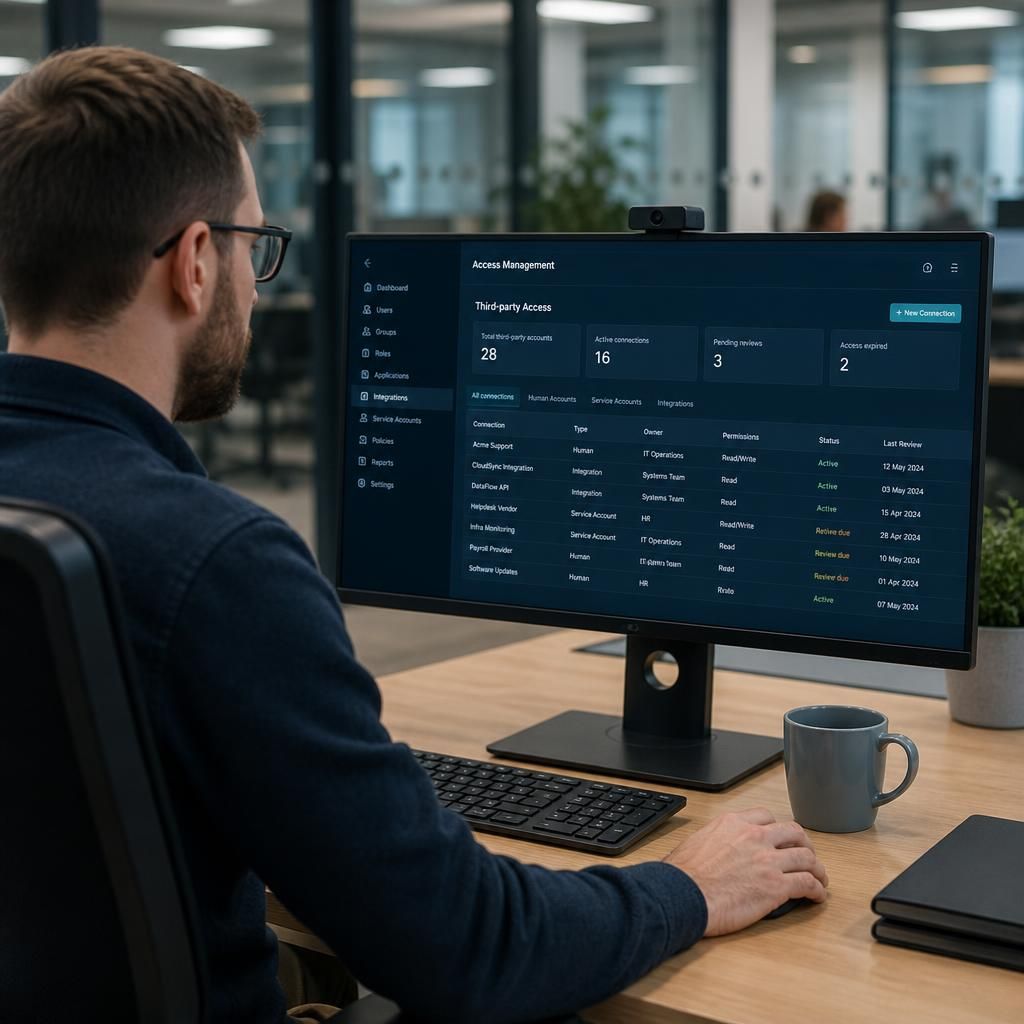
Third-party access includes automated connections as well as human logins. Supplier integrations, application programming interfaces (APIs), synchronisation tools and service accounts can exchange data or trigger actions without a person signing in, so they require their own security controls.
For each integration, the business should document its purpose, data flows, owner and permitted actions. Permissions should be limited to the specific records or functions required, with credentials stored securely rather than embedded in scripts or shared documents. Unused connections should be disabled, while active credentials and permissions should be changed when the supplier, system or business requirement changes.
Monitoring should look for unusual volumes, unexpected destinations, failed authentication attempts and activity outside the integration’s normal purpose. This helps distinguish a genuine supplier process from a compromised credential or misconfigured connection, including where the supplier does not use a conventional interactive account.