
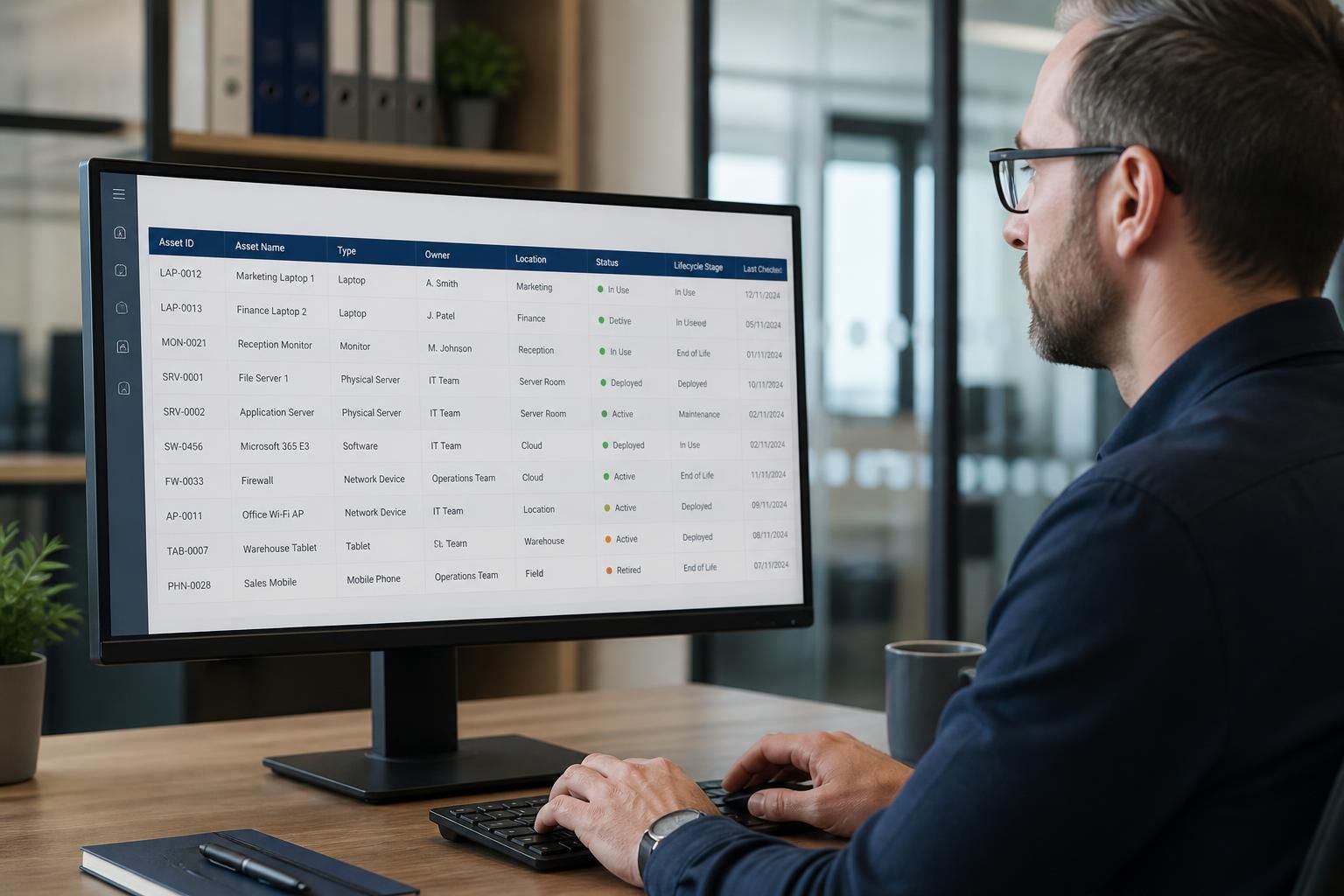
What information should an IT asset register contain?
An IT asset register should record each device, system or technology asset’s identity, type, owner, user, location, status, configuration, acquisition details, warranty or support information, lifecycle stage and disposal history. It should also capture relevant security, software licensing and business-criticality details so the organisation can manage risk, plan replacements and maintain accurate records.
A useful IT asset register contains more than a list of equipment. It should provide a structured record of how each asset fits into the organisation’s technology environment, what it depends on, what depends on it, how it is governed and what evidence supports the information recorded. The exact fields will vary by business, but the register should be detailed enough to support operational decisions, security reviews, audits and technology planning.
In addition to the core asset details, the following information is particularly valuable:
- Unique reference and data quality information: Assign a consistent internal reference to each record and record when it was created, last checked and last changed. A source field can show whether information came from a discovery tool, purchase record, service desk ticket, manual review or another system. This helps identify records that need validation rather than treating all data as equally reliable.
- Technical identifiers: Depending on the asset type, useful identifiers may include a hostname, serial number, hardware address, IP address, virtual machine identifier, cloud resource ID or application instance reference. These identifiers should be handled carefully because some can change over time or expose sensitive information.
- Relationships and dependencies: Link assets to the services they support and to other components they rely on. For example, a business application may depend on a database, a server, network connectivity, authentication services and a backup process. Recording these relationships makes it easier to assess the effect of a fault, planned change or security incident.
- Business service association: Identify the business process, department or customer-facing service connected with the asset. This gives technical records useful business context without assuming that every device has the same importance. It also helps decision-makers distinguish between an isolated endpoint issue and a component supporting a core operational process.
- Configuration information: Where appropriate, record relevant operating system versions, firmware, installed roles, supported protocols, configuration baselines and significant customisations. The register does not need to become a full configuration database, but it should point to the authoritative documentation where detailed settings are maintained.
- Data handling characteristics: Record whether an asset stores, processes or transmits confidential, personal, commercially sensitive or regulated information. It can also be useful to note the applicable data owner, retention requirement and approved storage location. This supports risk assessment and helps determine which controls or reviews are relevant.
- Control and assurance information: Include references to security controls, monitoring coverage, backup arrangements, encryption status, vulnerability findings and relevant audit evidence where these apply. Sensitive credentials, encryption keys and detailed secrets should never be placed directly in the register; the record should instead refer to an appropriately protected system.
- Operational history: Link significant incidents, changes, maintenance activities and exceptions to the relevant record. A history of repeated faults or unauthorised changes can reveal a wider management issue that would not be visible from the asset description alone.
- Financial and contractual context: Depending on the organisation’s requirements, the register may include purchase reference, capital or operating cost classification, funding arrangement, supplier relationship and contract reference. Financial detail should be consistent with the accounting system rather than maintained as an isolated duplicate that can quickly become inaccurate.
- Replacement and transition information: Record any approved action, dependency or constraint affecting a future change. Examples include a planned migration, an application that cannot yet be upgraded, a hardware component required for compatibility or a project responsible for replacing the asset. This is different from simply recording its current lifecycle stage because it explains the decision-making context.
- Environmental and resilience information: For important infrastructure, document relevant resilience arrangements such as redundancy, recovery dependencies, power requirements and the alternative component or service used if the primary asset becomes unavailable. The level of detail should reflect the consequences of failure.
The register should also distinguish between asset classes. A laptop record may need endpoint management status, encryption evidence and assigned applications, whereas a cloud resource may require subscription, region, account structure and dependency information. A software service may need its data flows, integrations, authentication method and contract reference rather than physical specifications.
Data governance is as important as the field list. Each field should have a defined meaning, an agreed format and, where practical, a nominated source of truth. Dates should use one standard format, statuses should come from a controlled list and free-text entries should be limited. Duplicate records, retired records that remain active and inconsistent naming can make a register misleading even when it appears comprehensive.
Access should follow the sensitivity of the information. Staff may need to search the register, while only authorised administrators should change records or view commercially and security-sensitive fields. Changes should be attributable to a named account, and important edits should be retained in an audit trail.
Finally, the register should support review rather than exist as a static spreadsheet. Automated discovery can help identify technical assets, but it will not reliably provide business context, contractual information or the significance of an asset to a particular process. Those details need controlled human validation and links to related records in systems such as service management, finance, change management and security monitoring platforms.

An IT asset register should define what counts as an asset, rather than recording only equipment purchased by the business. Its scope may include leased devices, contractor equipment, cloud resources, software subscriptions, domains, certificates and technology managed by a third party where the organisation remains responsible for the associated risk or service.
For each asset category, document the inclusion rule and the point at which an item enters or leaves the register. This prevents gaps such as an active subscription being omitted because it has no physical location, or a retired device remaining listed because its disposal was not recorded. A clear scope also makes audits and periodic reviews more consistent.