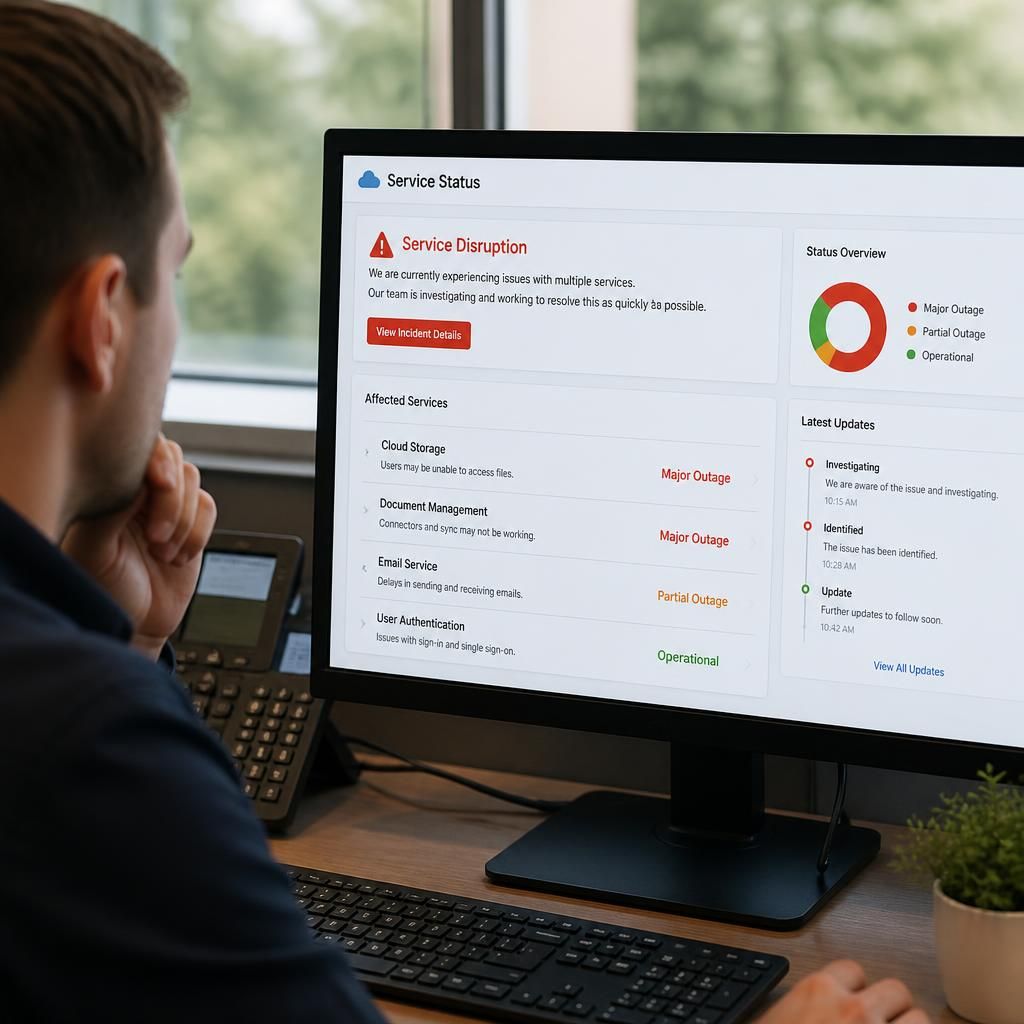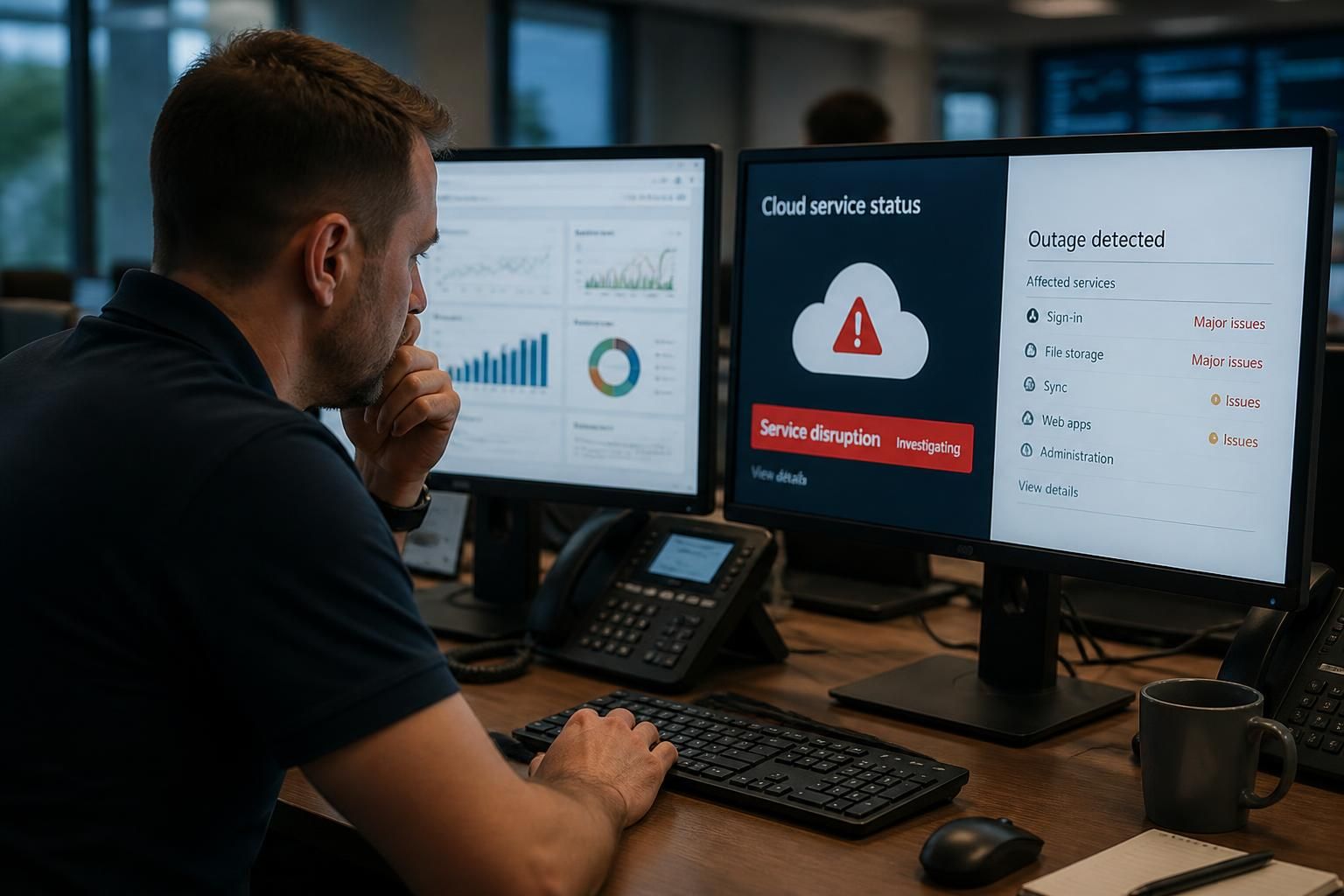
Can emergency IT support help when a cloud service fails?
Yes. Emergency IT support can help determine whether a cloud service failure is caused by a provider outage, connectivity problem, account issue or configuration error, then coordinate appropriate recovery actions such as restoring access, correcting settings and applying a safe workaround.
Yes. Emergency IT support can help a business manage the operational, technical and security consequences of a cloud service failure, even when the underlying fault sits with the cloud provider. The priority is to protect essential work, establish a controlled route to recovery and prevent rushed changes from creating further problems.
A cloud failure does not always affect every part of a service. Some users may be unable to sign in, while others can access files but cannot synchronise changes or use connected applications. A well-managed response therefore begins by identifying which business functions are affected, which users and locations are involved, and whether any work can continue safely.
Emergency support can help with several areas of the response:
- Business impact assessment: identifying critical processes that depend on the unavailable service, such as customer communication, document access, order processing or production workflows.
- Dependency checks: reviewing related identity systems, multi-factor authentication, domain services, integrations, endpoint applications and network paths that may prevent access even when the cloud platform itself is operating.
- Provider liaison: gathering the relevant account, tenant and diagnostic information so that the cloud provider can investigate the incident through the correct administrative or technical channels.
- Controlled continuity measures: helping the business use approved alternative processes, locally available information or other authorised systems while the affected service is being restored.
- Access and security review: checking whether unusual sign-in activity, expired credentials, permission changes or a security control has contributed to the disruption.
- Recovery validation: testing representative accounts, files, permissions, integrations and workflows before the service is considered usable again.
It is important to distinguish a provider-side incident from a problem affecting one organisation. A broad platform outage may require the provider to restore the service, whereas a tenant-specific problem may be addressed through administration, identity or configuration work. Emergency IT support cannot directly repair infrastructure controlled by a third-party provider, but it can reduce uncertainty, manage the business impact and ensure that any changes made locally are appropriate.
Businesses should avoid repeatedly changing passwords, deleting synchronised folders, removing security controls or recreating accounts without a clear recovery plan. These actions can remove useful evidence, create duplicate data or introduce synchronisation conflicts. Support personnel may instead preserve relevant error messages and logs, record the time and scope of the disruption, and make changes in a documented order.
Where files or records were being edited when the service failed, recovery requires particular care. Cached copies may not represent the latest approved version, and several users may have made different changes before access was lost. Restoring access is therefore only part of the task. The business may also need to check file versions, ownership, permissions, recent transactions and the status of connected applications before normal processing resumes.
Security should remain part of the investigation. An apparent cloud outage can coincide with an identity problem or unauthorised activity, particularly where users report unexpected sign-in prompts, changed recovery details or unfamiliar sessions. Appropriate measures may include reviewing audit records, ending active sessions, protecting administrator accounts and confirming that recovery actions do not preserve unauthorised access. These steps should be proportionate to the evidence rather than applied indiscriminately.
A practical incident record should capture:
- when the disruption was first noticed and who reported it;
- which users, sites, applications and data are affected;
- what error messages or unusual behaviour have been observed;
- which business processes are unable to continue;
- what temporary measures have been approved;
- which provider case references, administrative actions and tests relate to the incident.
Once access returns, recovery should be confirmed with the people who use the service, not assumed from a successful administrator sign-in. Testing should cover the most important workflows, permissions, file access, inbound and outbound communications, data updates and integrations. Any temporary workaround should then be removed or formally retained as part of a documented continuity arrangement.
After the incident, the business can reduce the effect of future cloud disruption by documenting service dependencies, recovery priorities, administrator responsibilities, provider escalation details and approved alternative procedures. It should also understand what information is held in the cloud, how it is protected and how it could be accessed or restored if the main service is unavailable.
S2 Technology Group provides managed IT support, cyber security and cloud services for businesses around Stourbridge, Kinver, Wordsley, Kingswinford, Kidderminster, Halesowen, Dudley and neighbouring areas. Its role in a cloud-service incident is to help establish a structured response, protect the wider IT environment and support a safe return to normal business operations.
During a cloud service failure, controlled communication is part of the technical response. Emergency IT support can help establish what users should be told, which alternative communication method is approved and how to report changes made while the service is unavailable.
This reduces the risk of duplicated requests, conflicting instructions or sensitive information being sent through unsuitable channels. For example, staff may need clear guidance on whether to continue accepting orders, defer updates or record them in an authorised temporary system. Once the cloud service is available again, those records can be reviewed and transferred in a controlled way, with responsibility for checking each item clearly assigned.