What is an EFM leased line?
An EFM (Ethernet First Mile) leased line is a dedicated business internet connection that uses Ethernet access delivered over one or more copper pairs, fibre, or a combination of both. It provides a symmetrical connection, with the same upload and download capacity, for organisations that need consistent connectivity between their premises and the provider’s network.
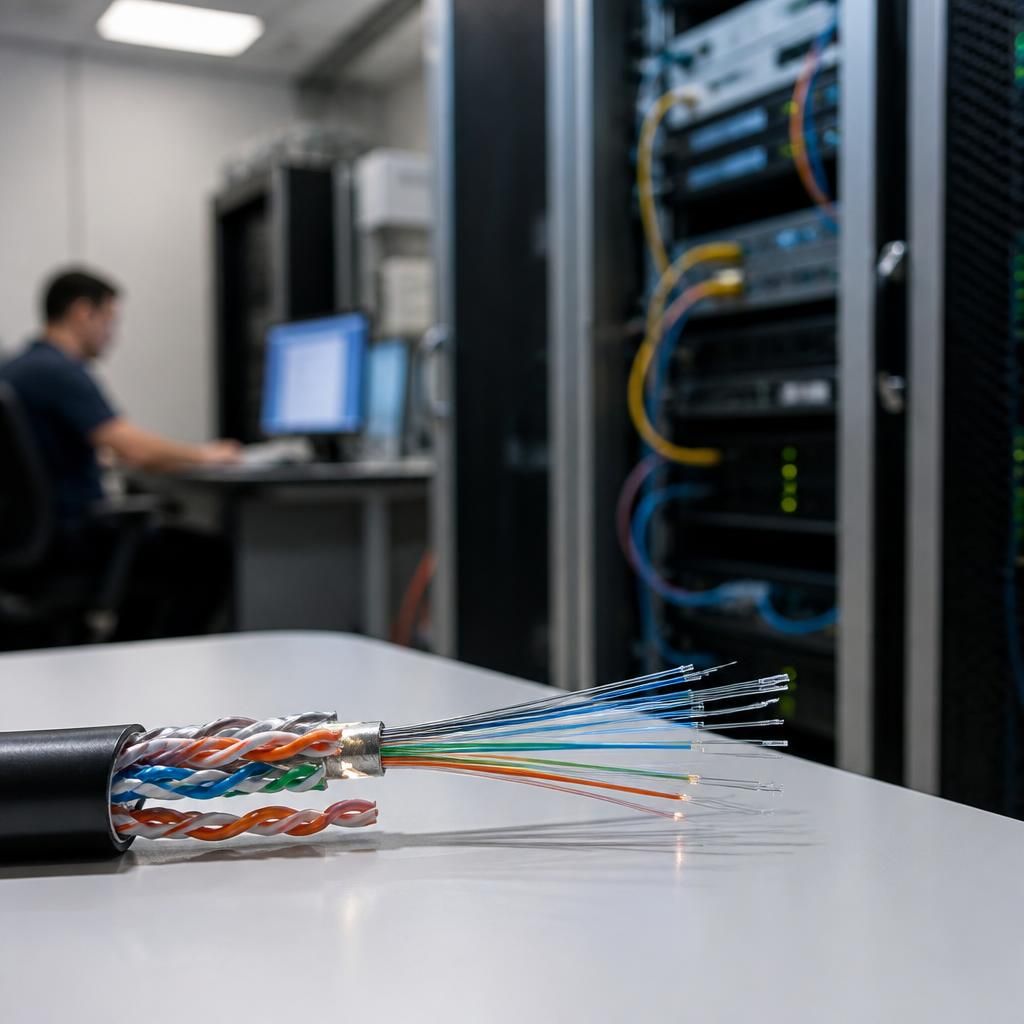
EFM is a last-mile access technology that extends an Ethernet service to a business premises using an access circuit built from copper pairs, fibre, or both. Where copper is used, several pairs may be bonded together so the connection can provide greater capacity and improved resilience than a single pair alone. The service then hands off to the customer as Ethernet, making it suitable for business routers, firewalls and managed network equipment.
How EFM works
EFM connects the customer site to an exchange or aggregation point operated by the connectivity provider. Copper-based EFM commonly uses Ethernet over copper technology, with multiple physical pairs combined into one logical service. The available performance depends on factors such as the distance to the relevant network equipment, the quality of the copper circuits and the number of pairs that can be provided.
Fibre-based EFM uses fibre for some or all of the access path. A mixed deployment may use fibre for the network section and copper for the final part to the premises. Consequently, two services described as EFM may have different technical characteristics, installation requirements and performance limits.
What makes it different from ordinary broadband?
EFM is designed as a business access service rather than a shared consumer broadband product. It is normally supplied with defined service characteristics, provider-managed equipment and contractual commitments covering matters such as fault handling, service availability, repair processes and performance measurement. The exact terms depend on the provider and the selected service level, so the contract should be examined rather than assuming that every EFM circuit has identical protection.
EFM can also provide a more predictable route for business traffic than a service whose performance varies substantially with local usage. This is relevant to organisations using hosted applications, voice services, remote access, cloud platforms and site-to-site connections. Predictability does not mean that every application will perform well automatically: the internal network, firewall, wireless infrastructure, traffic levels and application design remain important.
EFM compared with fibre Ethernet
Fibre Ethernet is generally the preferred option where a suitable fibre build is available and the organisation needs higher capacity or a longer-term platform for growth. EFM can be useful where a full fibre connection is unavailable, unsuitable for the premises or not proportionate to the required capacity. Its practical limitations are usually associated with copper distance, local infrastructure and the number of usable pairs.
EFM should therefore be assessed on the specific route to the building, not simply by comparing product names. A provider should confirm the access medium, estimated installation method, maximum available capacity, network hand-off, equipment requirements and any restrictions linked to the address.
What are the main benefits?
- Business-oriented Ethernet hand-off: The service can integrate directly with common business routing and security equipment.
- Consistent service design: Capacity, demarcation points and provider responsibilities can be documented clearly in the service specification.
- Support for important traffic: EFM may be appropriate for internet access, inter-site networking, hosted systems and other services requiring a managed connectivity platform.
- Alternative to full fibre: It may provide a practical access method where fibre availability is limited.
- Scalable bonded access: With copper-based services, additional pairs may allow a higher service tier where the local infrastructure supports it.
These benefits should be considered alongside the limitations. Copper-based EFM can have lower capacity than modern fibre services, may be more dependent on route length and may offer fewer upgrade options. Pair faults, water ingress, poor-quality joints or infrastructure changes can also affect a copper access circuit. Resilience is not automatic: bonding several pairs does not necessarily mean that they follow physically separate routes.
How much does an EFM leased line cost?
There is no single standard price. The cost can be affected by the required capacity, the access medium, the distance to network infrastructure, the number of copper pairs, installation complexity, equipment, contract term and the service level selected. A site requiring new construction or additional infrastructure may have different charges from one that can use existing network assets.
When comparing quotations, separate recurring service charges from installation or construction costs. Check whether router management, monitoring, engineering work, address changes, early termination and upgrades are included or charged separately. The lowest monthly price may not represent the lowest overall cost if the service has limited capacity, restrictive fault terms or expensive changes.
What should a business check before ordering?
- Confirm whether the proposed service is copper EFM, fibre EFM or a hybrid connection.
- Check the committed capacity and whether it is suitable for current traffic as well as planned growth.
- Identify the physical demarcation point and establish which equipment and cabling the provider manages.
- Review the service level agreement, including fault ownership, restoration targets, maintenance notifications and exclusions.
- Ask whether the circuit uses diverse routes or infrastructure if connectivity is business-critical.
- Check the installation survey, any building access requirements and the treatment of construction charges.
- Plan the migration, including router configuration, public addressing, firewall changes, testing and rollback arrangements.
EFM can be a sensible business connectivity option when its access limitations match the site and the organisation’s capacity requirements. The decision should be based on the verified route, technical specification, service terms and future connectivity plans, rather than on the EFM label alone. A managed IT provider can help assess those factors alongside the organisation’s network, security controls and cloud usage.
EFM describes the access technology, not necessarily the complete connectivity service. The same Ethernet hand-off may be used for internet access, a private connection between sites or another managed network service, depending on the provider’s design. This distinction matters when comparing quotations because two EFM circuits may offer different routing, public addressing, traffic management and security responsibilities.
Before installation, document how the service will connect to the organisation’s existing network. Confirm:
- where the provider’s equipment ends and the customer’s firewall or router begins;
- whether the service includes internet transit, private networking or both;
- who allocates and manages IP addresses;
- which party configures routing, firewall policies and monitoring; and
- how the service will be tested against the intended applications and remote sites.
This information creates a clear technical boundary between the EFM access circuit and the wider network. It also helps prevent problems during commissioning, particularly where the connection replaces an existing service or forms part of a multi-site design.