

How does identity security protect service accounts?
Identity security protects service accounts by restricting them to the systems and actions they require, while securing their credentials against theft or misuse. Access controls, credential management, activity monitoring and threat detection help identify unusual behaviour and prevent compromised accounts from being used to move through business systems.
Identity security protects service accounts by applying a controlled lifecycle to non-human identities: each account is documented, assigned an accountable owner, authenticated with suitable credentials, granted only an approved purpose, and removed when no longer needed. This reduces the risk that an unattended account becomes a permanent route into business systems.
Service accounts are used by applications, scripts, scheduled tasks, integrations, databases and infrastructure components. Unlike ordinary user accounts, they may operate without an employee signing in interactively. That makes them useful for automation but also creates a different security problem: a service account can continue to function after a project ends, an administrator leaves, or the original integration is forgotten.
Start with an accurate inventory. Identity security requires more than listing usernames. The inventory should record:
- the application, process or system that uses the account;
- the business and technical owner responsible for it;
- the permissions, systems and data it can reach;
- where its credentials are stored and which people or processes can retrieve them;
- the authentication method and any dependencies on other accounts; and
- the date and conditions for review, renewal or retirement.
Ownership is particularly important. A service account should not be treated as ownerless simply because software uses it. A named team or role must be able to confirm that the account is still necessary, understand its function and approve changes to its access. Accounts without a clear purpose should be investigated and, where appropriate, disabled through a controlled process rather than left active indefinitely.
Credentials need protection suited to machine use. Passwords, certificates, API keys and other secrets should not be embedded in source code, configuration files, spreadsheets or scripts that a broad group can read. They should be held in an appropriately protected secrets store, with access granted to the workload or deployment process that needs them. The secret itself should be separated from the application code so that publishing or copying the code does not disclose a usable credential.
Credential rotation is another essential control. A service account secret should be replaced according to a defined policy and immediately changed when exposure is suspected, a system is decommissioned or an authorised dependency changes. Rotation must be tested against the applications that rely on the account; otherwise, an apparently strong policy can cause outages or encourage staff to bypass it. Where supported, short-lived credentials and certificates can reduce the period in which a copied secret remains useful.
Non-interactive use should be enforced. A service account intended for an application should not normally be permitted to sign in to workstations, servers or administrative portals as if it were a person. Interactive logon restrictions, separate administrative identities and controls on remote access help prevent a stolen application credential from being used as a convenient human login. Exceptions should be documented, time-limited and approved for a specific operational reason.
Access should also be separated by function. For example, an account that reads information for a reporting process should not also be able to alter records, administer the database or create other identities. Different stages of an application or deployment pipeline may require separate accounts so that a compromise in one process does not automatically provide control over unrelated functions. This is more effective than assigning one highly privileged account to every automated task.
Changes should follow a defined approval path. Requests to create a service account, add a permission, change its authentication method or connect it to another system should identify the purpose and expected scope. The request should be reviewed by someone able to assess the risk, while the person or process implementing the change should not be the sole approver for sensitive access. Temporary permissions should have an expiry rather than relying on someone to remember to remove them.
Identity security also supports dependable investigation by linking activity to the service account’s known function. Records should make it possible to distinguish expected automated behaviour from actions that require investigation, such as use from an unapproved system, access to an unrelated data set, changes to account privileges or a sudden change in the type of operation performed. The surrounding context matters: the application, host, deployment event and account owner can help determine whether an action was authorised or indicates misuse.
When an account is suspected of compromise, the response plan should identify which credentials can be revoked, which dependent applications may fail, and how the account can be replaced safely. Useful measures include disabling the identity, invalidating active sessions or tokens where possible, rotating associated secrets, checking recent changes and assessing systems that the account could access. Designing this process in advance avoids relying on an improvised decision during an incident.
Finally, service accounts should be reviewed as part of joiner, mover and leaver processes for systems and suppliers, as well as during application changes and decommissioning. S2 Technology Group can help organisations assess these identity controls alongside broader IT and cyber security arrangements, particularly where automated processes span cloud services, on-premises infrastructure and third-party integrations.
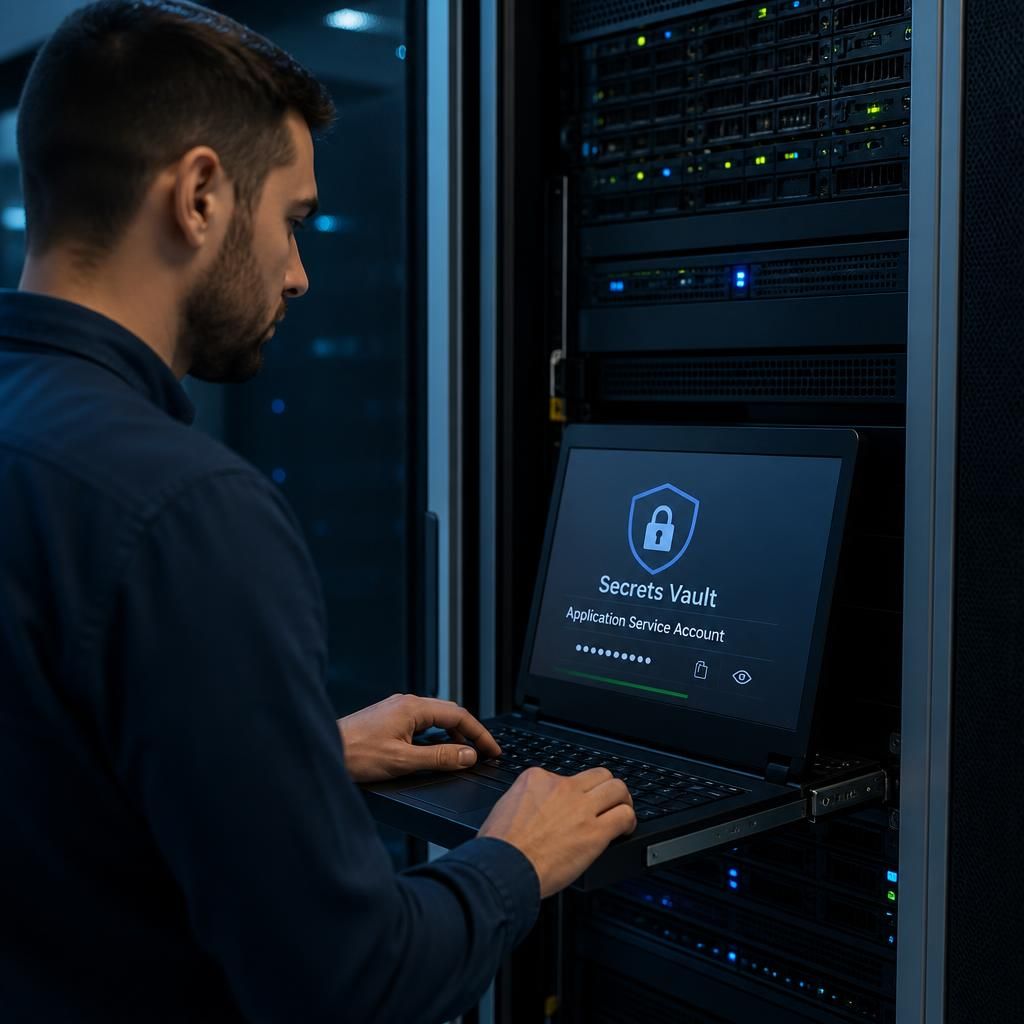
Service accounts should be treated as workload identities rather than ordinary directory users. Their access should be linked to the application, service or execution environment that needs it, so a credential cannot be reused freely from an unrelated device or process.
Where the infrastructure supports it, workload identity federation or certificate-based authentication can reduce reliance on long-lived passwords and static keys. These methods allow a trusted workload to obtain access based on its verified identity and context, while limiting the usefulness of copied credentials.
This approach should be supported by clear trust boundaries. Development, testing and production workloads should use separate identities, and an application should not inherit permissions simply because it runs on a shared server or belongs to a broad system group. Separating these relationships makes unexpected access easier to identify and limits the systems affected if one workload is compromised.