
How are emergency calls handled by business VoIP phone systems?
Business VoIP phone systems route UK emergency calls, such as 999 and 112, to the appropriate emergency service while passing the caller’s registered location information where supported. Businesses must keep locations accurate for each number, office and permitted remote user, and understand that loss of internet or power can affect VoIP emergency calling.
Business VoIP emergency calling is a controlled process that identifies an emergency dialling event, associates it with the caller’s registered location and passes it to the appropriate emergency call handler. The exact behaviour depends on the provider’s network, the business’s configuration and the type of device or connection being used.
Emergency calls are normally treated differently from ordinary business calls. They should not be sent through a receptionist, hunt group, interactive voice menu or other internal routing rule that could delay access to the emergency service. The platform should recognise the emergency number, apply the relevant routing policy and present a callback number that can be used if the call becomes disconnected.
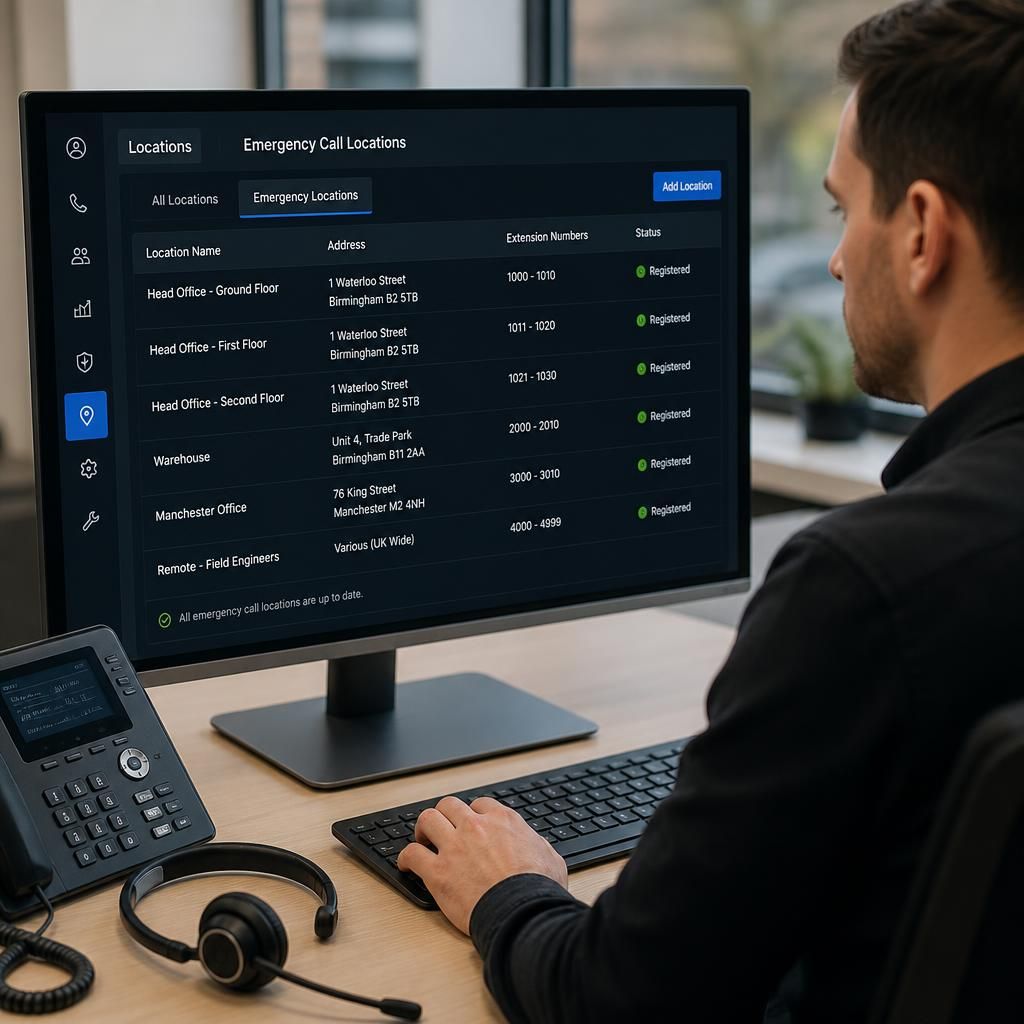
Location information is a central part of the process. A business VoIP system may associate a number with:
- a fixed office address;
- a particular floor, department or building within a larger site;
- a branch or other separately managed location; or
- a permitted remote user’s registered working address.
For a small single-site business, a main registered address may be sufficient for some arrangements. Larger or multi-site organisations need a more detailed location model so that the information presented to the emergency service reflects where the caller is actually working. A phone moved between offices, a softphone used from home and a device connected through a different internet service may each require separate treatment.
Organisations should establish how their provider handles location changes before deploying remote or mobile VoIP users. Some systems use a fixed address linked to the user or number, while others support a location portal, network-based detection or user confirmation. These methods are not interchangeable. Automatic detection can be affected by VPNs, private networks, shared internet connections and devices that are used away from their normal site.
The caller’s number is also important. Emergency call handling should provide a usable outbound caller identity rather than a generic switchboard number where that could make it difficult to identify or call back the person who made the call. Businesses should confirm whether the displayed number reaches the relevant user, reception point or site contact, and ensure that staff know what information to give verbally if asked to confirm the location.
Several operational conditions can affect the result:
- Remote working: a user’s registered address may become inaccurate when they work from another location.
- Multiple sites: shared numbering plans and centralised call platforms must still distinguish between branches.
- Softphones: a laptop or mobile device may be used on networks that do not provide reliable location context.
- Power and connectivity: phones, switches, routers and internet services may stop functioning during a local power or network failure.
- Network changes: firewall, VPN, internet or telephony configuration changes can alter how the service identifies a device.
For these reasons, emergency calling should be included in the design review for a business VoIP deployment rather than treated as an automatic feature. The business should document which numbers, devices, sites and remote users are covered; who is responsible for updating location records; and what alternative communication method is available if the VoIP service or local network cannot be used.
Testing requires care. A business should not place an unplanned live emergency call merely to check its configuration. Instead, it should ask its VoIP provider what test facility or verification process is available, what information can be validated without contacting emergency services and how changes to location records are confirmed. Testing should be repeated after office moves, number changes, major network alterations or the introduction of a new remote-working arrangement.
Staff guidance should be practical and concise. Users need to know the organisation’s emergency dialling procedure, whether an access code is required, how to state the site and room location, and how to report a problem with an emergency call. They should also understand that a VoIP number may not identify their physical location automatically, particularly when using a softphone away from the normal workplace.
Before choosing or renewing a business VoIP system, ask the provider:
- How are emergency calls identified and routed?
- What location information is passed for fixed-site, multi-site and remote users?
- How are address changes approved, recorded and audited?
- What caller ID is presented, and how can the emergency service call back?
- What happens if a user is connected through a VPN, mobile network or different broadband connection?
- How should the business verify its configuration safely?
- What equipment or service dependencies could prevent the call from being placed?
A properly configured business VoIP system can support emergency calling, but its effectiveness depends on accurate location records, suitable routing, reliable caller identification and clear user procedures. These controls should form part of the wider telephony and business continuity review, especially where employees work across multiple premises or use the same number from different locations.
A business VoIP emergency call does not automatically notify colleagues, building managers or on-site security. The external call to 999 or 112 and the organisation’s internal incident procedure are separate processes. Businesses should therefore define who contacts reception or site personnel, how the caller’s exact room or area is communicated internally, and how staff avoid delaying the emergency call while carrying out those additional steps.
This distinction is particularly important in larger premises, shared buildings and multi-site organisations. The registered address may identify the correct building without identifying the precise location of the incident. Internal procedures should explain how staff provide floor, room, access and landmark details directly to the emergency call handler, while designated colleagues manage access for responding services.
Review Your Business VoIP Emergency Call Configuration
Ask S2 Technology Group to review your business VoIP emergency call configuration and identify any changes needed for your sites, users and working arrangements. Use the review to clarify provider responsibilities and document the procedures your organisation relies on.