
What is the difference between an IT service desk and an IT helpdesk?
An IT helpdesk typically focuses on resolving users’ technical problems, while an IT service desk provides a broader service-management function covering support, requests, communication and continual improvement. In practice, organisations often use the terms interchangeably, but a service desk usually has a wider business and operational remit than a helpdesk.
The main difference is scope: an IT helpdesk is generally focused on assisting users with technical problems, while an IT service desk manages a broader relationship between users, IT services and the organisation. The terms are often used interchangeably, so the name alone does not define how a support function operates; its responsibilities and processes do.
An IT helpdesk is usually centred on restoring a user’s ability to work. Typical activities include diagnosing a failed application, resolving a connectivity issue, helping with password or account problems, and guiding users through common technical tasks. It may operate as a first point of contact that records incidents, applies known fixes and passes more complex issues to a specialist.
An IT service desk includes those support activities but treats them as part of an overall service-management process. It can provide a controlled route for:
- Incidents: unplanned interruptions or reductions in the quality of an IT service.
- Service requests: routine, authorised requests such as access to a system, equipment provision or software installation.
- Changes: planned modifications to infrastructure, applications, user accounts or security controls.
- Information and advice: guidance that helps users work effectively and follow appropriate IT procedures.
- Communication: updates about incidents, planned maintenance, service changes and issues affecting multiple users.
The service desk therefore considers more than whether an individual technical fault has been fixed. It also considers how work is logged, categorised, prioritised, assigned, communicated and reviewed. This creates a consistent experience for users and gives the organisation information about recurring problems, demand for services and areas where the IT environment could be improved.
The practical differences can be summarised as follows:
- Primary purpose: a helpdesk concentrates on solving user problems; a service desk coordinates support and the wider delivery of IT services.
- Scope: a helpdesk may focus mainly on incidents, whereas a service desk commonly handles incidents, requests, access, changes, communications and service information.
- Business alignment: a helpdesk is often measured by technical resolution activity; a service desk also examines business impact, service quality, risk and user experience.
- Process maturity: a helpdesk may rely on straightforward troubleshooting procedures; a service desk normally uses defined workflows, ownership, escalation paths and records.
- Improvement: a helpdesk can resolve individual issues, while a service desk is expected to identify patterns and reduce avoidable disruption through problem management, knowledge development or planned changes.
For example, if one employee cannot connect to a business application, a helpdesk may diagnose the device, network or account issue and restore access. A service desk would record the incident, assess its effect on the user and any wider service, provide appropriate updates, coordinate escalation where needed, and review the record for evidence of a recurring problem. If several employees are affected, the service desk may manage the communication and coordination as a wider service incident rather than treating each report as an unrelated fault.
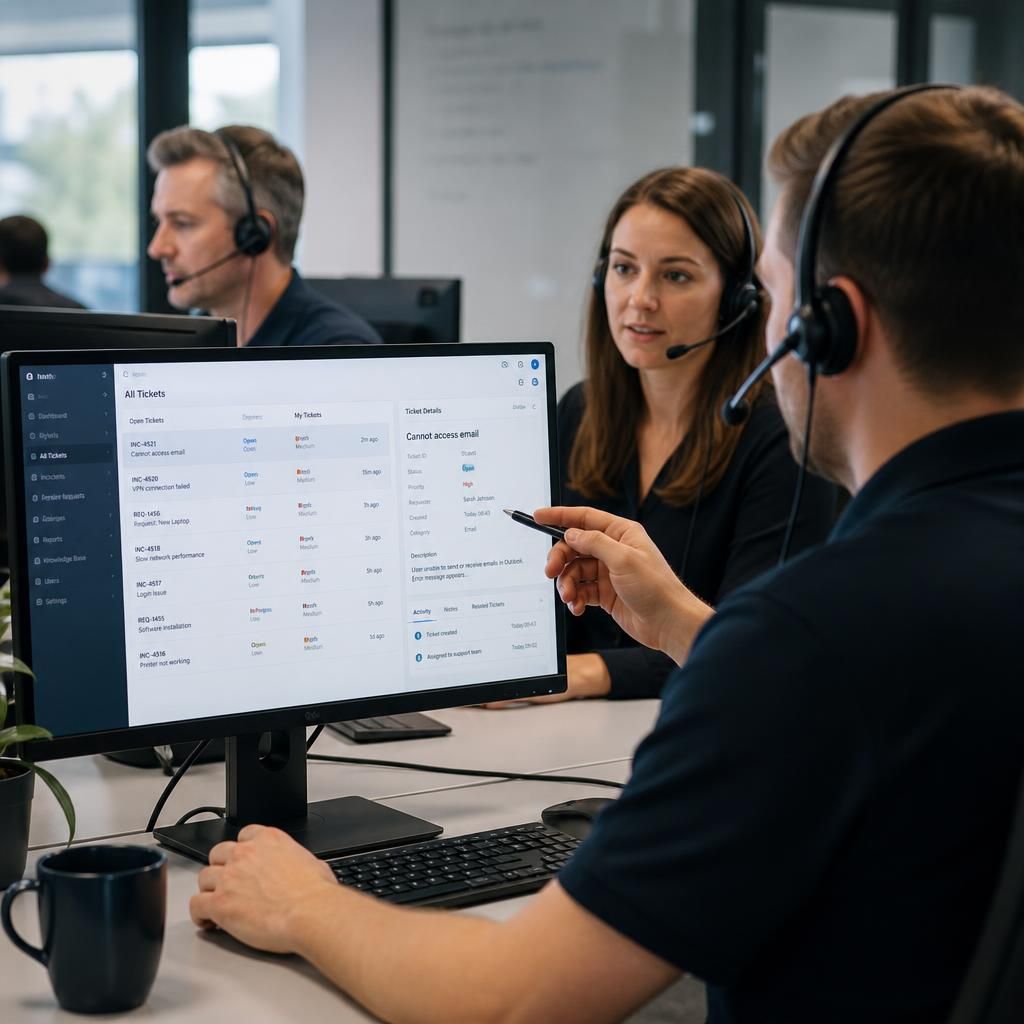
The distinction also affects ticket handling. A helpdesk ticket commonly records the user’s problem and the steps taken to resolve it. A service desk record may additionally capture the affected service, business impact, request type, approval requirements, related incidents, change references and final outcome. These details support reporting and help organisations make informed decisions about priorities, resources and improvements.
Neither model is automatically suitable for every organisation. A small business with a limited range of systems may need a straightforward support function with clear routes for reporting faults and requesting assistance. A growing or multi-site organisation, or one that depends on several interconnected cloud and business systems, may benefit from service-desk practices that provide stronger coordination, ownership and visibility. The appropriate model depends on the complexity of the technology environment, the consequences of disruption, regulatory or security requirements, and whether the organisation needs structured service improvement.
When comparing providers or internal support teams, look beyond whether they use the term “helpdesk” or “service desk”. Check what types of tickets they accept, how incidents and requests are separated, how business impact influences priority, how escalations are managed, what information is reported, and whether recurring issues lead to corrective action. A provider calling itself a helpdesk may deliver a broad service-desk function, while a service desk may offer only a limited troubleshooting service.
In short, an IT helpdesk is usually a user-support function, whereas an IT service desk is a wider operating model for managing IT support and service delivery. For organisations that need reliable, secure and scalable technology, the more important question is whether the support arrangement provides the right processes, ownership and visibility—not which label appears in its name.
The distinction between an IT helpdesk and an IT service desk is about operating scope, not technical ability or seniority. A helpdesk can provide highly capable troubleshooting, while a service desk may still rely on specialist teams for infrastructure, security or application issues. In many organisations, the helpdesk functions as the user-facing part of a wider service desk.
This matters when assessing an IT support model. Ask whether the team only resolves individual faults or also coordinates requests, approvals, communications and follow-up across the relevant technical teams. A clear division of responsibility can prevent users from having to repeat information, while giving the organisation a reliable record of who owns each issue and what action is required.