

How does endpoint detection support cloud security?
Endpoint detection supports cloud security by monitoring laptops, desktops and other devices for suspicious activity that could compromise cloud accounts or data. It provides evidence for investigation and enables a compromised endpoint to be isolated, helping prevent threats from spreading into connected cloud services.
Endpoint detection supports cloud security by connecting activity on user devices with activity in cloud accounts and services. This gives security teams greater context when assessing whether a cloud login, file access event or administrative change is legitimate. It also allows actions taken on the endpoint, the user account and the cloud service to be coordinated rather than managed as separate security issues.
Cloud services are accessed through endpoints such as laptops, desktops and mobile devices. If one of those devices is running malicious software, has an exposed session or is being used by an unauthorised person, cloud controls may be challenged with apparently valid credentials. Endpoint detection adds information about what happened before, during and after the cloud access event, including:
- the user account and device involved;
- processes that were running when the access occurred;
- changes to files, browser sessions or security settings;
- connections to unusual destinations;
- the time and sequence of related actions; and
- whether the device meets the organisation’s security requirements.
This context helps distinguish a normal cloud sign-in from activity associated with credential theft, session hijacking, malicious scripts or unauthorised data handling. A cloud login from a familiar account may appear acceptable when viewed in isolation, but becomes more concerning if endpoint telemetry shows a new browser extension, an unusual process or a recently altered security setting.
How endpoint detection strengthens cloud controls
Endpoint detection supports several parts of a cloud security model:
- Identity protection: Endpoint signals can contribute to decisions about whether an account should be allowed to access a cloud resource. A device with outdated protection, suspicious activity or an unknown configuration may be required to complete additional verification or be denied access until reviewed.
- Event correlation: Endpoint events can be compared with cloud audit records, authentication logs and file activity. Correlation can reveal a sequence such as a suspicious process starting on a device, followed by a new sign-in and unusual downloads from a cloud repository.
- Investigation: Investigators can establish whether an event began with a device compromise, a stolen credential, a misconfiguration or legitimate administrative work. This reduces reliance on a single log source and helps determine which accounts, devices and data require attention.
- Containment: Depending on the tools and permissions in use, response actions may include restricting the device, revoking active sessions, resetting credentials, disabling an account or blocking access to particular cloud resources. These actions should follow documented procedures so that business-critical access is not removed without appropriate authorisation.
- Compliance evidence: Records of device status, detection decisions and response actions can help demonstrate how access to cloud data is controlled and how security incidents are handled.
Endpoint detection is particularly important where cloud access is distributed across office devices, home-working equipment, shared sites or personally owned hardware. The cloud service may have strong authentication and access controls, but those controls cannot by themselves show whether the device used for access is trustworthy. Device telemetry provides an additional source of risk information for access and investigation decisions.
What the process typically involves
- Collect endpoint data: An endpoint detection agent or integrated security tool records relevant security events while respecting the organisation’s privacy, retention and access policies.
- Assess activity: Rules, analytics and threat intelligence identify patterns that may indicate compromise or misuse. Alerts should be prioritised according to the sensitivity of the cloud services and data involved.
- Correlate with cloud records: Analysts compare the endpoint event with sign-ins, privilege changes, application activity and data access in the relevant cloud environment.
- Validate the alert: The activity is checked against approved maintenance, known software, user responsibilities and other legitimate explanations. Detection should not automatically be treated as proof of an attack.
- Apply the response: The organisation follows its incident response plan to restrict access, protect evidence, remove the cause and restore approved access where appropriate.
- Review and improve: Findings are used to refine detection rules, access policies, device standards, user training and cloud logging.
Effective protection depends on integration. Endpoint alerts that are not connected to cloud audit data may lack useful context, while cloud logs without device information may not explain how an account was used. Organisations should define which events are collected, how long they are retained, who can investigate them and which response actions require approval.
Endpoint detection does not replace identity and access management, multi-factor authentication, cloud configuration management, data loss controls or secure backup. It is one layer in a broader control set. It also has limitations: an unmanaged device may provide little telemetry, a disabled security agent can reduce visibility, and an alert can indicate risk without proving that cloud data was accessed. These limitations should be reflected in access policies and incident procedures.
For small and medium-sized organisations, a practical approach is to establish a consistent device baseline, connect endpoint and cloud logging where possible, define clear escalation rules and test the response process. An IT security provider such as S2 Technology Group can help organisations assess these controls, manage the supporting infrastructure and align endpoint monitoring with wider cloud security requirements.
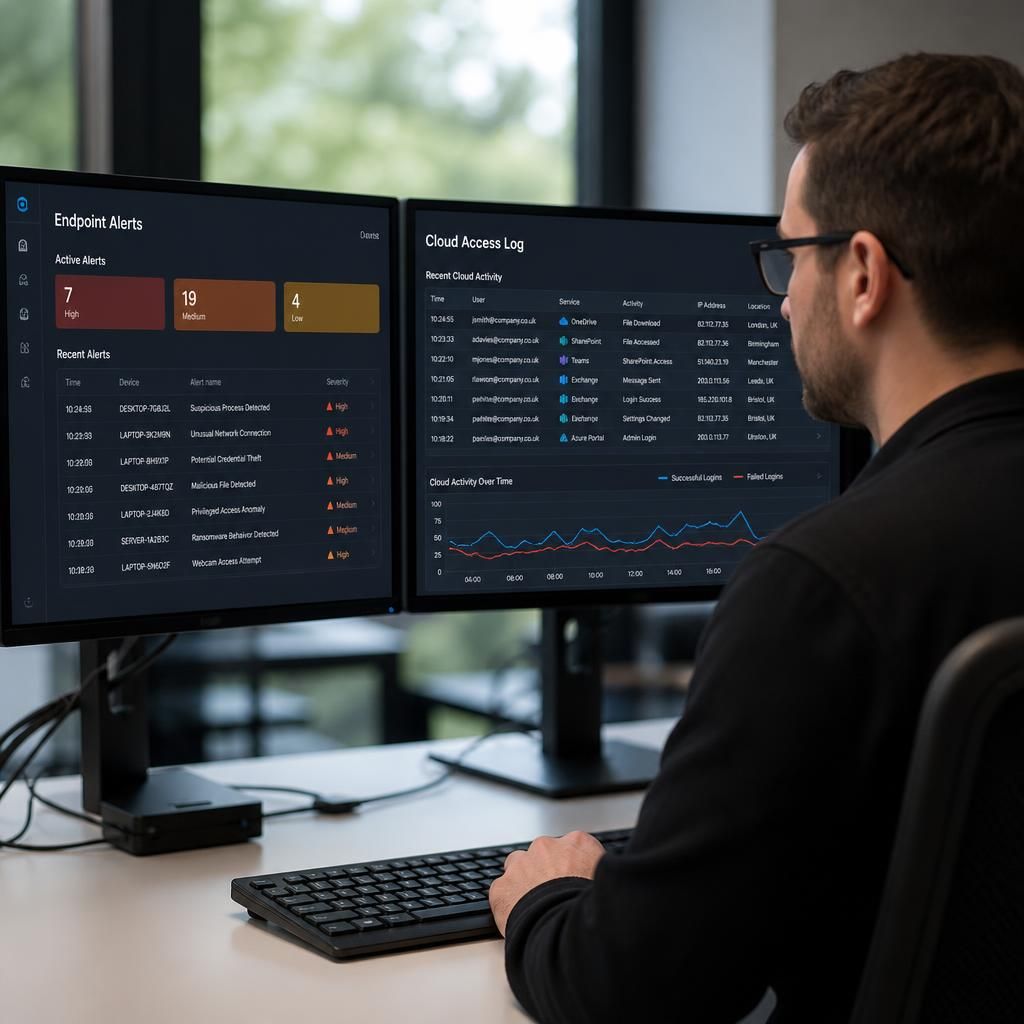
Endpoint detection is most effective for cloud security when its findings are used as a risk signal rather than treated as an automatic instruction to block access. A device alert should be assessed alongside the sensitivity of the cloud resource, the user’s role and the action being attempted. For example, suspicious activity on a device accessing a general collaboration area may require verification and monitoring, while the same activity during an attempt to change payment details or download restricted records may justify immediate access restrictions.
This risk-based approach supports proportionate decisions and reduces unnecessary disruption to legitimate business work. Organisations can define different responses for different combinations of device condition, user privilege and cloud activity, such as:
- requesting additional authentication when device risk increases;
- limiting access to sensitive applications until the device is checked;
- requiring approval for high-impact administrative actions; and
- preserving relevant records before access or configuration changes are made.
These rules should be documented, tested and reviewed when applications, devices or working practices change. They turn endpoint detection from a collection of isolated alerts into a controlled part of cloud access governance.