

How are emergency IT support incidents prioritised?
Emergency IT support incidents are prioritised according to business impact, security risk, the number of users or sites affected, and whether essential services are unavailable. A widespread outage, suspected cyber incident or failure affecting critical operations will generally take precedence over an isolated issue with an available workaround.
Emergency IT support incidents are prioritised through a structured triage process that assesses urgency, operational consequences, technical dependencies and the risk of further damage. The initial priority is not necessarily determined by who reports the issue or which device failed; it is based on the effect of the incident on the organisation and the action needed to stabilise it.
Initial triage establishes the nature of the incident. The support team will normally confirm what has happened, when the symptoms began, which systems are involved and whether the problem is still developing. This distinguishes a service outage from a configuration fault, equipment failure, access problem or suspected security incident. Establishing the incident type helps ensure that the appropriate technical expertise and escalation route are used from the outset.
Priority is then refined by considering factors such as:
- Operational dependency: whether the affected system supports a process that other business activities depend on, such as order processing, production control, telephony or access to essential records.
- Data and compliance exposure: whether information may have been accessed, altered, encrypted or destroyed, particularly where the incident could create legal, contractual or regulatory obligations.
- Incident progression: whether the issue is stable, spreading to other systems or likely to become more difficult to contain if action is delayed.
- Recoverability: whether a known backup, secondary system or documented recovery procedure is available and usable.
- Workaround quality: whether staff can continue operating safely and accurately, rather than merely finding a temporary way to bypass the fault.
- Technical dependencies: whether the affected service relies on identity systems, network infrastructure, shared storage, hosted platforms or another component that could extend the impact.
A useful distinction is made between an inconvenience and a condition that threatens business continuity. A single user who can continue working through a safe alternative route may require a lower priority than a smaller number of users who cannot complete a legally, operationally or commercially essential process. Conversely, an apparently limited issue may be treated urgently if it indicates unauthorised access or a wider control failure.
Security incidents are assessed for containment as well as restoration. In a suspected compromise, preserving evidence and limiting access may take precedence over immediately returning every affected service to operation. Disconnecting an endpoint, disabling an account or restricting network access can temporarily reduce productivity, but may be necessary to prevent the incident spreading. The correct action depends on the evidence available, the systems involved and the organisation’s incident response procedures.
Prioritisation is not a one-time decision. An incident can be reclassified when new information becomes available. For example, an issue initially treated as a local access fault may become more serious if several accounts show the same symptoms. Equally, a major service interruption may be downgraded once a safe recovery route has been confirmed. Each change should be recorded with the reason for the decision, the actions taken and any outstanding risks.
Businesses should also distinguish between priority and resolution order. The most serious incident is normally handled first, but technical work may need to follow a dependency sequence. Restoring an application before its underlying identity, network or storage service is functioning may waste time or create inconsistent data. Triage therefore identifies both the business priority and the safest order in which systems should be investigated and recovered.
The expected response is normally defined by the emergency IT support agreement or service desk procedure. A well-defined arrangement should set out the severity categories, the information required at the point of escalation, the target for initial acknowledgement, communication responsibilities, escalation points and the circumstances that justify changing the priority. It should not rely on an assumption that every reported fault qualifies as an emergency.
For the business, accurate information improves prioritisation. The incident report should identify the affected service, users or sites, visible error messages, recent changes, known workarounds, security concerns and the business process currently blocked. Screenshots, timestamps and details of actions already attempted can help separate symptoms from the underlying fault. Businesses should avoid repeatedly rebooting devices, deleting logs or making unapproved changes where a security incident is suspected.
S2 Technology Group applies this type of structured assessment when helping organisations around Stourbridge, Kinver, Wordsley, Kingswinford, Kidderminster, Halesowen, Dudley and neighbouring areas understand and manage critical IT incidents. The aim is to direct technical effort towards the most consequential risk first, while maintaining a clear record of decisions and next steps.
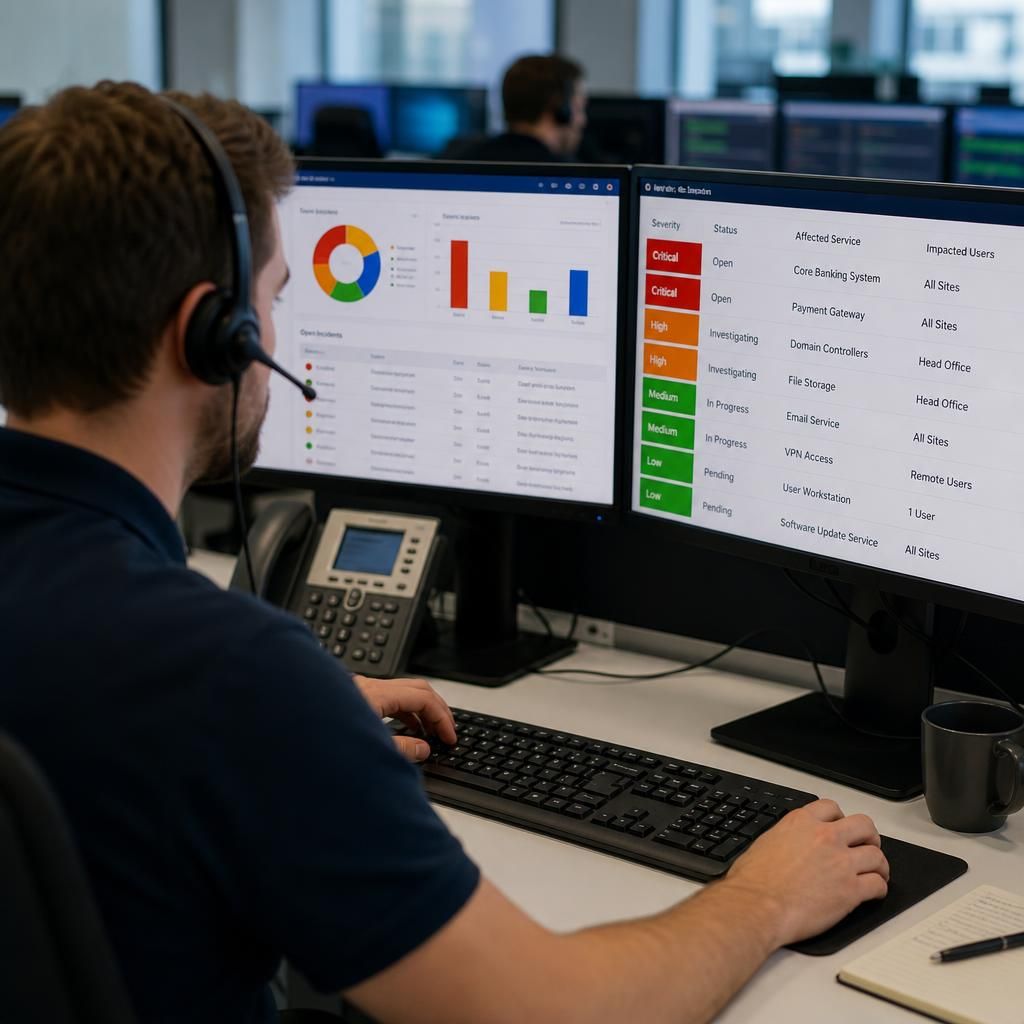
Emergency IT support prioritisation separates technical severity from business urgency. A technically complex fault is not automatically the highest priority: the deciding question is whether delay could prevent an essential business activity, increase security exposure or make recovery more difficult.
- High impact and high urgency: a suspected compromise of an administrator account or an outage affecting a core operational system.
- High impact but lower urgency: a significant system limitation where a safe, documented alternative is available.
- Lower impact but high urgency: an isolated issue that appears to indicate unauthorised access or a wider control weakness.
- Lower impact and lower urgency: a contained fault with no effect on essential processes and a reliable workaround.
This approach helps the support team direct attention according to risk and consequence rather than technical complexity alone. The classification should remain evidence-based and be revised if the incident’s effect, scope or security implications change.
Discuss your emergency IT support priorities
Discuss your organisation’s emergency IT support priorities with S2 Technology Group and identify which systems, users and decisions require the greatest protection. Use the discussion to inform a clear escalation and incident response arrangement before a serious disruption occurs.