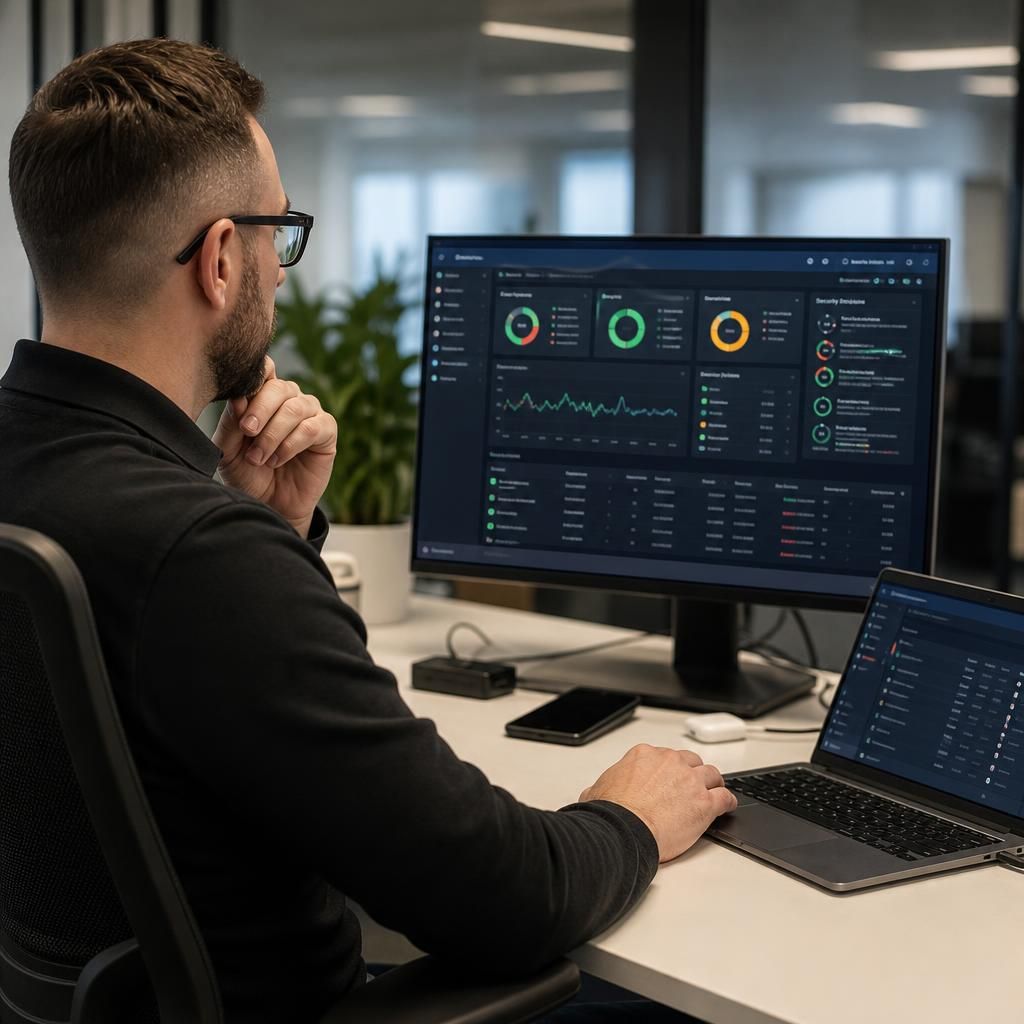
What do managed IT services for small businesses usually cover?
Managed IT services for small businesses usually cover proactive IT support, system monitoring, cyber security, cloud services, connectivity and technology advice. The provider manages day-to-day infrastructure and helps keep systems secure, reliable and suitable for the organisation’s changing needs.
Managed IT services for small businesses usually cover the ongoing management of users, devices, systems, data and technology suppliers, rather than isolated fault repair. The exact scope depends on the provider and contract, but a well-defined service typically combines day-to-day user assistance with preventative maintenance, security controls, backup management, documentation and technology planning.
User and service desk support
Employees can raise issues relating to computers, applications, accounts, printers, remote access and other business technology. The provider assesses each request, resolves faults where possible and escalates matters that require specialist intervention. Support may be delivered remotely, on site or through a combination of both, depending on the organisation’s requirements.
A managed service may also include assistance with routine user administration, such as creating accounts, changing permissions, setting up new starters and removing access when someone leaves. These processes are important because inaccurate or delayed access changes can create both operational disruption and security risk.
Management of devices and infrastructure
Managed providers commonly maintain the organisation’s computers, servers, network equipment and other connected devices. This can include:
- Applying operating system and application updates
- Checking device health, storage and performance
- Managing standard configurations and approved software
- Maintaining servers, network equipment and essential infrastructure
- Identifying ageing or unsupported equipment that may need replacing
Centralised management helps maintain a consistent technology environment. It also gives the provider a clearer record of which devices exist, who uses them and whether they meet the organisation’s security and operational requirements.
Access, identity and security controls
Cyber security within a managed service is not limited to installing protective software. It can include managing user permissions, strengthening account security, controlling administrator access, reviewing unusual activity and helping staff follow safer working practices. Providers may also help establish policies for passwords, multi-factor authentication, acceptable use, mobile working and access to company data.
Good access management follows the principle that users should have the permissions needed for their role, but no more than they require. This reduces the potential impact of a compromised account and makes it easier to identify inappropriate access during a review.
Backup and recovery arrangements
Many managed IT agreements include the operation and review of backups for important files, systems and business data. This should cover more than confirming that a backup job has run. The provider should establish what is being protected, where copies are held, how long they are retained and how data or systems would be restored after accidental deletion, equipment failure or a cyber incident.
Businesses should check whether recovery planning is included in the service. Backup, disaster recovery and business continuity are related but different: a backup preserves data, whereas recovery planning addresses how the organisation will resume essential operations and in what order systems should be restored.
Cloud and hosted service administration
Where a business relies on hosted applications or cloud-based systems, managed IT support may cover account administration, permissions, configuration, integration and supplier coordination. The provider can help determine which information should be accessible to which users, how data is shared and what happens when a member of staff changes role or leaves.
Cloud management should also consider licensing, data locations, security settings and dependencies between services. A business may have reliable individual applications but still experience disruption if accounts, connectivity or access controls are not managed as part of the wider environment.
Documentation and supplier coordination
A mature managed service maintains practical records of the technology environment. These may include equipment lists, network information, system dependencies, user access, backup arrangements, licences and agreed procedures. Accurate documentation reduces reliance on individual employees’ knowledge and helps faults, changes and security events to be handled more consistently.
The provider may also liaise with internet, software, hardware and specialist service suppliers. This can include diagnosing whether a problem sits within the business’s own environment or with an external service, coordinating technical changes and keeping relevant information together for future support.
Planning and continual improvement
Managed IT services often include periodic reviews of risks, recurring issues, capacity, obsolete equipment and upcoming business changes. The purpose is to connect technology decisions with practical requirements such as new staff, additional locations, remote working, changing applications or compliance obligations.
Small businesses should therefore assess a proposal by asking what is included, what is excluded and how work outside the standard scope is charged. The agreement should identify supported systems, user and device limits, maintenance responsibilities, security measures, backup coverage, escalation arrangements and the process for requesting changes. S2 Technology Group provides this type of broader managed IT approach for small and medium-sized organisations that need their technology to be maintained as an operating environment rather than treated as a series of unrelated faults.
Managed IT services may also cover the business network and its connectivity, including internet connections, firewalls, switches, wireless access points and secure remote access. The provider can monitor network performance, maintain configurations, review capacity and investigate whether a problem originates within the organisation’s equipment or with an external connection.
This part of the service is especially relevant to businesses that depend on cloud applications, multiple sites or staff working remotely. The agreement should clarify whether it includes:
- Configuration and maintenance of network and security equipment
- Management of virtual private network access and user permissions
- Connectivity fault diagnosis and coordination with the relevant supplier
- Network changes required when offices, users or applications are added
- Replacement of equipment that is obsolete, unsupported or unsuitable for current demand
Internet circuits, hardware purchases, installation work and structured cabling may sit outside the recurring managed service, so these boundaries should be confirmed before the agreement is signed.