
How should a business VoIP phone system prioritise voice traffic?
A business VoIP phone system prioritises voice traffic by using Quality of Service (QoS) rules to give voice packets precedence over less time-sensitive data. This helps control latency, jitter and packet loss, producing clearer calls when the network is carrying other traffic.
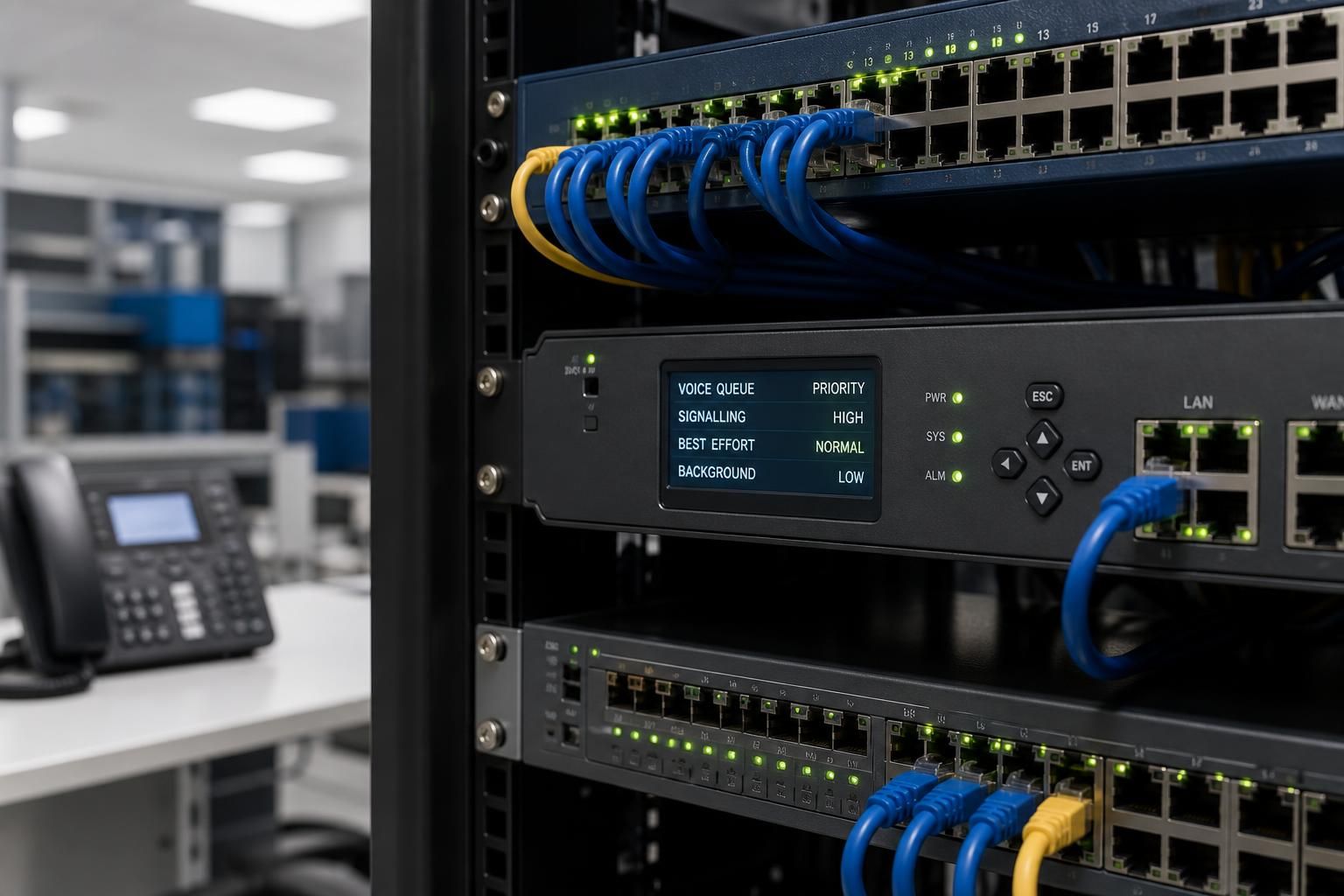
A business VoIP phone system should prioritise the real-time voice media stream over traffic that can tolerate delay, using coordinated Quality of Service (QoS) policies across the phones, switches, routers and internet or private network connection. The aim is not simply to reserve bandwidth for telephony, but to identify voice traffic correctly, place it in an appropriate queue and prevent other applications from causing delay, variation in delay or dropped packets.
Voice calls are sensitive to network conditions because audio is transmitted as a sequence of small packets that must arrive at regular intervals. A short-lived download may slow down without being noticed, whereas the same congestion affecting a call can cause clipped speech, gaps, distortion or people speaking over one another. QoS therefore gives voice packets preferential treatment when links are busy, while allowing ordinary data to use the remaining capacity.
Effective prioritisation normally involves several stages:
- Classification: the network identifies voice media, usually RTP packets, separately from signalling traffic used to establish and manage calls.
- Marking: packets may be given a recognised DSCP value so that each managed network device can apply the same treatment.
- Queuing: routers and switches place voice in a low-latency or priority queue ahead of less time-sensitive traffic.
- Shaping and scheduling: traffic is controlled at congested links so that large transfers do not fill the connection before voice packets can be sent.
- Validation: monitoring checks whether the policy is being applied and whether calls are experiencing packet loss, jitter or excessive delay.
Classification must be accurate. Prioritising all traffic from a phone or an entire office VLAN could give unrelated data an unnecessary advantage, while failing to recognise the media stream leaves calls competing with file synchronisation, backups, video meetings and large downloads. A well-designed policy distinguishes voice media from call signalling and applies appropriate treatment to each. Signalling is important for call setup and control, but the audio stream is the traffic most directly affected by latency and jitter.
QoS should be applied from end to end rather than only on the local network. A typical path may include the handset, access switch, internal router, firewall, wide area connection and the provider’s network. Prioritisation on the office switch cannot compensate for an overloaded internet circuit or a misconfigured router. Traffic markings may also be removed or changed at network boundaries, so the policy should define which devices are trusted to mark packets and where markings are checked or rewritten.
Capacity planning remains essential. QoS controls the order in which packets are handled during congestion; it does not increase the bandwidth available on a circuit. The connection must be assessed for normal and peak usage, including cloud applications, backups, remote access, guest traffic and video. Upload capacity is particularly important where voice traffic leaves the premises. If the access link is regularly saturated, the correct remedy may include increasing capacity, scheduling intensive transfers, separating traffic or applying rate limits, rather than relying on priority queues alone.
Network design can support the policy by separating voice devices from general data, either through dedicated voice VLANs or clearly defined logical policies. This can make classification and troubleshooting easier, but segmentation by itself is not QoS. The switches and routers still need suitable queueing rules, and the configuration must account for phones connected through a computer, wireless handsets, softphones and users working remotely. Wireless networks require particular care because contention, signal quality and roaming can affect audio independently of wired bandwidth.
Voice codecs also influence prioritisation requirements. A codec that uses more bandwidth creates a larger demand on the network, while compression can reduce bandwidth at the cost of processing or audio characteristics. The phone system, network design and available links should use compatible settings rather than selecting a codec without considering the complete call path. Calls routed through external providers or remote users may follow different paths and need separate testing.
Monitoring should measure more than whether a call connects. Useful checks include:
- latency, meaning the time taken for packets to travel between endpoints;
- jitter, meaning variation in packet arrival times;
- packet loss, which can remove parts of the audio;
- queue drops and interface errors on switches, routers and firewalls;
- link utilisation during busy periods; and
- whether voice packets retain their intended markings across network boundaries.
Testing should include realistic contention, such as a large transfer taking place while several calls are active. It should cover internal calls, calls to external numbers, remote users and any site-to-site connections. Reviewing call-quality records alongside network monitoring can help determine whether a problem is caused by local congestion, a faulty link, wireless conditions or a service-provider path.
A practical implementation therefore starts with mapping the call paths and identifying the traffic types, followed by a documented classification and marking policy. The policy is then applied consistently to switches, routers, firewalls and relevant remote-access connections, with capacity reviewed before priority queues are configured. Regular testing and configuration reviews are important because new applications, additional sites and changes to internet connectivity can alter the traffic pattern. This approach makes voice prioritisation a controlled network function rather than a setting applied to the phone system in isolation.
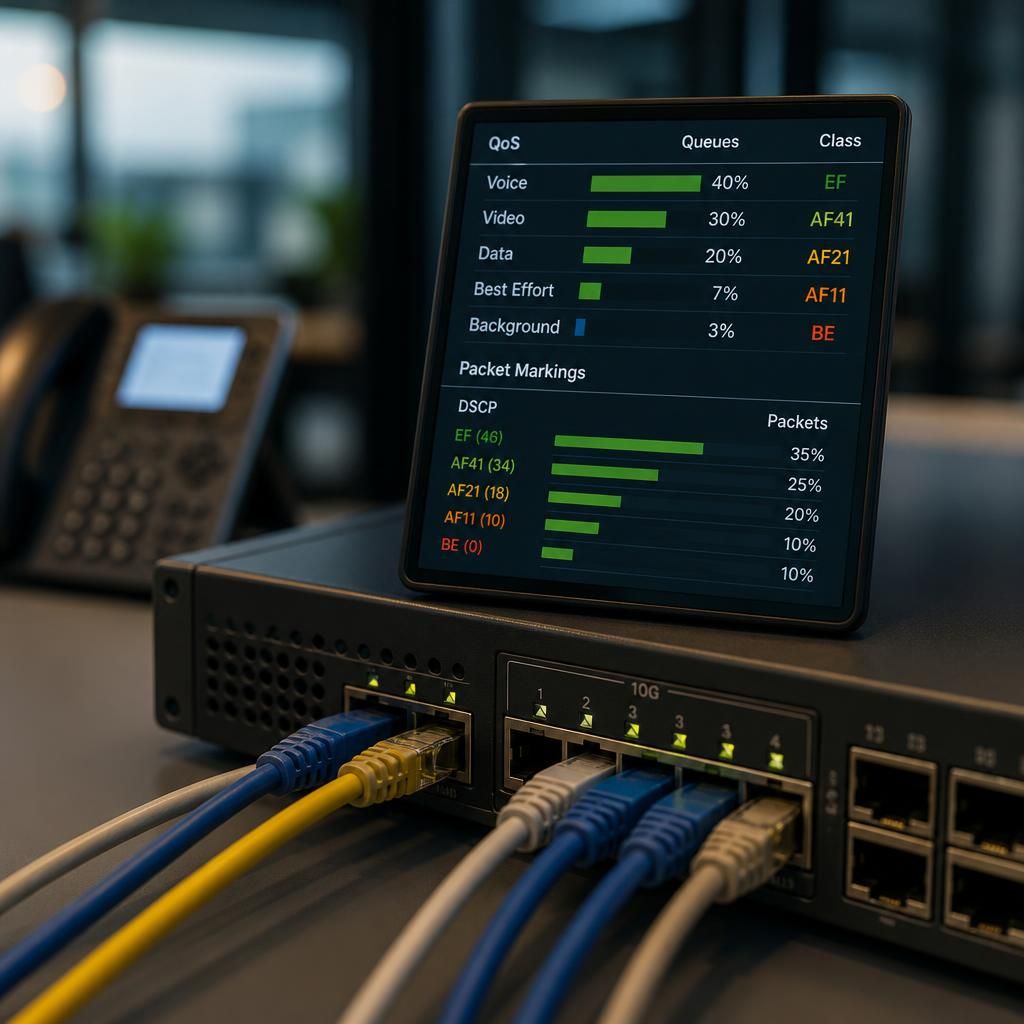
Voice traffic should receive priority during congestion without being allowed to consume network capacity indefinitely. A strict priority queue that is poorly configured can delay business-critical applications, cause queues for other traffic to grow and make the wider network less stable. Effective QoS therefore treats voice as a protected class within a controlled scheduling policy, rather than as a reason to place every telephony-related packet ahead of all other data.
The policy should define safeguards such as a maximum share of link capacity for real-time traffic and suitable treatment for important non-voice applications. It should also specify what happens when voice demand exceeds the available capacity: calls may need to be limited, additional capacity may be required, or lower-priority traffic may be restricted temporarily. This creates a predictable balance between call quality and the applications the organisation depends on to operate.
Review the policy when the business adds users, sites, softphone clients or collaboration services. A configuration that is appropriate for a small number of handsets may not remain suitable as calling and video usage increases. Documenting the intended traffic hierarchy makes future changes easier to assess and helps prevent a local QoS adjustment from creating problems elsewhere in the network.
Review your business VoIP phone system’s QoS requirements
Review your current network and call paths with S2 Technology Group to identify whether your business VoIP phone system needs a coordinated QoS policy. We can help you assess the configuration and plan suitable next steps for your organisation.