
What should an IT service management knowledge base contain?
An IT service management knowledge base should contain organised, searchable guidance for resolving common issues, completing service requests and following approved IT processes. It may include FAQs, step-by-step solutions, troubleshooting procedures, technical documentation, known errors, escalation guidance and records of changes or service dependencies.
An effective IT service management knowledge base should contain trusted, structured information that helps users and support teams make consistent decisions. Its value depends not only on the amount of information stored, but also on whether each article has a clear purpose, an accountable owner, appropriate security controls and a defined review cycle.
Core content should cover the service environment. This can include descriptions of business and technology services, their purpose, supported users, service owners, dependencies and operating requirements. Linking information to the relevant service helps readers understand the wider impact of an issue or request, rather than treating each technical symptom in isolation. Where appropriate, an article should also identify affected locations, user groups, systems or business processes.
- Service definitions and boundaries
- Business and technical ownership
- Dependencies between applications, infrastructure and suppliers
- User eligibility and approval requirements
- Relevant policies, standards and compliance obligations
Each article needs a consistent structure. A practical template might include the purpose, intended audience, symptoms or circumstances, prerequisites, instructions, expected result, follow-up action and escalation criteria. This makes articles easier to scan and reduces the risk of omitting an important condition. Instructions should distinguish between actions suitable for end users, service desk staff and specialist administrators.
Technical procedures should state any required permissions, tools, dependencies or precautions before the reader begins. They should explain the effect of an action where that effect may not be obvious, particularly if it could interrupt a service, alter data or weaken a security control. Where a task has multiple paths, the article should make clear which path applies to which situation.
The knowledge base should also record decisions and context. Useful content may include the reason a control exists, the conditions under which an exception is permitted, ownership of a decision and the evidence needed for approval. This is particularly important for access management, security events, technology changes and data handling, where a technically successful action may still breach policy or create an audit issue.
Good organisation is as important as good writing. Articles should use meaningful titles, consistent terminology and categories that reflect how people search for help. Tags, service names, error references and audience labels can improve retrieval, but they should support rather than replace clear wording. Related articles should be connected so that a reader can move from an explanation to the relevant procedure, policy or escalation route without duplicating the same instructions in several places.
Search results should favour current, authoritative content over obsolete material. This requires avoiding multiple articles that answer the same question in slightly different ways. If information applies only to a particular environment, role or service version, that limitation should be stated prominently rather than left for the reader to infer.
Ownership and lifecycle information should be recorded for every article. At a minimum, this normally includes:
- The article owner responsible for accuracy
- The team or role that approved its content
- The date it was created and most recently reviewed
- The next scheduled review or triggering event
- The source documents, policies or service records used
- The status, such as draft, approved, superseded or retired
Reviews should be triggered not only by a calendar date but also by relevant events, such as a system change, altered supplier arrangement, new security requirement or repeated support failure. Retired content should be removed from normal search results while retaining an appropriate record where auditability or historical understanding requires it.
Access controls form part of the content design. General guidance can be made available to a wider audience, while privileged procedures, sensitive configuration details, credentials, personal data and security response information require restricted access. The knowledge base should never become an uncontrolled repository for secrets. Links to protected systems should be governed separately, and sensitive values should be stored in an appropriate secure mechanism rather than in ordinary article text.
Content should be written in plain, precise language and should not assume that every reader has the same technical knowledge. Acronyms need explanation where they are used, screenshots and examples need to match the current environment, and commands or configuration values should be presented in a way that reduces copying errors. A clear distinction between mandatory instructions, recommendations and background information also helps readers act correctly.
Measurement should assess usefulness, not just article volume. IT service management teams can review searches that produce no useful result, articles that generate repeated follow-up requests, user feedback, incorrect self-service actions and content that is rarely viewed despite being important. Support staff can also identify recurring explanations that should be documented or unclear articles that cause inconsistent handling. These findings should feed into a controlled improvement process.
Finally, the knowledge base should connect with the wider IT service management operating model. Its articles may support service desk work, user self-service, onboarding, incident analysis, request fulfilment, change assessment and continuity planning, but each use should have clear ownership and access rules. A knowledge base is therefore best treated as governed operational information: accurate enough to guide action, structured enough to find, and maintained closely enough to remain relevant as services change.

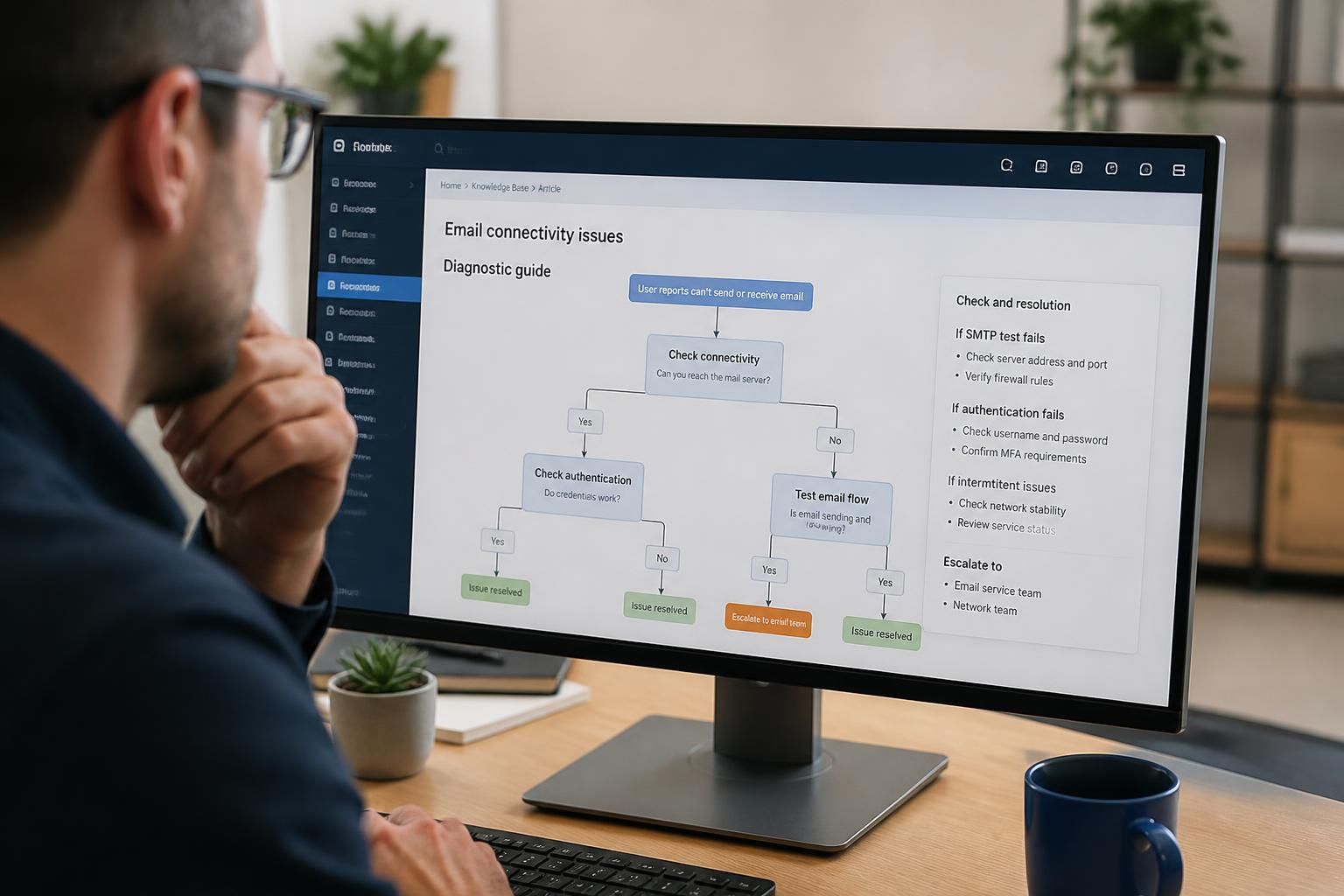
An IT service management knowledge base should contain diagnostic pathways as well as individual answers. A branching guide can help a reader move from an observed symptom to the appropriate check, solution or escalation route without applying a procedure to the wrong situation.
Useful diagnostic content explains which questions to ask first, what each answer indicates and when to stop troubleshooting. It can also specify the evidence to record, such as error wording, timestamps, affected services or recent actions. This gives support teams a consistent basis for deciding whether an issue is suitable for standard resolution, requires specialist investigation or may represent a wider incident.
Decision trees are particularly useful when similar symptoms have different causes. They should use clear conditions, avoid unnecessary technical jargon and identify points where continuing could increase risk. This makes the knowledge base more useful during diagnosis while helping staff capture information that supports later incident or problem analysis.