What should managed IT infrastructure reporting include?
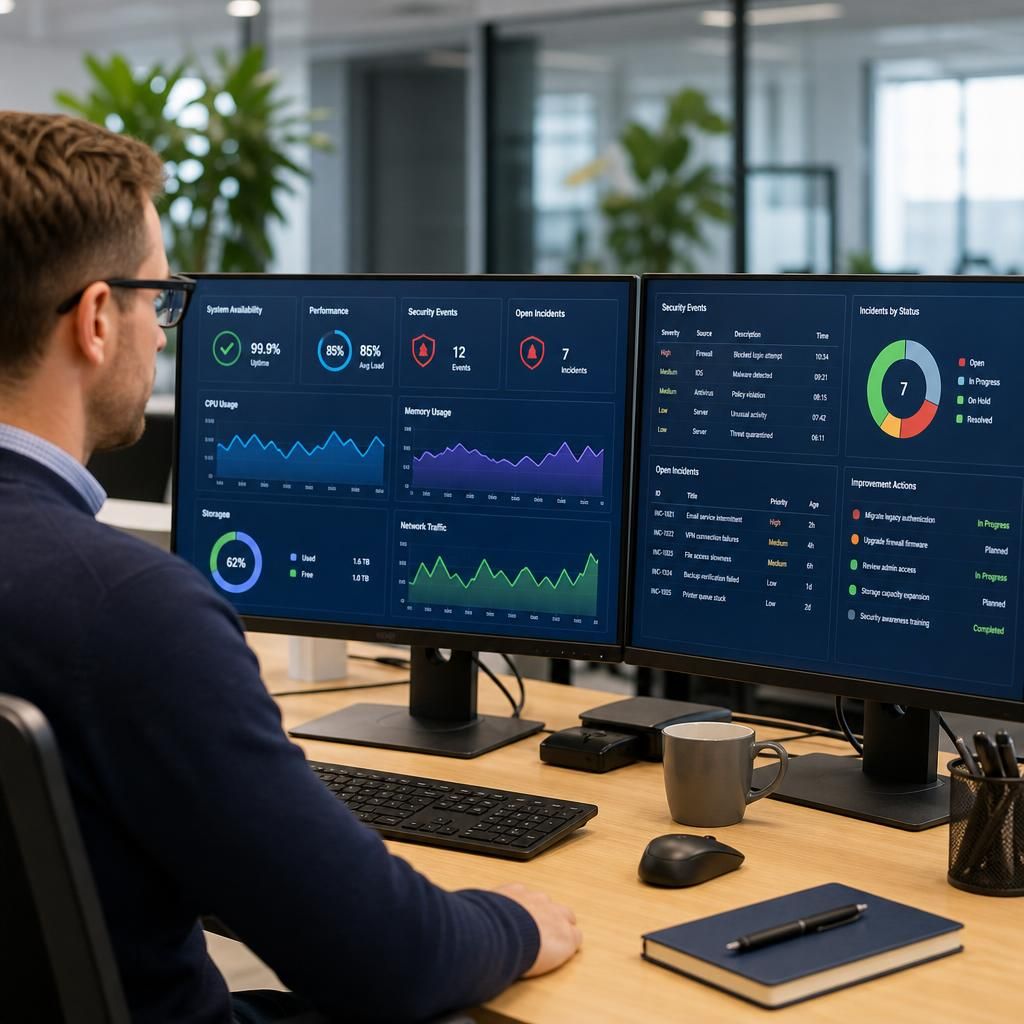
Managed IT infrastructure reporting should provide a clear view of system performance, availability, capacity, security events, incidents, changes, risks and costs. It should also record actions taken, outstanding issues and practical recommendations so decision-makers can assess current performance and plan improvements.
Managed IT infrastructure reporting should combine reliable evidence with clear interpretation, so a business can understand what its technology environment is doing, why it matters and which decisions require attention. A useful report is not simply a collection of technical metrics; it explains the reporting period, the systems covered, the significance of the findings and the actions that follow.
1. Scope and reporting context
Each report should state the period it covers and identify the infrastructure, locations, platforms or business services included. This prevents readers from assuming that a finding applies to systems outside the report’s scope. It should also record any exclusions, unavailable data or changes to the environment that could affect comparisons with earlier reports.
The report should explain the purpose of the review. For example, a monthly operational report may focus on service health and recurring faults, while a quarterly management report may focus on trends, investment priorities and technology risk. Different audiences need different levels of detail, but the underlying evidence should remain consistent.
2. Data sources and measurement method
Readers should be able to see where the information came from and how it was calculated. Relevant sources may include monitoring systems, service desk records, backup verification, security platforms, asset registers, configuration records and supplier information. Definitions are important: a “device affected”, “security alert”, “planned change” or “open issue” should have a consistent meaning from one report to the next.
Good reporting also identifies data limitations. If a system was not monitored for part of the period, an asset record is incomplete or a classification is uncertain, that limitation should be visible rather than hidden within a summary figure. This helps decision-makers judge the confidence they can place in the result.
3. Trends, baselines and exceptions
A single measurement gives limited insight. Reports should compare current results with an agreed baseline, previous reporting periods or an internal target where one exists. Trend information can show whether a recurring issue is reducing, remaining stable or becoming more significant.
Exceptions deserve particular attention. A report should distinguish routine activity from unusual conditions, repeated failures, material deviations or unresolved control weaknesses. It should explain the likely cause where this is known, the effect on business services and the reason an exception has been prioritised. This is more useful than presenting every event with equal visual weight.
4. Business impact and dependencies
Technical findings should be linked to the business services they support. A storage constraint, configuration weakness or ageing component matters differently depending on which applications, sites or operational processes depend on it. Reporting should therefore identify relevant dependencies and describe the practical effect of a problem, including affected users, locations, workflows or information.
This section can also highlight dependencies on third parties, internet connections, hosted platforms, key suppliers or shared infrastructure. Mapping these relationships helps distinguish an isolated technical fault from a condition that could affect several business functions.
5. Resource and cost context
Where infrastructure decisions require funding or changes to the technology estate, the report should provide enough context for comparison. This may include recurring and one-off expenditure, licences, support arrangements, equipment renewal needs and the operational consequences of deferring work. Costs should be tied to a defined item or proposed activity rather than presented as unexplained totals.
Financial information should be accompanied by assumptions. For example, the report may need to state whether a figure includes implementation work, third-party charges, subscription commitments or only the managed service element. Clear assumptions reduce the risk of comparing unlike options.
6. Prioritised improvement register
A report should turn observations into a controlled improvement register. Each item should have a description, business rationale, priority, owner, target review point and current status. The priority should reflect factors such as business impact, likelihood, technical complexity, dependency and regulatory significance, rather than the age of the item alone.
Completed work should remain traceable. Recording the original issue, the decision taken, the implementation date and any follow-up validation creates a useful history for future reviews. Deferred work should include the reason for deferral and the condition that would cause it to be reconsidered.
7. Governance and readability
Reports should separate management conclusions from supporting technical detail. An opening summary can identify the most important matters, while appendices can retain detailed records for technical reviewers. Tables, consistent terminology and clear status labels make the report easier to use, provided they do not conceal uncertainty or missing information.
The format should support review and accountability. It should show who prepared the report, who reviewed it, which decisions were made and when the next review is due. Sensitive technical information should be distributed only to appropriate recipients, with detailed credentials, security configurations and other confidential material kept out of general management copies.
For a small or medium-sized organisation, the most useful managed IT infrastructure report is one that connects technical evidence to business decisions without overwhelming the reader. S2 Technology Group can use reporting as part of a broader managed IT service, helping organisations around Stourbridge and neighbouring areas maintain a consistent view of their infrastructure and plan technology work on an informed basis.
Managed IT infrastructure reporting should distinguish between systems controlled directly by the business and services operated by external providers. A supplier’s status report may confirm that a platform is available, but it does not necessarily show whether users can authenticate, connect from business locations or complete the processes that depend on it.
For externally managed services, the report should include:
- the provider and service covered;
- provider-reported incidents or service interruptions;
- independent observations from the organisation’s own monitoring or service desk;
- any contractual measures or service commitments relevant to the review;
- supplier actions, outstanding queries and evidence still required.
This distinction gives decision-makers a more accurate view of service quality and helps separate an infrastructure fault from a supplier issue. It also provides a useful record when a recurring problem requires review with a cloud, connectivity or hosted-service provider.