How is remote IT support documented for audit purposes?
Remote IT support is documented through an audit trail that records the support request, authorised access, actions taken, relevant system changes and the outcome. Ticket logs and access records provide evidence of who performed the work, why it was needed and how the issue was handled.
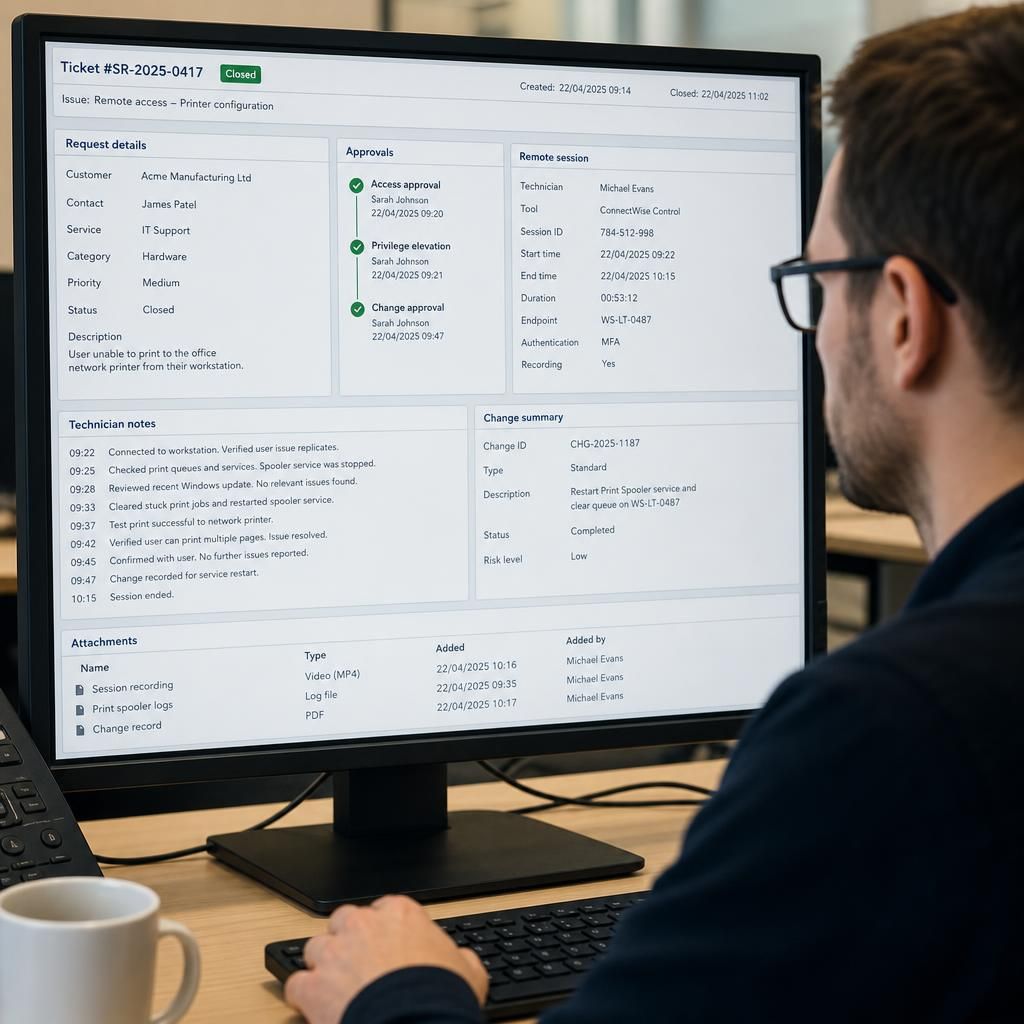
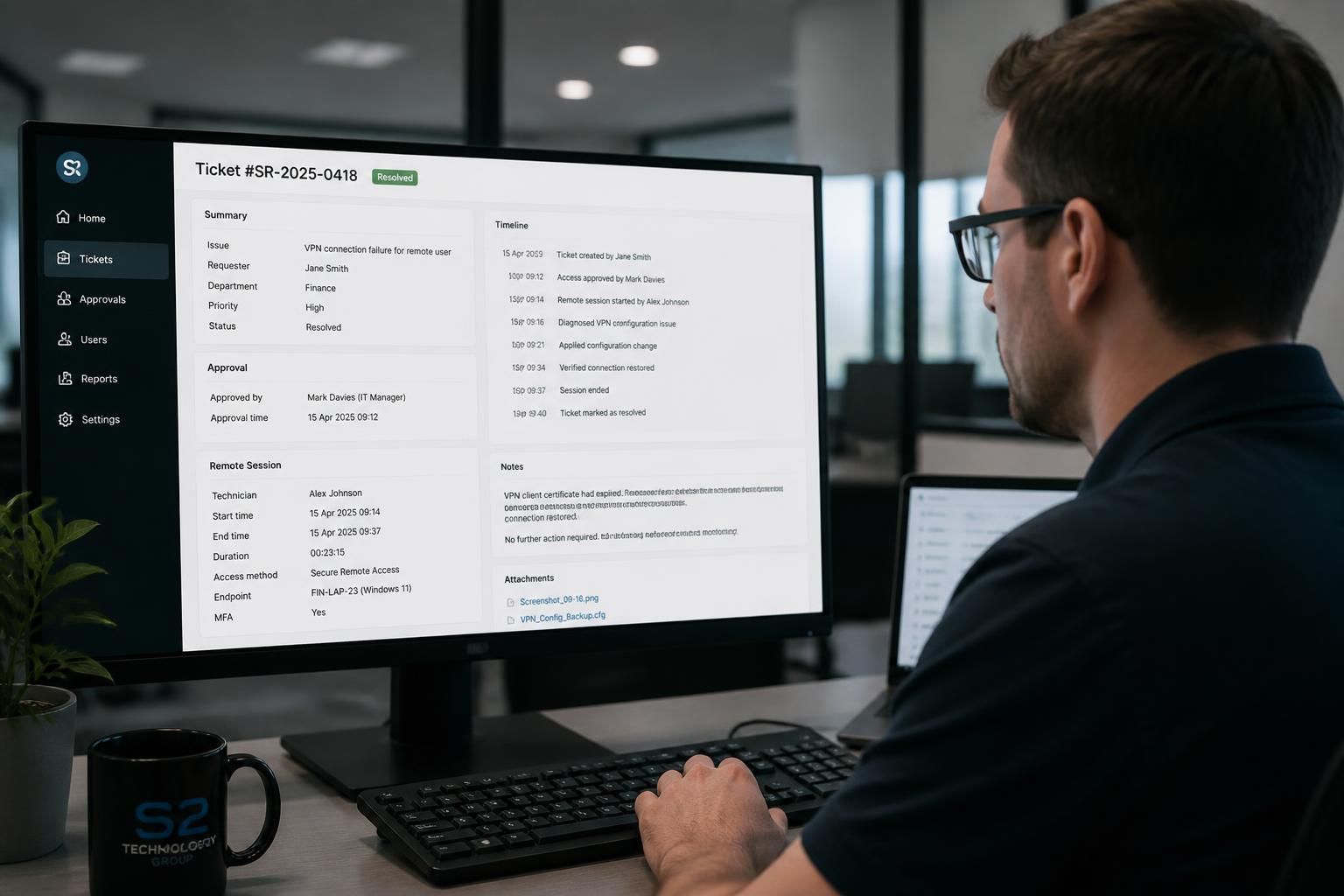
For audit purposes, remote IT support should be documented as a controlled case record that allows an independent reviewer to follow the decision-making, approvals, technical work and closure of the matter. The record should be sufficiently detailed to demonstrate that access was justified, activity was attributable to an identifiable person and changes were handled under the organisation’s IT and security procedures.
Key information in the case record
- Case reference: A unique identifier links the support request to related correspondence, change records, security events and follow-up actions.
- Business context: The record explains which service, device, user or business process was affected and why support was required.
- People involved: It identifies the person reporting the issue, the person responsible for approving access and the technician carrying out the work. Where responsibility changes during the case, that handover should also be recorded.
- Timing: Relevant events are recorded using consistent timestamps, including approval, connection, significant interventions and closure. Time synchronisation is important when records from several systems need to be compared.
Remote session evidence
A remote support platform may generate technical metadata about the connection. Depending on the tool and the organisation’s policy, this can include the endpoint involved, the technician’s account, authentication events, elevation of privileges, connection start and end times, and whether a session was interrupted. These records should be linked to the case rather than kept as unexplained standalone entries.
Screen recordings, command histories or detailed activity logs can provide additional evidence, but they should not be collected automatically without considering privacy, contractual obligations and data protection requirements. If recording is justified, the purpose, scope, retention period and authorised viewers should be defined. Sensitive information such as passwords, authentication codes and unrelated personal data should be excluded or redacted wherever possible.
Technical notes and change evidence
The technician’s notes should describe the investigation in chronological order, using enough detail for another suitably authorised person to understand what was checked and why a particular action was selected. Useful evidence may include:
- relevant error messages, alerts or diagnostic results;
- configuration values before and after an approved change;
- software, policy or permissions modified during the work;
- references to scripts, commands, files or configuration backups used;
- the reason for any deviation from the planned procedure; and
- links to a separate change, incident or security record where the activity forms part of a wider event.
Notes should distinguish between facts observed during troubleshooting and the technician’s assessment of the likely cause. This makes the record more reliable during a later review and helps prevent assumptions from being mistaken for confirmed findings.
Approval and separation of duties
Where a support action carries additional risk, the record should show the approval route used before the work began. Examples include access to sensitive systems, changes to security controls, creation of an administrator account or removal of a restriction. A reviewer should be able to see whether the person requesting support, the person authorising the action and the person performing it were appropriately separated, or why an exception was necessary.
Emergency work should be marked as such and retrospectively reviewed under the organisation’s procedure. Recording the reason for the exception and the follow-up approval is more useful than simply labelling the work urgent.
Closure and verification
Closing a record involves more than stating that the technician disconnected. The final entry should explain the condition reached, how it was checked and whether any residual risk remains. It may also record user or system-owner confirmation, outstanding recommendations, monitoring requirements and any further work that must be tracked separately.
If the issue could not be fully resolved, the record should state the current impact, the reason for stopping, the next owner and the evidence needed for continuation. This prevents an incomplete remote session from appearing to be a completed fix.
Record protection and retention
Audit documentation should be protected against unauthorised alteration while remaining available to authorised reviewers. Appropriate controls can include role-based access, restricted deletion rights, protected audit logs, version history and backups. Retention should follow the organisation’s documented policy and any applicable legal, regulatory, contractual or insurance requirements. Records should not be kept indefinitely without a defined business or compliance reason.
Access to the documentation itself should be auditable. A sensitive support record may contain system details or personal information, so permissions should be limited to people with a legitimate need to review it. Exported evidence should be handled securely and checked for confidential information before it is shared with an auditor or third party.
What an auditor should be able to establish
- what business need led to the intervention;
- who approved and performed the work;
- which systems and accounts were involved;
- whether access and changes followed the relevant procedure;
- what evidence supports the technical conclusions;
- how the result was verified; and
- whether follow-up actions, risks and retention requirements were managed.
S2 Technology Group can help a small or medium-sized organisation define a consistent remote-support record structure, align it with existing IT and security processes, and identify gaps between technician notes, access logs and change documentation. The appropriate level of detail depends on the sensitivity of the system, the organisation’s policies and the audit requirements that apply to it.
Remote IT support records are easier to audit when every case follows the same documentation standard. A structured template reduces variation between technicians and makes it simpler to find comparable evidence across different support tools, systems and business units.
The organisation should periodically review a sample of completed cases against its documentation requirements. This review can check whether required fields were completed, whether supporting evidence is attached to the correct case and whether the recorded outcome is consistent with the work performed. Repeated omissions may indicate that the template, technician guidance or support workflow needs to be revised.
A useful standard can define:
- which fields are mandatory before a case can be closed;
- which types of intervention require additional approval or evidence;
- how incidents, changes and security-related work are categorised;
- who is responsible for checking documentation quality; and
- how identified gaps are corrected and tracked.
This approach turns audit documentation into a maintained process rather than a collection of retrospective notes. It also helps an organisation demonstrate that its remote support controls are applied consistently, not only when an audit is already under way.