

What reporting should remote managed IT support provide?
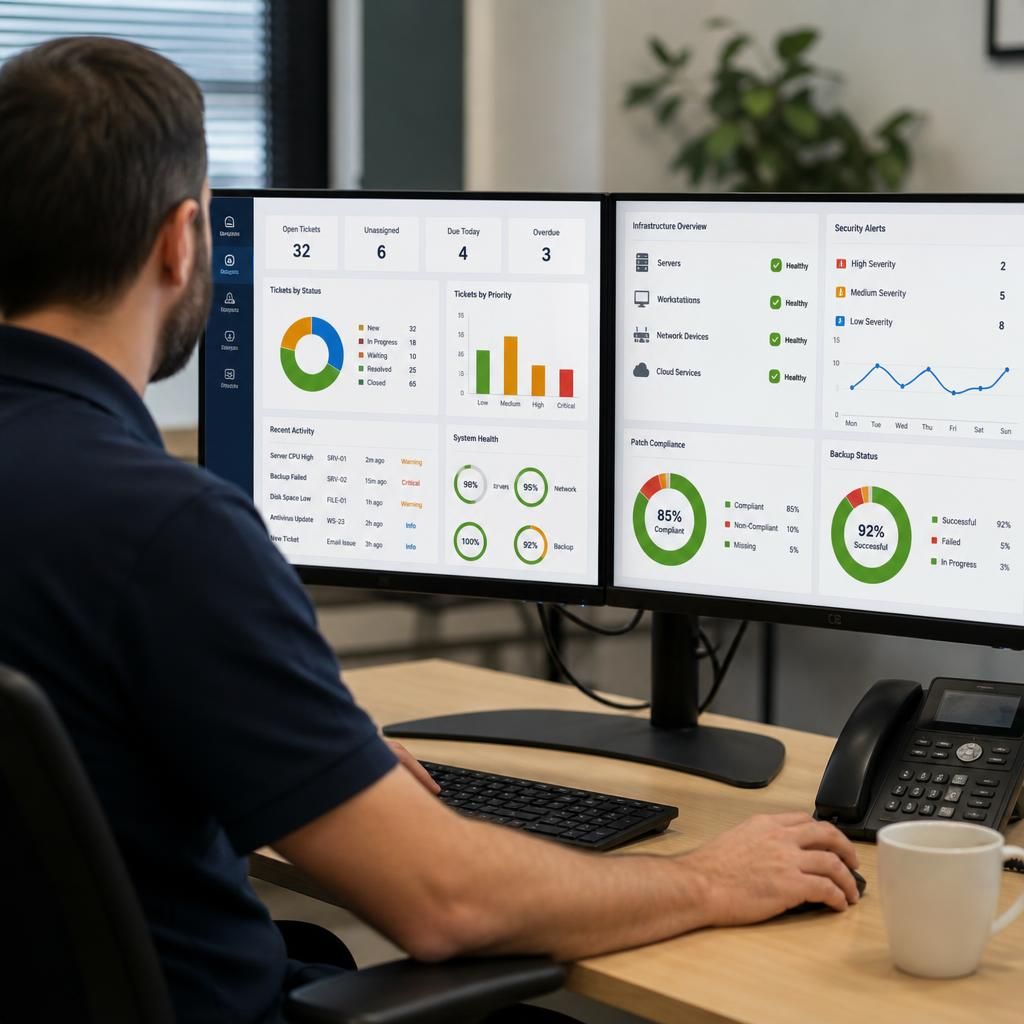
Remote managed IT support should provide clear reporting on service activity, system performance, security events, recurring issues and outstanding actions. Regular reports should turn technical data into practical insights, helping businesses assess risks, identify trends and make informed decisions about their IT environment.
Remote managed IT support should provide an understandable record of what has been monitored, what has changed, which risks require attention and what actions are recommended. Effective reporting is more than a list of tickets: it connects technical activity with business impact, helping decision-makers judge the condition of their IT environment and set priorities.
A useful report should normally cover the following areas:
- Support activity: a summary of incidents, service requests, changes and recurring categories, with their current status and the teams or systems affected.
- Infrastructure health: relevant observations about servers, endpoints, network equipment, cloud services and connectivity, including capacity concerns, failed checks or devices that require investigation.
- Security posture: notable alerts, unresolved vulnerabilities, suspicious activity, endpoint protection status and recommendations for reducing exposure. Sensitive technical details should be handled appropriately rather than circulated widely in a general management report.
- Maintenance status: confirmation of relevant patching, maintenance tasks, configuration changes and exceptions. Exceptions are particularly important because an apparently healthy overall position can conceal devices or systems that have not been updated.
- Backup and recovery observations: where backup monitoring forms part of the service, reports should distinguish between completed jobs, failed or incomplete jobs, unprotected systems and recovery tests. A successful backup job does not by itself prove that data can be restored, so recovery evidence should be shown separately.
- Open risks and actions: each outstanding item should have an explanation, an owner where appropriate, a priority and a next step. This prevents recommendations from becoming a static list that is repeatedly carried into future reports.
Reports should also show the difference between an isolated event and a developing pattern. For example, several similar user issues may indicate a training requirement, a permissions problem or a failing application rather than separate unrelated tickets. Repeated device faults may justify replacement planning, while increasing storage, bandwidth or processing demand may indicate that infrastructure needs to scale. Trend information gives the reader context that an individual support record cannot provide.
Good reporting uses measures that support decisions. Depending on the systems being managed, this may include ticket volumes by category, unresolved incidents, recurring fault types, device compliance, capacity indicators, backup exceptions, security alerts and changes made during the period. The report should explain what each measure means and why it matters. A count without context is difficult to interpret: a rise in tickets may reflect a new business system, a wider user base, improved reporting by staff or a genuine deterioration in service.
Reports should identify the scope of the information presented. This includes the devices, users, sites, cloud services and security tools covered, as well as any assets that could not be monitored. Clear scope prevents a report from being read as a statement about the entire IT estate when only part of it is connected to the managed service. It is also useful to record data limitations, such as unavailable monitoring, incomplete asset records or events that still need validation.
Different readers need different levels of detail. A business owner or senior manager may need a concise summary of material risks, business impact, decisions required and planned improvements. An internal IT contact may need incident references, affected assets, technical findings and change details. A report can serve both audiences by presenting an executive summary first, followed by supporting detail and an action register. This avoids replacing useful analysis with either excessive technical language or an overly simplified dashboard.
Security reporting requires particular care. It should make clear whether an item is an alert, a confirmed incident, a vulnerability or a recommended control improvement. It should record the investigation status and any containment or remediation action without exposing unnecessary credentials, personal data or sensitive system information. Access to reports should follow the organisation’s information governance requirements, especially where reports contain user, device or security-event details.
Reporting is most valuable when it follows an agreed structure and review process. Before support begins, the organisation and provider should agree the assets in scope, the information required, the intended readers, the meaning of key measures and the process for escalating material risks. A consistent format then makes it easier to compare periods, verify whether actions were completed and identify changes in the risk profile. The format can be refined as the organisation’s systems and priorities develop.
S2 Technology Group can use remote managed IT support reporting to give small and medium-sized organisations a clearer view of their IT environment without requiring every reader to interpret raw monitoring data. The practical test is whether each report helps the business answer three questions: what has changed, what requires attention and what decision or action should follow. If it cannot do that, it is likely recording activity rather than providing meaningful management information.
Remote managed IT support reports should also be easy to verify and use after they have been issued. Each report should show the reporting period, preparation date, systems or data sources used, and any changes to the reporting method. Definitions for terms such as “open incident”, “non-compliant device” or “failed backup” prevent different readers from drawing inconsistent conclusions.
The report should be available in a format that can be retained and reviewed alongside previous reports, rather than existing only as a live dashboard. This creates a reliable record of how the IT environment was assessed at a particular point in time and helps decision-makers check whether a reported issue has genuinely changed, remained unresolved or been closed with supporting evidence.