How does IT security consultancy test whether recommended controls will work in practice?
IT security consultancy tests recommended controls by combining configuration reviews, controlled simulations and practical exercises with checks against the organisation’s risks and operating requirements. This shows whether a control works as intended, produces usable evidence and can be maintained without creating unacceptable disruption.
IT security consultancy tests whether recommended controls will work in practice by turning each recommendation into a set of observable tests. The assessment examines the control’s configuration, its response to realistic events, the evidence it produces and the actions people must take. A control is not treated as effective simply because it has been purchased, documented or enabled.
The process normally starts by defining what the control is intended to prevent, detect or limit. For example, an access control may be intended to stop an unauthorised user reaching sensitive systems, while a backup control may be intended to support recovery after data is deleted or encrypted. The consultant records the relevant systems, user groups, information and business processes, together with assumptions and exclusions. This prevents a test from producing a technically accurate result that does not relate to the organisation’s actual exposure.
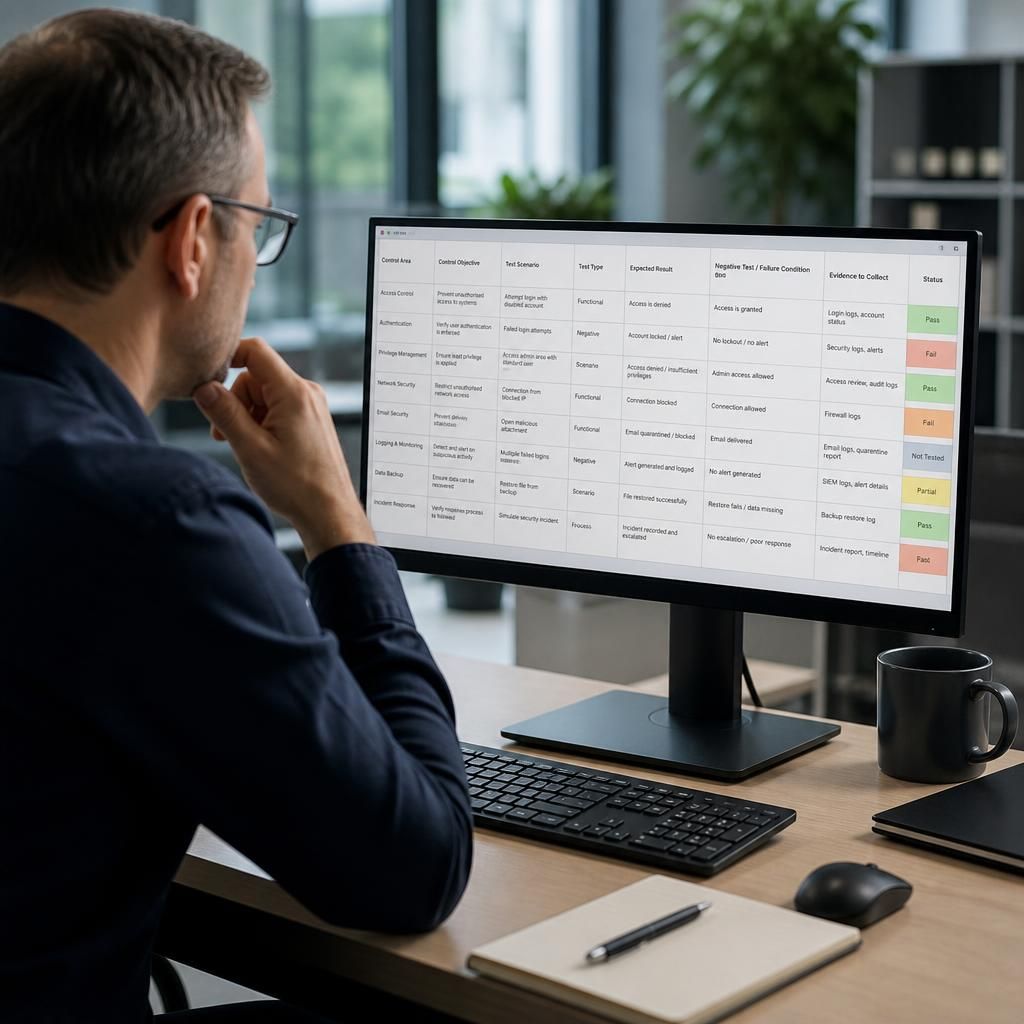
Each recommendation is then expressed as a testable outcome. This might include confirming that access is refused when an account does not meet the required conditions, that an alert is created when suspicious activity occurs, or that a recovery process restores usable data to an appropriate environment. The test should identify what is being checked, how it will be carried out, what result is expected and what evidence will demonstrate the result.
- Configuration checks: reviewing policies, permissions, device settings, network rules, retention settings and administrative controls against the intended design.
- Functional tests: carrying out controlled actions to establish whether the control behaves as expected, such as testing account changes, alert generation or access restrictions.
- Scenario-based tests: examining how several controls work together during an event, rather than assessing each control in isolation.
- Process tests: checking whether staff know what to do, who makes decisions, how incidents are escalated and how actions are recorded.
- Recovery tests: verifying that recovery instructions, technical dependencies and available data support the required business process.
Technical testing should be controlled so that it does not create an avoidable outage, alter production data or trigger an unnecessary incident response. The consultant agrees the scope, test accounts, systems, timing constraints and stop conditions before testing begins. Where a live test would be inappropriate, a representative non-production system, sample data or a tabletop exercise may provide safer evidence. The method should still be close enough to normal operating conditions to expose practical weaknesses.
People and procedures are tested alongside technology. A security control can fail because an alert reaches the wrong person, an approval route is unclear, an exception is not reviewed or an instruction depends on knowledge held by one employee. Exercises can therefore examine whether the relevant team recognises an event, follows the documented process, preserves useful information and makes the required decisions. This often reveals gaps that a configuration review cannot identify.
Consultants also examine the quality of the evidence produced by each control. Useful evidence may include audit records, alert details, access reports, change records, recovery logs or exercise notes. The review considers whether records are complete, time-ordered, protected from inappropriate alteration and available to the people responsible for investigation or compliance. If a control operates but leaves no reliable evidence, its effectiveness may be difficult to demonstrate when an incident occurs.
Results are assessed against agreed acceptance criteria rather than a simple pass-or-fail label. A control may be fully effective, partly effective, ineffective in a particular scenario or unable to be tested because a dependency is missing. The report should explain the observed condition, the associated risk, the affected systems or processes and the reason for the conclusion. It should distinguish a design weakness from an implementation error, a user-process issue or a limitation in the test itself.
Where testing identifies a weakness, the recommendation is refined into a practical remediation plan. This may involve changing a policy, correcting permissions, improving monitoring, revising an operating procedure, providing targeted training or addressing a dependency in another system. Remediation should be assigned to an owner and prioritised according to risk and operational importance. The consultant can then repeat the relevant test to establish whether the change addressed the original finding without introducing a different weakness.
Testing is also revisited when there are significant changes to systems, suppliers, working practices or regulatory obligations. A control that worked against one technical design may not behave the same way after an application migration, new remote-access arrangement or change in administrative responsibility. For that reason, effective IT security consultancy treats practical testing as part of an ongoing assurance cycle, not as a one-off approval of a written security recommendation.
A useful control test checks failure conditions as well as the expected result. This is often called negative testing: instead of only confirming that an authorised user can access a system, the consultant examines what happens when an account is disabled, a permission is removed, an authentication step fails or an exception is incorrectly applied.
The review looks for unsafe behaviour such as access being granted by default, alerts being suppressed after repeated events, or a protective process stopping without a clear warning. It can also examine boundary conditions, including expired accounts, incomplete device information and interrupted connections. These tests help distinguish a control that works in a straightforward case from one that remains dependable when normal assumptions no longer apply.
Findings from negative testing should record the condition used, the observed behaviour and the business consequence. This gives decision-makers a clearer basis for correcting weaknesses and deciding whether a control is suitable for the systems and processes it is intended to protect.