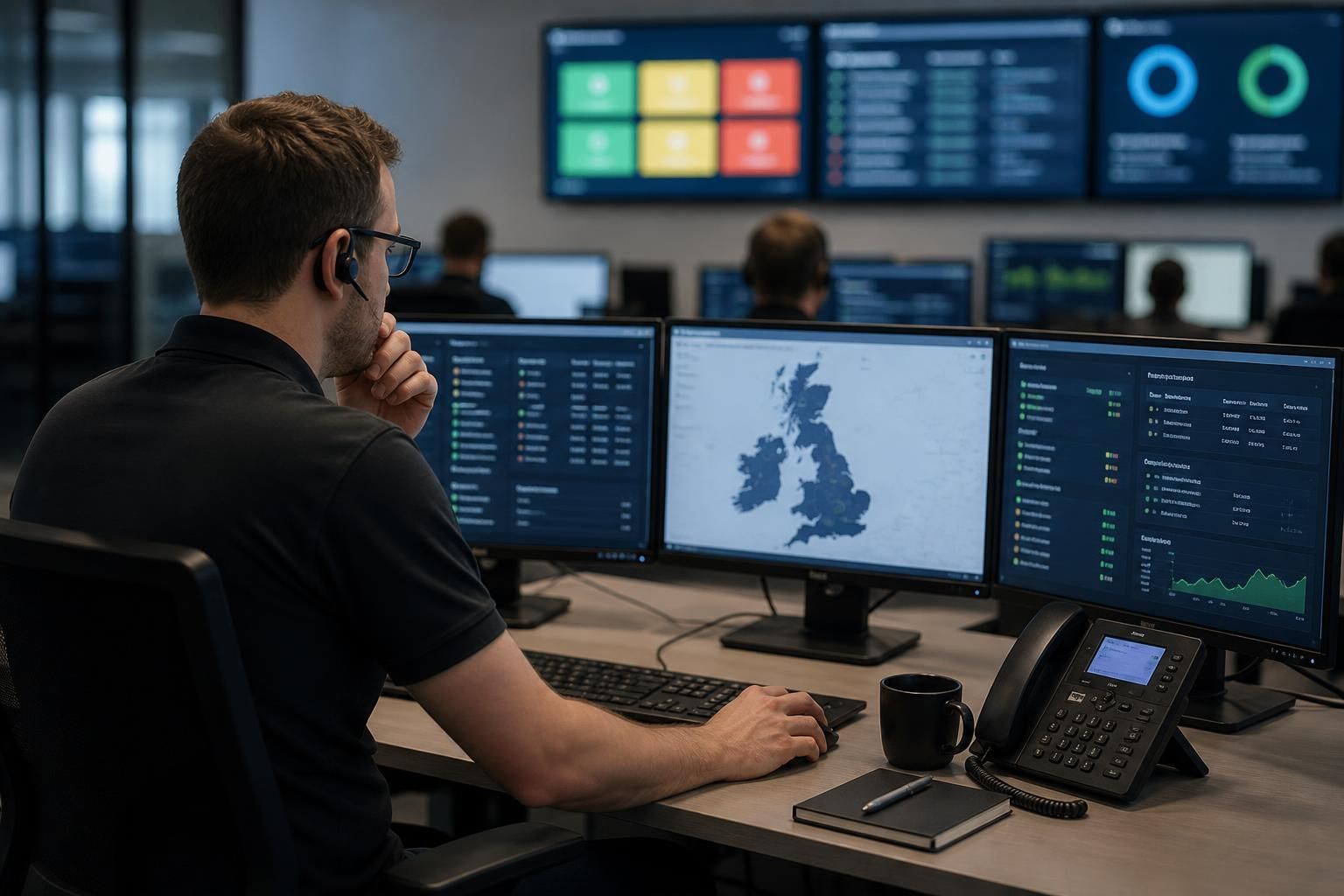
How is emergency IT support coordinated across multiple business sites?
Emergency IT support across multiple business sites is coordinated through a central incident lead who assesses the overall business impact, assigns actions to the appropriate technical specialists and keeps each site’s authorised contact informed. The process typically combines consistent triage, secure remote access where suitable, site-specific troubleshooting and a shared record of actions so that separate responses do not conflict.
Coordinating emergency IT support across multiple business sites requires a single operational plan that separates organisation-wide risks from local faults. The response should establish which systems affect every location, which sites are unable to operate, what dependencies exist between them and which actions can be taken safely in parallel. This prevents each site from pursuing a different fix while the underlying incident continues to spread.
Establish the scope and business impact. The first coordination task is to create a current view of the incident. This normally records:
- Which sites, users and services are affected
- Whether the issue is limited to one location or is visible across shared systems
- Which business functions have stopped, degraded or moved to a manual process
- Whether the affected service depends on a central server, cloud platform, network connection, identity system or security control
- Any signs that the incident involves unauthorised access, malware or data exposure
This distinction matters because a failed local switch, for example, should not be handled in the same way as a fault affecting shared authentication or a common file service. Site-level symptoms can be caused by a central dependency, so technicians should compare evidence from more than one location before making changes.
Use a common incident record. Every action, observation and decision should be recorded in one controlled incident record rather than in separate email threads or informal messages. The record should include the time of each update, the person who supplied it, the system or site involved, the action taken and the result. It should also identify open questions and actions that must not be repeated.
A shared record gives technical staff a reliable operating picture and provides an audit trail if systems need to be restored, credentials changed or security evidence preserved. It is particularly important when several specialists are working on different parts of the same environment.
Separate workstreams by dependency. Multi-site incidents are easier to control when work is divided into related workstreams, such as:
- Connectivity between sites and access to shared services
- Servers, storage and virtual infrastructure
- Identity, authentication and privileged accounts
- Endpoint devices and local network equipment
- Cloud applications and external service dependencies
- Security containment, evidence preservation and recovery
These workstreams should have clear boundaries. For instance, rebuilding a device may be inappropriate while an account compromise is still being investigated, and restarting a shared server may destroy useful evidence or interrupt another site that is still operating. Changes therefore need to be checked against the wider incident plan before they are carried out.
Prioritise actions by business consequence. The first site to report a fault is not necessarily the first site to receive technical attention. Priority is usually determined by factors such as the number of users affected, the importance of the business process, the availability of a safe workaround, the risk of data loss and whether the fault could affect additional locations.
A site supporting a critical operational process may take precedence over an office with a narrower issue. Equally, a seemingly small security indicator may require immediate investigation if it could represent a wider compromise. This approach balances service restoration with containment and avoids using all available effort on the most visible symptom.
Coordinate communications through named contacts. Each site should have an authorised contact who can confirm local conditions, support basic checks and communicate agreed instructions to staff. Technical teams should avoid issuing conflicting directions to different locations. Updates should state what is known, what is being investigated, which actions are approved and what information is still required.
Communication should be proportionate to the incident. Operational staff need practical instructions, while decision-makers may need information about business impact, risk, dependencies and recovery choices. Sensitive technical details, credentials and security evidence should be shared only through approved channels.
Use secure and controlled access. Remote investigation can reduce the need for travel between sites, but access must be limited to the systems and accounts required for the task. Technicians should verify the target environment before making changes, use appropriate privileged access controls and record significant administrative actions. Where remote access is unavailable or unsafe, the plan should identify what a local contact can check without compromising systems or evidence.
Local assistance may include checking power and cabling, identifying equipment indicators, confirming whether a device is connected, isolating a suspected endpoint or providing physical access to infrastructure. These instructions should be specific and reversible. Staff should not be asked to delete files, rebuild devices or reset security settings unless the action has been assessed and authorised.
Sequence restoration carefully. Restoring several sites at once can create further problems if shared dependencies are unavailable or if a fault has not been contained. A controlled sequence may involve stabilising the core service, testing connectivity, restoring a limited set of systems, validating access and then extending restoration to other locations. The correct order depends on the architecture and the incident type.
Each stage should have a defined check before the next stage begins. Validation may include confirming user authentication, application access, data integrity, printing or telephony where relevant, and communication between sites. A service that appears available but produces incomplete data or intermittent access should not be treated as fully restored.
Handle security incidents differently from ordinary faults. If there are indications of ransomware, compromised credentials or unauthorised access, the priority may be to isolate systems and preserve evidence rather than restore connectivity immediately. Actions such as disabling accounts, restricting network routes or disconnecting devices should be coordinated so that they contain the threat without unnecessarily disrupting unaffected locations.
Recovery should follow an agreed decision process, with attention to clean backups, known-good systems, credential security and the possibility that restoring an infected environment could reintroduce the problem. The incident record should distinguish between confirmed facts, working assumptions and actions taken to reduce risk.
Confirm closure across every affected site. An incident should not be closed merely because the original reporting site can work again. Closure checks should confirm that all affected locations have tested the relevant services, that temporary workarounds are recorded, that monitoring or follow-up tasks are assigned and that users know about any remaining restrictions.
Afterwards, the organisation should review the timeline, dependencies, communication routes and technical controls. This can identify improvements such as clearer site inventories, tested recovery procedures, alternative connectivity, documented local contacts or stronger separation between sites. The result is a more usable response plan for future multi-site incidents, rather than a record that only describes what happened.
A reliable multi-site emergency response depends on accurate information about each location before an incident occurs. A central support team should be able to identify each site’s network equipment, connectivity, critical systems, physical access arrangements and local constraints without relying on assumptions during a disruption.
A useful site profile should record:
- Which services and users depend on the site
- How the location connects to shared systems and other offices
- Where key infrastructure is situated and who can provide physical access
- Any site-specific dependencies, such as manufacturing equipment, telephony or specialist applications
- Approved local contacts and documented fallback procedures
These profiles give the incident lead a consistent basis for comparing locations and deciding whether a problem is isolated or part of a wider failure. They also reduce unnecessary investigation, help technical staff direct precise checks to the relevant site and make it easier to coordinate external suppliers or local personnel when physical intervention is required.