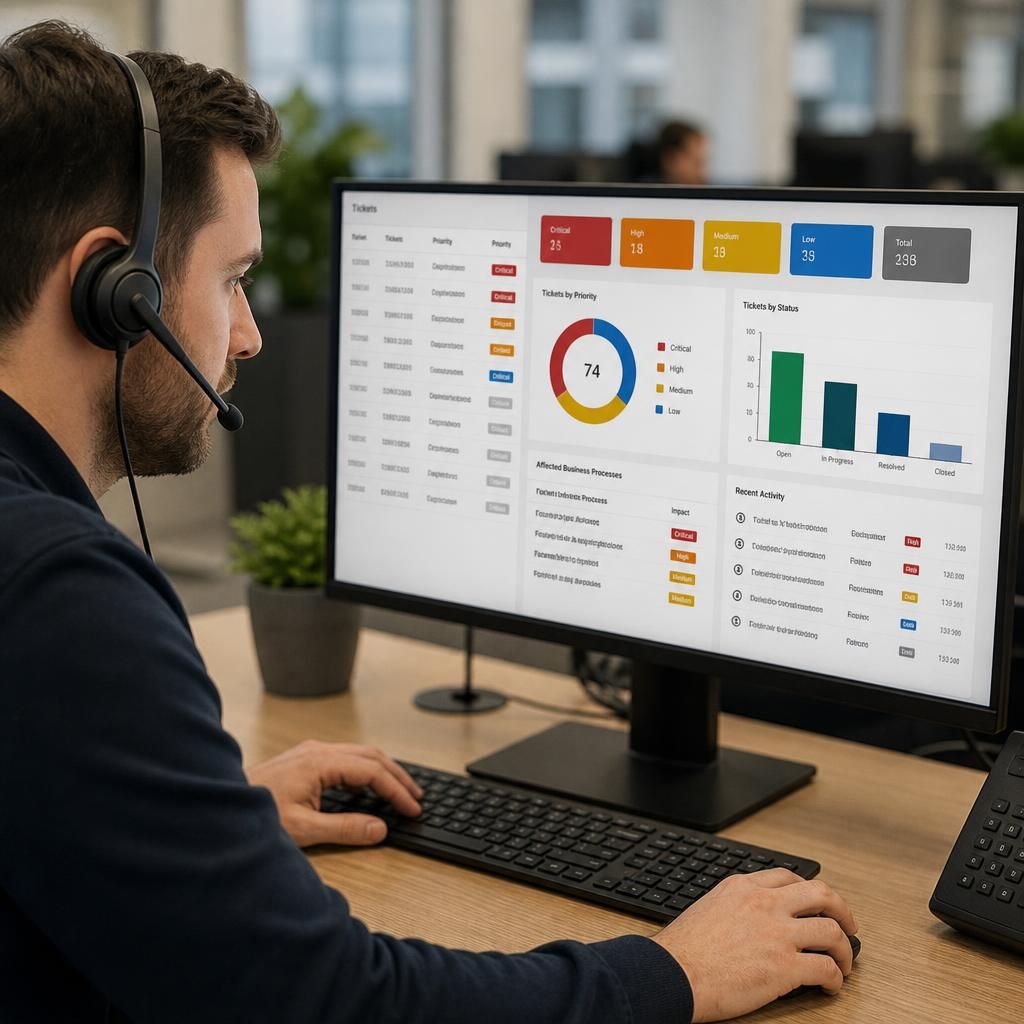
How should an IT service desk prioritise tickets by business impact?
An IT service desk should prioritise tickets according to the scale of business disruption, the number of people or processes affected, security risk and the urgency of recovery. Critical incidents affecting essential operations or exposing serious risks take precedence over isolated user issues, while agreed service levels and available workarounds help determine the order of less severe tickets.
Business-impact ticket prioritisation is a structured method for ranking IT service desk work according to the operational consequences of each issue. Rather than treating tickets in the order they arrive, the service desk assesses what the issue prevents the organisation from doing, how widely it affects operations, what risks it creates and whether an acceptable alternative is available.
Start with a consistent impact model. A useful model separates impact from urgency. Impact describes the scale of the business effect; urgency describes how soon action is needed to prevent that effect from worsening. Keeping these concepts separate avoids giving every demanding request the same priority and makes decisions easier to explain.
- Business process: identify the activity affected, such as order processing, payroll, production, customer service or financial reporting.
- Scope: record whether the issue affects one person, a team, a site, several sites, a customer-facing service or the organisation as a whole.
- Operational dependency: establish whether other processes, systems or teams are blocked as a result.
- Risk: consider possible data loss, unauthorised access, regulatory exposure, safety implications or damage to the organisation’s ability to trade.
- Workaround: determine whether users can continue the relevant activity through a reliable and practical alternative.
- Time sensitivity: assess whether a deadline, scheduled event, trading period or operational dependency makes delay particularly consequential.
These factors can be combined into a small number of priority levels. The exact labels may vary, but each level should have a clear definition and examples. A top-level priority might cover a widespread outage, a serious cyber security concern or the loss of a business-critical function with no viable alternative. A middle level could cover a significant team or process affected by a degraded service, while a lower level could cover an individual issue with an effective workaround or a request that does not interrupt current operations.
Define priority using business language. “The application is down” is a technical description, not an impact assessment. The ticket should establish what the application supports, which activities have stopped, how many users are affected and whether work can continue elsewhere. For example, inability to access a system used for time-sensitive customer transactions generally warrants more attention than a problem affecting a non-essential reporting feature, even if both are technically described as application faults.
Use decision questions at intake. A service desk can improve consistency by asking the same short set of questions for every potentially significant ticket:
- What business activity cannot be completed?
- Who is affected, and which locations or teams are involved?
- Is the service completely unavailable, impaired or merely inconvenient?
- Is there a safe workaround, and can affected users apply it?
- Could the issue involve a security incident, data exposure or loss of data integrity?
- Is there a deadline or dependency that changes the consequence of delay?
- What evidence supports the stated scope, such as affected users, devices, sites or transactions?
The person logging a ticket may describe urgency from an individual perspective, so the service desk should validate the wider effect rather than accepting urgency as the priority automatically. A senior requester, a frustrated user or a frequently recurring problem should not receive preferential treatment unless the underlying business impact supports it.
Separate incidents from service requests. An incident represents an unplanned interruption or reduction in service and normally requires restoration of an existing capability. A service request, such as access approval, equipment setup or a standard change, should be prioritised according to its business deadline and dependency rather than being placed ahead of an active incident without a clear reason. This distinction prevents routine requests from obscuring operational disruption.
Apply security considerations carefully. A suspected compromised account, malicious activity, exposed information or uncontrolled access should be assessed by potential harm as well as by the number of users affected. A security-related ticket affecting one account may therefore warrant greater priority than a broader but low-risk usability issue. The service desk should record the indicators that led to the classification and follow the organisation’s incident response and escalation procedures where appropriate.
Reassess priority as facts change. Initial information is often incomplete. A single-user fault may become a wider service incident when similar reports arrive, while an apparently major problem may be reduced when a stable workaround is confirmed. Priority should be reviewed when the affected scope changes, a workaround fails, a security risk emerges, a deadline approaches or technical investigation reveals a different root cause. Every change should be recorded with the reason, decision-maker and relevant evidence.
Prioritisation should not mean that lower-priority tickets are ignored. The service desk should assign ownership, communicate the current classification and review work that is waiting. If several tickets have comparable impact, useful tie-breakers include the risk of further harm, the number of dependent activities, the effort required to restore service and the age of the ticket. These tie-breakers should support the impact model, not replace it.
Connect priority to service levels without confusing the two. Priority describes the relative importance of the ticket; a service level defines the agreed handling target associated with that priority. Organisations should document what each level means, who can change it and what happens when information is missing. Targets should distinguish acknowledgement, investigation, updates and restoration or fulfilment where those measures are relevant. This creates a clearer operational record than using one undifferentiated deadline.
Useful ticket records include the affected business process, impact level, urgency, scope, workaround, security indicators, service-level category, escalation owner and review history. Reporting can then examine whether tickets were classified consistently, whether priority changed during investigation and whether high-impact incidents were identified early. If the same type of issue is repeatedly misclassified, the service desk should improve its category definitions, intake questions or staff guidance rather than simply telling analysts to work faster.
A sound approach is therefore repeatable, evidence-based and reviewable. It gives immediate attention to the issues with the greatest operational or security consequences, while retaining a fair process for routine faults and requests. Regular calibration between the service desk, business process owners and technical teams helps ensure that the definitions reflect how the organisation actually operates.
Business-impact prioritisation is more reliable when the service desk has a documented view of which technology services support each business function. A service map can link systems, infrastructure, suppliers, locations and user groups to activities such as production, order fulfilment, payroll or customer service.
Before incidents occur, business owners should identify which services are essential, what dependencies they have and what level of disruption they can tolerate. When a ticket is logged, the analyst can compare the reported fault with this information instead of relying solely on the requester’s description. This also helps identify indirect effects, such as a network problem that appears limited to one site but prevents several dependent systems from operating.
Service maps should be reviewed when processes, applications or locations change. Keeping them accurate gives the service desk a stronger evidence base for assigning priority and helps technical teams understand which restoration activities will protect the most important business operations.