
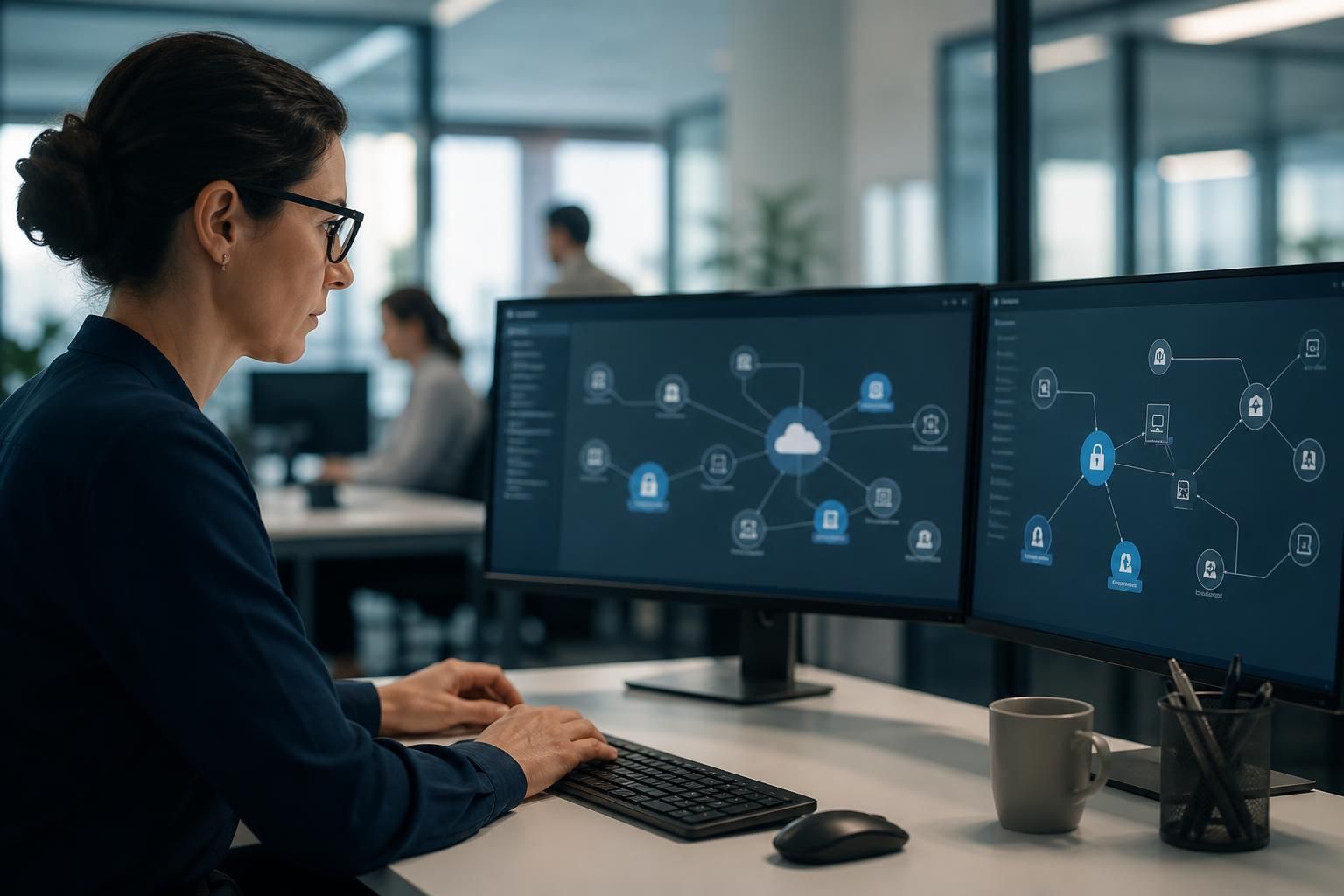
How Does an SME Cyber Security Provider Manage Supply Chain Risk?
An SME cyber security provider manages supply chain risk by identifying critical suppliers, assessing their security controls, limiting third-party access and setting clear requirements for reporting and responding to incidents. It also reviews supplier relationships regularly, monitors for changes in risk and helps the business maintain secure alternatives or continuity plans if a provider is compromised.
Supply chain risk management is a structured process for understanding how external organisations, software, platforms and service providers affect an SME’s confidentiality, integrity and availability. An SME cyber security provider helps turn this complex ecosystem into a prioritised set of dependencies, evidence, safeguards and actions that can be governed throughout each supplier relationship.
Start with dependency mapping
The first step is to map how the business relies on third parties, rather than looking only at companies that have direct access to the network. The review should include:
- Hosted applications and cloud platforms used to store or process business information
- Outsourced IT, payroll, finance, marketing and customer-support services
- Connectivity, hosting, backup and software providers
- Manufacturing, logistics or facilities partners whose systems affect physical operations
- Subcontractors and other fourth parties used by a primary supplier
- Software libraries, integrations and automated data exchanges embedded in business systems
This mapping should record what each dependency does, which business process it supports, what information passes through it and what would happen if it became unavailable or untrustworthy. It can reveal indirect exposure that a basic supplier list misses, such as a payroll provider relying on another hosting company or a business application connecting to several external services.
Classify suppliers by business impact
Not every supplier needs the same level of scrutiny. A provider can help the SME apply consistent categories based on the sensitivity of the information involved, the importance of the service, the extent of technical integration and the difficulty of finding a replacement. A supplier handling personal or commercially confidential information will generally require more detailed evidence than one providing a low-risk consumable service.
Classification should also consider concentration risk. If several important processes depend on the same cloud platform, connectivity provider or software ecosystem, a single failure may affect more than one area of the business. Recording these shared dependencies allows management to distinguish between individual supplier risk and wider structural exposure.
Use proportionate due diligence
Due diligence should be matched to the supplier’s classification. It may include a security questionnaire, review of relevant policies, examination of independent assurance reports, confirmation of how data is protected and an explanation of how vulnerabilities are handled. For higher-risk relationships, the business may need more direct evidence, such as details of security testing, resilience arrangements, staff access controls and subcontractor oversight.
Questionnaires alone are not proof that controls work in practice. A cyber security provider can help assess whether the evidence is current, relevant to the service being purchased and supported by a suitable governance process. Where evidence is incomplete, the risk should be recorded with an owner and a clear decision about whether to reduce, accept or avoid it.
Build security into procurement and contracts
Security should be considered before a supplier is selected, not added after technical integration has taken place. Procurement teams should define the information the supplier will handle, the systems it must connect to, the minimum security expectations and the evidence required during the relationship.
Contracts should address practical matters such as:
- Ownership and permitted use of business data
- Data location, retention and secure deletion
- Use of subcontractors and responsibility for their activities
- Security obligations for systems, personnel and stored information
- Co-operation with investigations, audits and regulatory obligations
- Requirements for returning information and assisting with an orderly exit
These provisions should be reviewed alongside the service’s technical design. A contract cannot compensate for an integration that exposes unnecessary data or creates an unmanaged administrative account.
Control the technical relationship
Third-party connections should be designed so that a supplier receives only the information and system functionality necessary for its defined task. Separate integration accounts, strong authentication, protected application interfaces and clear ownership of credentials reduce the consequences of misuse or compromise.
Where possible, sensitive systems should be separated from general business services so that a weakness in one connection does not provide a direct route to unrelated resources. Logs should identify activity performed by external accounts, and those records should be available for investigation. Access and integrations that are no longer required should be removed as part of a defined offboarding process.
Consider fourth-party and software risk
A supplier may depend on other organisations that the SME has not selected or dealt with directly. This fourth-party risk is particularly relevant for hosted services, software development, payment processing and managed platforms. The review should establish which dependencies are material, how they are governed and whether the primary supplier can provide meaningful information about them.
Software supply chain risk also requires attention to updates, open-source components, code repositories and build processes. Businesses should understand how updates are authenticated, who can publish them and how vulnerabilities in underlying components are identified and corrected. Keeping an accurate inventory of applications and versions makes it easier to investigate a suspect update or remove an affected component.
Monitor changes throughout the relationship
Supply chain risk changes when a supplier is acquired, alters its hosting arrangements, introduces a new subcontractor, changes its software or experiences a security incident. The SME should define events that trigger a reassessment rather than relying only on an annual calendar review.
Useful management information can include overdue evidence, unresolved security findings, changes to critical dependencies, expired contracts and suppliers that no longer meet their agreed requirements. The purpose is not to generate paperwork; it is to identify decisions that need management attention and ensure that risk owners understand the current position.
Prepare for disruption and supplier failure
Resilience planning should cover more than keeping a list of alternative suppliers. It should identify the business processes affected, the information required to resume them, the people responsible for decisions and the practical steps for switching services or operating manually. Where a supplier stores essential data, the SME should understand how that data can be retrieved in a usable format.
Exit arrangements should be considered during procurement and tested where the dependency is significant. This can expose problems such as undocumented integrations, inaccessible administrative accounts, proprietary data formats or a lack of internal knowledge. A cyber security provider can help document these dependencies and align supplier governance with the organisation’s wider risk management and incident response arrangements.
For an SME, effective supply chain security does not mean applying the same process to every vendor. It means understanding which relationships could materially affect the business, applying evidence-based scrutiny to those relationships and maintaining enough technical, contractual and operational control to make informed decisions when circumstances change.

Shared responsibility is a key consideration when managing cloud and hosted-service supply chain risk. The supplier may secure the underlying infrastructure, but the SME usually remains responsible for areas such as user permissions, configuration, data protection and the safe use of connected applications.
An SME cyber security provider can help document this division of responsibility for each important service. The review should identify:
- Which organisation manages the platform, operating environment and physical infrastructure
- Who configures access controls, authentication and administrative permissions
- Who protects, retains and securely deletes the business’s information
- Which party monitors activity and investigates suspected misuse
- What the SME must do to maintain secure settings and supported integrations
This prevents the business from assuming that a supplier’s security statement covers every risk. Responsibilities should be recorded alongside the service’s configuration and reviewed when features, users, integrations or contractual arrangements change. Clear ownership makes it easier to identify gaps and ensures that important controls are not left unmanaged between the SME and its supplier.