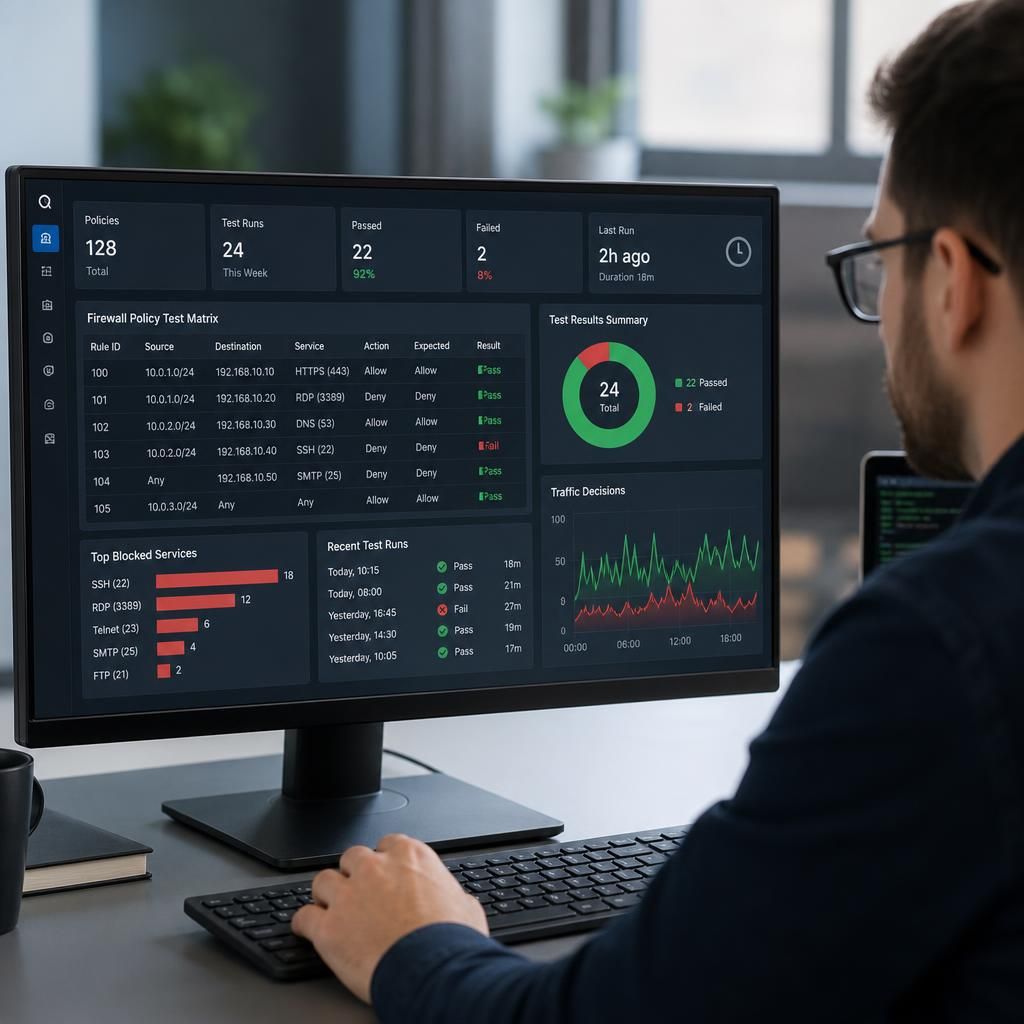
How should firewall rules be tested before affecting live business traffic?
Firewall rules should be tested in a controlled environment or staged deployment before they are applied to live business traffic. Validate that permitted services work, unauthorised connections are blocked, logging records the expected events, and a documented rollback plan is ready before implementation.
Firewall rule testing is a structured verification process that confirms a proposed policy behaves as intended across normal, exceptional and malicious traffic conditions before the policy is enabled for business use. It should examine not only whether an individual rule is correct, but also how it interacts with rule order, address translation, identity controls, VPNs, network segmentation and the firewall’s default behaviour.
Start with a precise test specification. Each proposed rule should have a defined source, destination, service, protocol, direction, user or device condition where relevant, intended action and business justification. Record the expected result for both matching and non-matching traffic. This makes it possible to distinguish a faulty rule from an incorrect assumption about how an application communicates.
The specification should also identify dependencies. An application described as using HTTPS may require DNS, certificate validation, authentication services, software updates, APIs or database connections as well. Testing only the visible application port can therefore produce a false result: the initial connection may work while an essential supporting function fails.
Check policy logic before generating traffic. Review rules from top to bottom, because many firewalls apply the first matching rule rather than evaluating every applicable entry. Look for:
- Rules hidden by a broader rule placed above them.
- Overlapping address groups or service definitions.
- Unnecessary “any” sources, destinations or services.
- Conflicting rules between IPv4 and IPv6 policies.
- Unexpected effects from NAT, proxying or application control.
- Rules that permit access in one direction but unintentionally allow return traffic or related sessions.
- Administrative access exposed through an interface or network where it is not required.
Where the firewall supports it, use policy analysis or rule simulation to determine which entry would handle each test flow. This is particularly important when a new exception is being added to an established policy, as the apparent change may have no effect if an earlier rule already governs the same traffic.
Build a test matrix rather than relying on one successful connection. Include an approved connection, a similar connection that should be refused, an unauthorised source attempting the approved service, and traffic using the wrong port or protocol. Test both sides of a boundary where access is being restricted, such as a user network and a server network. For remote access, include permitted and unpermitted user groups, managed and unmanaged devices, and access to resources that should remain unavailable.
Application testing should cover the actions users actually perform. For example, a business system may need tests for signing in, reading data, saving changes, uploading files, sending notifications and connecting to an external service. A web page loading successfully does not prove that every required function is available. Record the test account, device type, network location and application version so that results can be repeated.
Use representative traffic where possible. Synthetic connection tests are useful for checking ports and routes, but they do not always reproduce real application behaviour. Packet captures, flow records or traffic mirroring can help compare the proposed policy with genuine connection patterns without permitting those flows through the new rule. Take care to protect credentials, personal data and commercially sensitive content when using captures.
Test failure conditions as deliberately as success conditions. Examine what happens when a name cannot be resolved, a service is unavailable, a session expires, a certificate is invalid, a device changes network, or a connection is interrupted. Confirm that the firewall fails in the intended direction and does not create a broad alternative path. Particular attention is needed for fail-open behaviour, automatic policy changes and temporary access exceptions.
Include performance and capacity checks for significant policy changes. A rule can be logically correct while creating an operational problem if it activates resource-intensive inspection, decryption, authentication or content filtering for a large traffic class. Assess CPU, memory, connection-table use and interface throughput during representative activity. Check that legitimate traffic is not being delayed or reset when multiple users perform the same operation.
Document the evidence for each test, including the test case, date, initiating system, destination, expected result, observed result and any relevant firewall decision or application response. Mark each case as passed, failed or requiring investigation. A failed test should lead to a policy correction or a documented explanation; it should not be treated as acceptable merely because another connection succeeded.
Finally, have someone who did not create the rule review the test plan and results. Independent review often identifies overly broad objects, missing denial cases or business dependencies that the original author overlooked. Once the rule is in use, compare its actual matches with the approved test assumptions and remove temporary test objects or exceptions that are no longer needed. This keeps testing from becoming a permanent source of unnecessary access.
A pre-production firewall test environment is a separate, controlled copy of the relevant network design used to validate policy behaviour without exposing live business systems. It should reflect the production topology closely enough to reproduce routing, network segments, address translation, VPN paths and identity controls, while remaining isolated from genuine users and sensitive data.
Use representative but sanitised devices, accounts and application data to confirm that the proposed rule works across the intended connection paths. Keep the test policy and configuration versioned so that the exact conditions behind each result can be identified. Comparing the test environment’s traffic decisions with an approved baseline can reveal unintended access or blocked dependencies before the change reaches production.