
How should managed IT pricing change as your organisation grows?
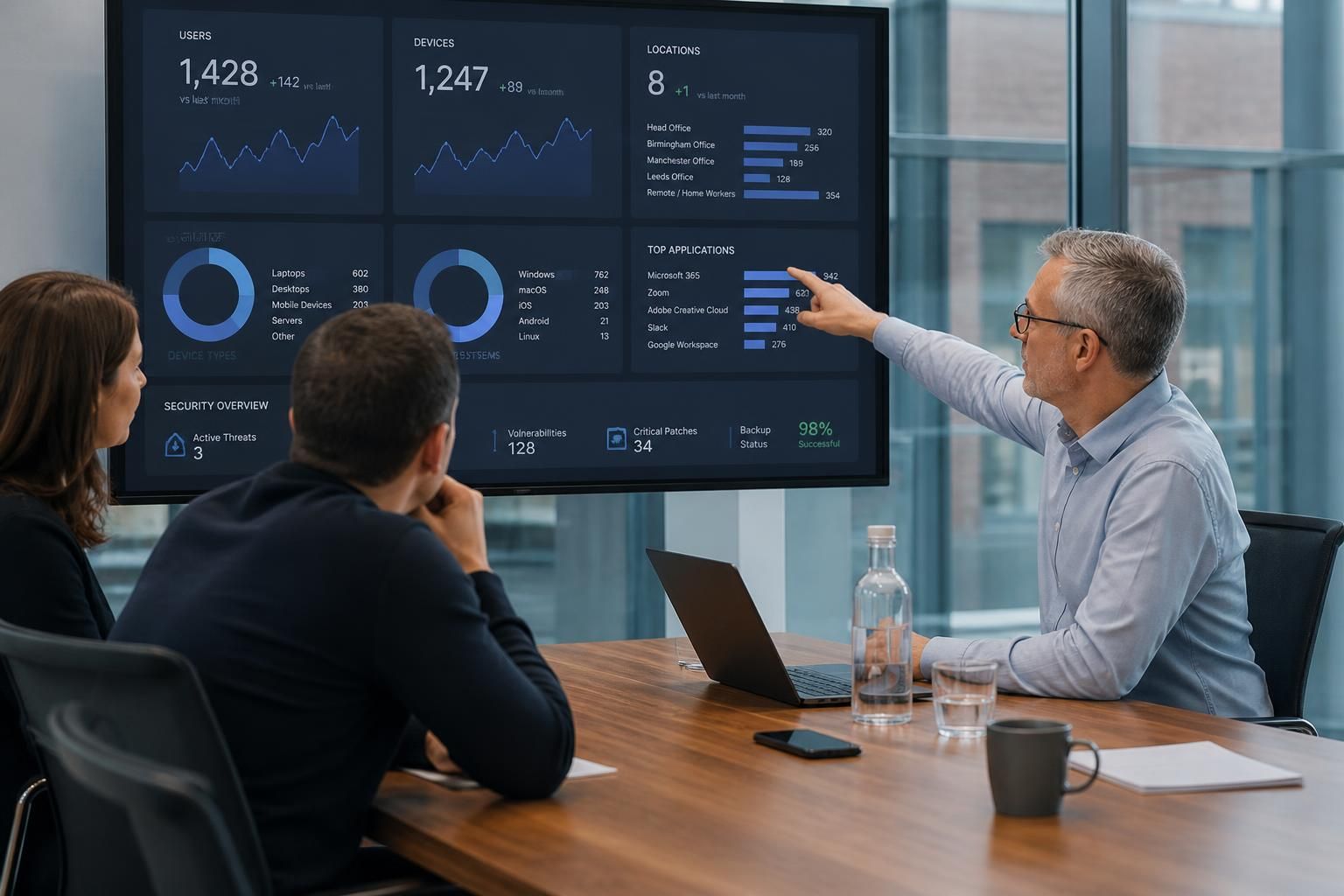
Managed IT pricing should scale with the number of users, devices, locations and the complexity of your systems, rather than increase simply because your organisation is larger. As your requirements develop, costs may also reflect broader services such as proactive management, cyber security, cloud solutions, business connectivity and strategic technology planning.
As an organisation grows, managed IT pricing should change according to the level of management, governance and risk required—not simply according to turnover or headcount. A smaller organisation may initially need core support and routine maintenance, while a growing business may require more structured monitoring, security oversight, user lifecycle management, supplier coordination and technology planning.
The main pricing changes usually arise from four areas:
- More users and assets to manage: Additional employees, computers, mobile devices, servers, applications and network equipment increase the work involved in administration, monitoring, patching and support.
- Greater operational complexity: Multiple offices, remote workers, production systems, specialist applications and interconnected platforms require more planning and coordination than a straightforward single-site setup.
- Higher governance requirements: As the organisation becomes more dependent on technology, it may need clearer access controls, documented procedures, backup oversight, security reviews and reporting for management or customers.
- A broader service scope: Growth often changes the agreement from reactive assistance to a more managed arrangement covering prevention, reviews, optimisation and technology roadmapping.
Pricing may also change when the organisation moves between service tiers. An entry-level arrangement might cover agreed support channels and routine maintenance. A more comprehensive package could include continuous infrastructure oversight, device management, security administration, backup management, supplier liaison and scheduled service reviews. The important point is to compare what each tier includes rather than judging the monthly charge in isolation.
Growth can affect the balance between recurring charges and project costs. Adding a new site, replacing ageing infrastructure, migrating systems, improving connectivity or introducing stronger identity controls may require project work outside the standard monthly service. These costs should be distinguished from the ongoing management charge so that the organisation can see which expenditure is funding a one-off change and which is supporting its normal operations.
New starters and leavers can create a further pricing consideration. A managed service may need to account for account creation, access changes, equipment allocation, software permissions and the removal of access when someone leaves. If these activities are included, the agreement should explain the scope. If they are charged separately, the basis of that charge should be clear. This prevents growth-related administration from becoming an unexpected cost.
Expansion can also expose inefficiencies that were acceptable at a smaller scale. Unused software licences, duplicated tools, unsupported equipment and inconsistent configurations can all increase the cost of managing the environment. A periodic review can identify where systems should be consolidated, standardised, retired or replaced. This does not mean that every review will reduce the monthly price; it helps ensure that the organisation is paying for an arrangement that reflects its actual requirements.
A practical pricing review should examine:
- the current number and type of users, devices and systems;
- changes to sites, working arrangements and operational processes;
- which support, maintenance and security activities are included;
- the level of reporting, documentation and strategic advice required;
- planned technology projects and expected changes in the organisation;
- any compliance, customer or contractual requirements affecting IT management;
- which charges are recurring and which relate to separate project work.
The timing of a review should be linked to meaningful changes rather than an arbitrary assumption that costs must rise each year. Opening a location, adopting a new business system, increasing remote access, acquiring another organisation or changing security requirements are all sensible triggers. A review should consider whether the existing service remains proportionate, whether responsibilities are clearly allocated and whether the pricing model still matches the way technology is being used.
For a growing organisation, the most useful managed IT pricing arrangement is one that is transparent about its charging units, inclusions, exclusions and review process. S2 Technology Group can assess these requirements as part of its managed IT services, with support covering IT management, cyber security, cloud solutions and business connectivity where relevant to the organisation’s operating model.
Managed IT pricing is easier to control when planned growth is addressed before new users, locations or systems are introduced. An organisation should document expected changes and agree how each will affect the service arrangement, rather than waiting for growth to appear as an unplanned adjustment.
A useful approach is to separate predictable expansion from exceptional change. Planned recruitment, additional offices or standard software additions can be incorporated into the pricing assumptions for the next review. By contrast, an acquisition, major platform replacement or significant change to operational risk may require a separate assessment. The agreement should explain when each type of change is reviewed and how the resulting charge is calculated.
This gives management a clearer basis for forecasting technology expenditure. It also makes it easier to test whether the proposed service remains suitable as the organisation develops, instead of treating every increase in activity as an automatic reason for a higher monthly cost.

Review Your Managed IT Pricing as Your Organisation Grows
Discuss your organisation’s current technology requirements and planned changes with S2 Technology Group to assess whether your managed IT arrangement remains proportionate. Contact the team to explore suitable managed IT services, cyber security, cloud and connectivity support.