What happens to VoIP during an internet connection failure?
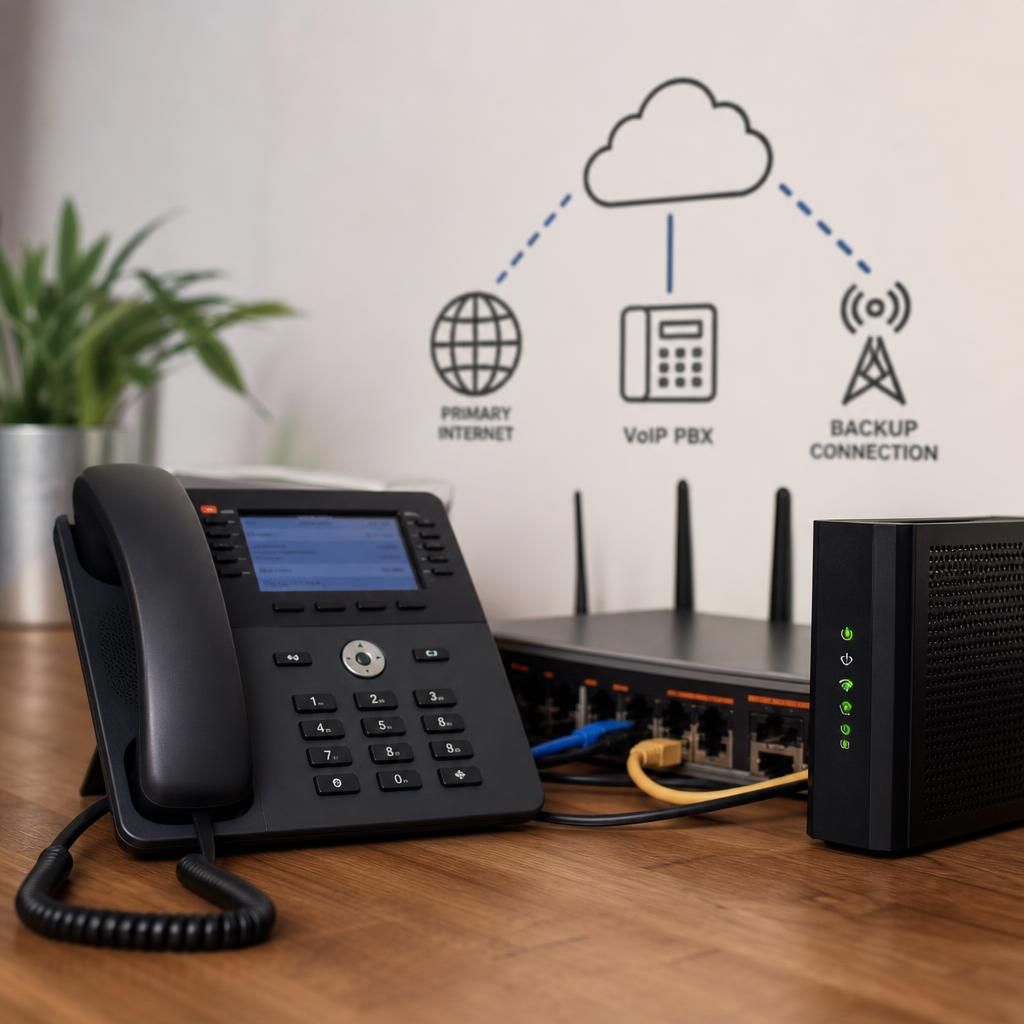
VoIP calls rely on an internet connection, so a failure can prevent new calls and disconnect active ones. The impact can be reduced through backup connectivity, failover routing or alternative call-handling arrangements configured as part of the business’s VoIP service.
During an internet connection failure, VoIP service is affected according to which part of the network has failed and how the telephony system is configured. A loss of connectivity at the office can stop desk phones and local softphones from registering, while the hosted telephony platform may continue operating normally. This distinction determines whether calls fail completely or can be redirected to another reachable endpoint.
When a phone is registered, it maintains communication with the VoIP platform so the platform knows where to deliver calls. If that registration is lost, the phone may appear offline and cannot reliably receive new calls. Outbound calls from that device will also normally be unavailable because the signalling and voice traffic cannot reach the provider. Registration does not usually recover simply by restarting the handset; the underlying network connection must be restored or an alternative route must be available.
Calls already in progress are particularly vulnerable because the voice stream is passing through the affected connection. A brief interruption may cause broken audio or silence, while a longer interruption can terminate the call. If only the office’s internet access fails but the caller and the telephony platform remain connected, the platform may still apply its configured treatment for an unreachable device. This can include sending the call to another endpoint, such as a mobile application using a separate connection, another office, voicemail or a designated answering arrangement.
Business continuity for VoIP is normally built in layers:
- Secondary connectivity: a separate broadband, fibre, 4G or 5G connection can provide a route for phones and other network services when the primary circuit is unavailable. The resilience of this arrangement depends on whether the backup uses genuinely separate equipment and network infrastructure.
- Automatic failover: a suitably configured router or firewall can move traffic to the secondary connection. VoIP may still require correct public addressing, firewall rules, quality-of-service settings and session handling before calls work properly on the replacement route.
- Cloud-based call treatment: inbound call rules can be held in the telephony platform rather than relying solely on equipment in the office. This allows calls to follow an agreed route when a user or site cannot be reached.
- Alternative user devices: softphones or mobile applications can provide access through a different internet connection, provided they have been configured, authenticated and tested in advance.
Not every failure is an internet circuit failure. A damaged router, failed switch, local wireless problem, power interruption, incorrect firewall rule or wider provider outage can produce similar symptoms. A secondary circuit connected to the same failed router will not provide useful resilience, and a softphone on the same office network will be affected by the same local fault. Troubleshooting therefore needs to identify whether the problem is with the access circuit, local network, telephony platform, user device or power supply.
Managed IT support can document the dependency chain, monitor the network equipment and confirm that the failover design matches the business’s call flows. It can also check that voice traffic receives suitable network priority, that critical phones have the required power, and that routing rules reflect how the organisation wants calls handled during an outage. Any change to the firewall, router or telephony configuration should be assessed together because resolving the internet problem while overlooking a related security or routing rule can leave VoIP unavailable.
Testing is essential because a backup connection that has never been used under realistic conditions may not support every phone, queue or call route. A controlled test should verify registration, outbound calling, inbound numbers, transfers, voicemail, call recording where applicable and the return to the primary connection. The test should also confirm who is responsible for recognising the failure, communicating the temporary call route and restoring normal settings afterwards.
S2 Technology Group can help businesses around Stourbridge, Kinver, Wordsley, Kingswinford, Kidderminster, Halesowen, Dudley and neighbouring areas assess the network dependencies behind their VoIP service and plan suitable resilience measures. The appropriate design depends on the number of sites, existing connectivity, handset arrangement, call flows and the consequences of losing telephone access.
A backup connection must be assessed for voice quality, not just basic internet access. When traffic moves to the secondary link, available capacity, latency, jitter and packet loss can affect conversation quality even if phones successfully register. Other users and cloud applications may compete for the same connection, so voice traffic may need suitable prioritisation and bandwidth controls.
Resilience testing should therefore include a realistic mixture of calls and normal business activity. Check two-way audio, transfers, queues and softphones while the backup route is active, then review whether users can still access the systems they need. This identifies a failover arrangement that technically connects the phones but does not provide a usable telephone service.