How is managed IT infrastructure adapted to business growth?
Managed IT infrastructure is adapted to business growth by designing systems that can scale in capacity, security and functionality as an organisation’s requirements change. This includes reviewing current performance, planning technology upgrades and aligning support, cloud services and connectivity with operational needs.
Managed IT infrastructure is adapted to business growth through a controlled combination of scalable architecture, standardised processes, security controls and governance. The aim is to increase capacity and capability without allowing additional users, locations, applications or data to create unnecessary complexity or operational risk.
Growth affects infrastructure in several ways. A business may add employees, open sites, introduce new software, handle larger data volumes or require more demanding collaboration and reporting systems. Each change can affect network capacity, identity management, storage, device configuration, backup requirements and access permissions. Managed infrastructure therefore uses repeatable methods to identify the effect of growth and apply changes consistently.
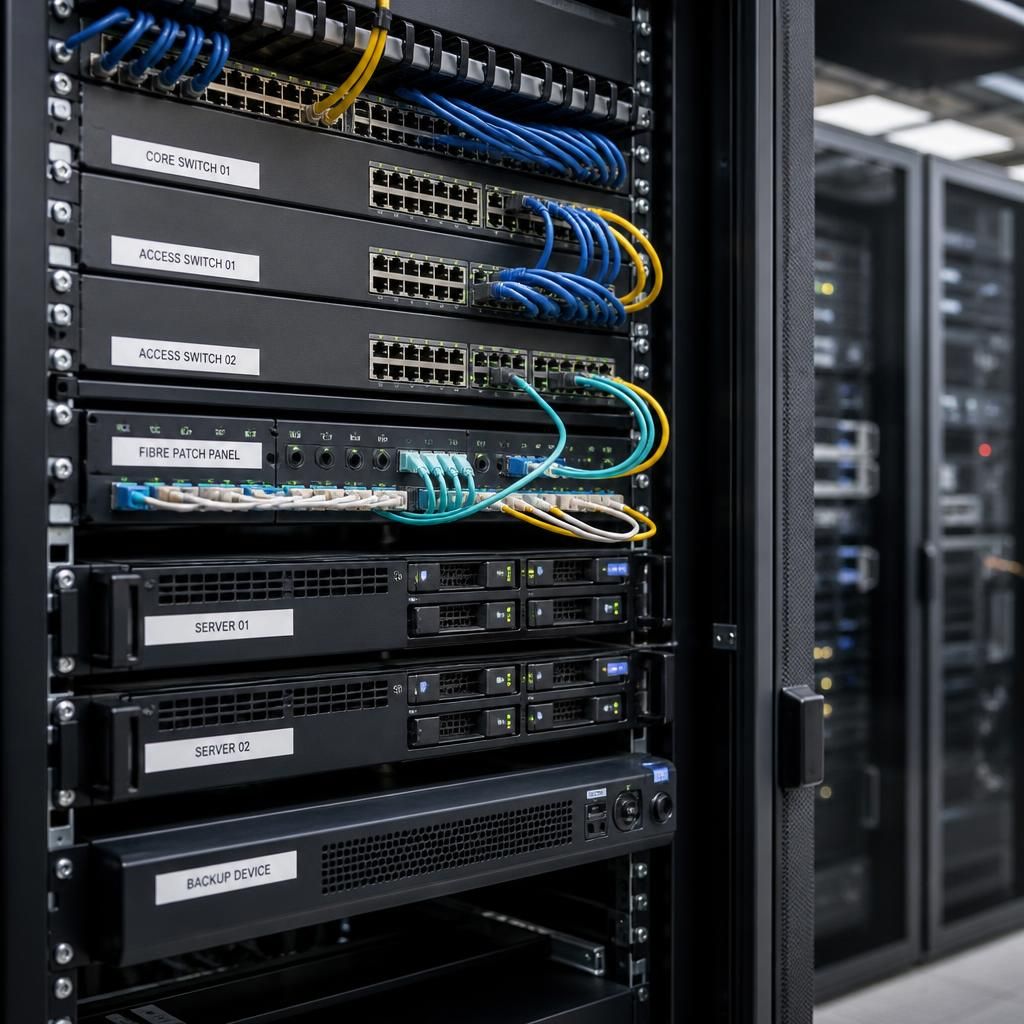
A scalable design usually separates core services into manageable components rather than relying on a single, oversized system. User accounts, endpoints, applications, storage, connectivity and security controls can then be expanded or adjusted independently where appropriate. This makes it easier to introduce a new service or location without redesigning the entire environment. It also supports clearer fault isolation, because an issue in one component is less likely to affect unrelated business functions.
Capacity is assessed against the way the organisation operates, not only against current usage. Relevant considerations include:
- the number of users, devices and sites that need to be supported;
- the applications and data each team requires;
- the level of access needed by employees, contractors and third parties;
- the volume and importance of business data;
- dependencies between business applications and infrastructure services; and
- the effect of a service interruption on critical operations.
This information helps determine whether growth should be supported by additional physical resources, cloud-based capacity, revised network design, application changes or a combination of these options. Cloud services can provide flexible resource allocation, but they still require appropriate configuration, access control, data management and cost oversight. Moving a workload to the cloud without addressing those areas does not, by itself, create a scalable infrastructure.
Security controls must expand alongside the organisation. More users and devices create more identities, permissions and potential entry points. A growth-ready approach applies access according to job responsibilities, removes or changes access when roles change, and separates administrative privileges from routine user activity. Device standards, multi-factor authentication where suitable, security monitoring, patch management and tested backup arrangements should be incorporated into the operating model rather than added only after an incident.
Standardisation is another important part of adaptation. Consistent device builds, naming conventions, configuration records and onboarding procedures reduce variation as the user base grows. They also make it easier to identify unauthorised changes and replace equipment without introducing incompatible settings. Standardisation should not prevent legitimate business requirements, but exceptions should be documented, assessed and managed deliberately.
Infrastructure changes should be introduced through defined governance. A suitable process records the reason for a change, its dependencies, its expected effect, who is responsible and how the organisation will return to the previous state if necessary. Larger changes may require staged implementation, user acceptance checks and a review after deployment. This prevents growth-related decisions from becoming a collection of uncoordinated fixes.
Documentation becomes increasingly important as an organisation expands. Records should describe the infrastructure layout, critical services, ownership, supplier dependencies, administrative access arrangements and recovery procedures. Documentation reduces reliance on individual knowledge and gives internal teams and an IT services provider a common basis for making decisions. It should be maintained as part of normal service management rather than treated as a one-off project.
Managed IT infrastructure also adapts through lifecycle management. Devices, operating systems, software versions and network equipment have different support periods and replacement requirements. A lifecycle plan identifies technology that is approaching obsolescence, prioritises changes according to business impact and avoids allowing a growing organisation to build further dependencies on unsupported systems. This is particularly relevant where older applications or specialist equipment remain necessary for operational reasons.
The most suitable approach depends on the organisation’s growth pattern. A business adding staff within one site may need more structured identity, endpoint and application management. A business opening additional locations may place greater emphasis on connectivity, centralised administration and consistent security policies. A business introducing new production or logistics systems may need careful integration, resilience and data protection controls. In each case, infrastructure is adapted according to operational requirements rather than by applying the same package of changes to every organisation.
S2 Technology Group approaches managed IT infrastructure as an ongoing technology management function for small to medium-sized businesses and growing organisations. The relevant service mix may include IT support, cyber security, cloud solutions, infrastructure upgrades and business connectivity, selected according to the organisation’s requirements. This allows infrastructure decisions to remain connected to business processes as the organisation develops, rather than treating growth as a series of isolated technical purchases.
Managed IT infrastructure is adapted to business growth not only by adding capacity, but also by simplifying the technology estate. Before a business expands an application, service or site, it is useful to review whether existing tools still serve a clear purpose. Duplicate applications, unused services and inconsistent configurations can increase cost and make future changes more difficult.
A technology rationalisation review can identify which services should be retained, consolidated, replaced or retired. This may involve comparing overlapping software, removing inactive accounts, reducing unnecessary system variations and confirming which applications remain suitable for the organisation’s operating model. The result is a clearer foundation for growth, with fewer dependencies to maintain and less technical debt carried into future projects.
This approach is particularly relevant when a business is adding locations, teams or new operational functions. Establishing a defined set of supported services makes it easier to extend the environment consistently while allowing legitimate specialist requirements to be assessed separately. It also gives decision-makers a clearer basis for prioritising future infrastructure investment as the organisation develops.