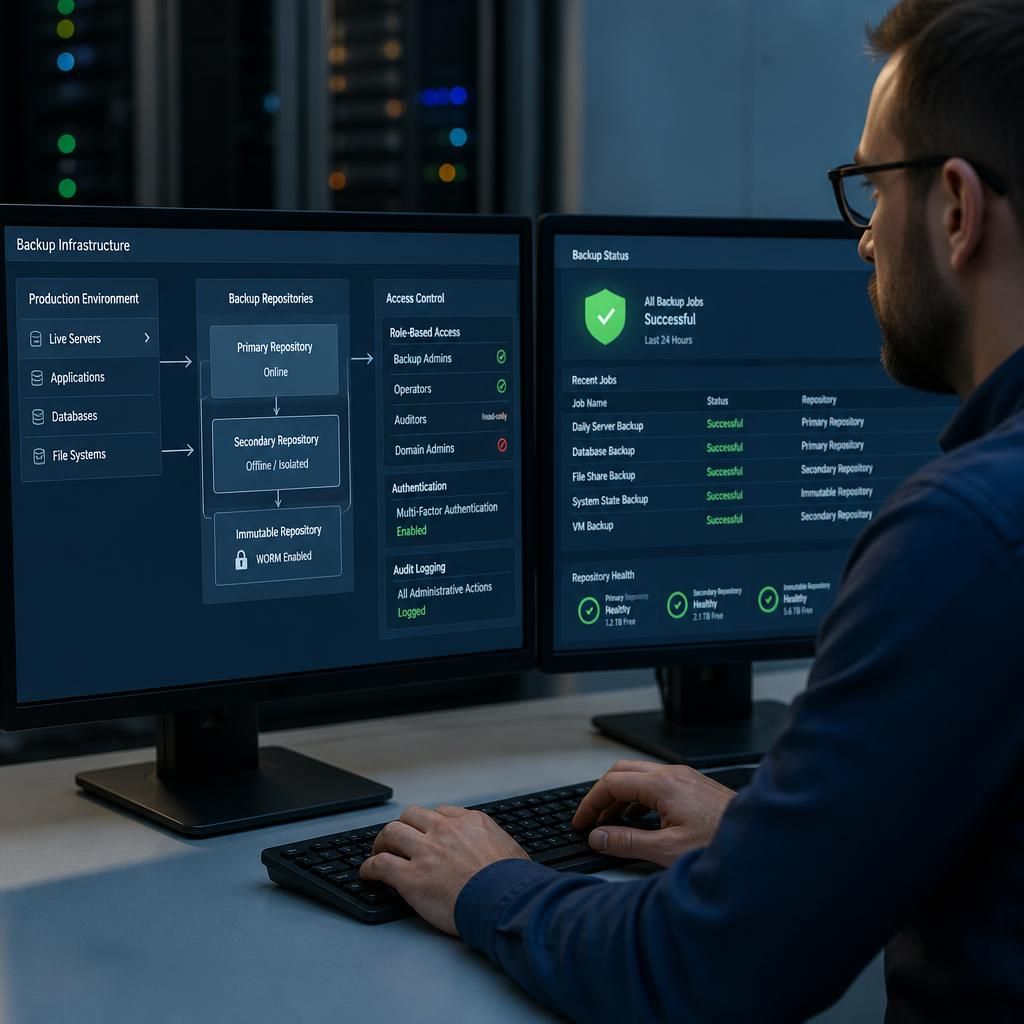
Can your server backups survive a compromised administrator account?
Server backups may not survive a compromised administrator account if the attacker can access, alter or delete the backup repository. Resilience depends on separating backup administration from production accounts and using controls such as immutable or offline copies, multi-factor authentication and tested recovery procedures.
Server backups can survive a compromised administrator account only when the backup environment has a different security boundary from the systems and credentials the attacker has obtained. A backup job running successfully is not enough: resilience also depends on whether an attacker can reach backup management tools, change retention settings, encrypt stored copies, or obtain the keys needed to restore them.
Start by defining the compromise. An administrator account may provide access to a server, a hypervisor, a backup console, a cloud management portal, or several of these at once. The consequences differ in each case. If the account controls only a production server, a separately administered backup platform may remain usable. If it can manage the backup repository or alter its access policies, the attacker may be able to remove recovery points as well as damage the live data.
A useful assessment should establish:
- Which systems the account could administer;
- Whether it could create, alter or delete backup jobs and recovery points;
- Whether it could access backup storage directly through a file share, API or management console;
- Whether it could retrieve encryption keys or service credentials;
- Whether the backup platform records administrative activity independently of the affected environment; and
- Which copies remain outside the compromised account’s control.
Protect the backup control plane. The backup control plane includes the console, scheduling configuration, repository permissions, encryption settings, retention rules and recovery credentials. It should be treated as a separate privileged environment rather than as an ordinary server application. Administrative access should be limited to named roles, with permissions separated so that one compromised identity cannot both change backup policy and destroy existing recovery points.
Service accounts used by backup agents should also be narrowly scoped. They should have only the permissions required to read source data, write to the intended destination or perform a defined recovery operation. Reusing a broad domain administrator credential for backup tasks increases the potential impact of a stolen password. Credentials should be stored and rotated through an appropriate secrets-management process, with access reviewed when staff, systems or responsibilities change.
Consider what an attacker can do after gaining access. A threat actor may not need to delete every backup. They could reduce retention, disable a schedule, change the destination, tamper with catalog data, remove encryption keys or wait until older recovery points expire. They may also corrupt backup files subtly, leaving the job marked as successful while making a later restoration unreliable. Monitoring should therefore cover configuration changes and unusual administrative actions, not just whether the latest scheduled task completed.
Useful monitoring includes alerts for disabled jobs, changes to retention or repository settings, unexpected deletion requests, new privileged users, changes to encryption configuration and access from an unfamiliar administrative host. Logs should be retained somewhere the compromised administrator cannot edit and should contain enough detail to reconstruct who changed what and when. This evidence supports both containment and the decision about which recovery points can still be trusted.
Keep recovery knowledge independent from the compromised environment. Recovery may fail even when backup files are intact if the organisation cannot obtain the required credentials, encryption keys, licence information, system configuration or application dependencies. Maintain documented recovery procedures in a location that is not dependent on the affected identity or production network. Record the order in which systems must be recovered, including directory services, databases, application servers and file services where dependencies exist.
Encryption requires particular care. Encrypted backups protect confidentiality, but they are unusable without the correct keys or passphrases. Key access should therefore follow a separate process from ordinary server administration, with controlled custody and a documented method for authorising recovery. If an attacker may have accessed a key, treat the related backup set as potentially exposed and assess whether new keys and new recovery points are needed.
Decide which recovery points are trustworthy. After an administrator account is compromised, the newest backup is not automatically the best backup. It may contain malware, unauthorised changes or a copy of the attacker’s persistence mechanisms. Review the timeline of suspicious activity and identify recovery points created before the earliest credible compromise. Check backup metadata, administrative logs and security monitoring for evidence that the backup process or repository was tampered with during that period.
Recovery should take place in a controlled environment rather than directly over the affected systems. Rebuild or isolate the destination, establish clean administrative credentials, apply relevant security updates and scan restored data before reconnecting it to business services. Applications may also require integrity checks, database validation and review of scheduled tasks, scripts and user permissions. Restoring files alone does not prove that the recovered server is safe to operate.
Review the policy after the incident or assessment. The results should show whether the organisation can identify an unaffected recovery point, obtain the necessary keys and instructions, restore critical services in the right order, and distinguish clean data from compromised data. Any dependency on one administrator, one console, one network path or one set of credentials represents a potential single point of failure.
A robust server backup design is therefore based on separation of authority, restricted service permissions, independent audit evidence, protected recovery information and a clearly defined process for establishing trust after compromise. S2 Technology Group can help organisations assess these dependencies as part of a wider managed IT and cyber security strategy, particularly where a growing business relies on servers without a large in-house IT function.
An offline or logically isolated backup copy can remain recoverable after an administrator account has been compromised because it cannot be changed through the same management path as the live server environment. This protection is only effective if the isolation is genuine: a backup share that is merely hidden from users, but still writable through the compromised account, does not provide a separate recovery option.
Organisations should document how an isolated copy is created, who can authorise access to it and how it is brought into a recovery environment. The process should include checking that the copy is complete and usable, rather than assuming that its existence proves recoverability. A controlled restore to separate infrastructure can confirm that the required data, configuration information and encryption access are available without exposing the protected copy to the compromised administrator account.