

How should cyber security services handle risks from suppliers and third parties?
Cyber security services should manage supplier and third-party risk through structured due diligence, clear security requirements in contracts, controlled access, ongoing monitoring and defined incident responsibilities. This approach helps identify weaknesses in outsourced services, cloud platforms, contractors and other external connections before they affect the business.
Cyber security services should treat supplier and third-party risk as an extension of the organisation’s own attack surface. The process should identify every external dependency, determine what could happen if it were compromised or unavailable, and apply controls proportionate to the data, systems and business processes involved.
A supplier is not limited to an outsourced IT company. Relevant third parties may include cloud hosting providers, software vendors, payroll processors, accountants, consultants, contractors, payment providers, logistics partners and organisations that connect to internal systems. A supplier may also rely on its own subcontractors, creating fourth-party dependencies that are less visible but still capable of affecting the business.
Start with a complete dependency map
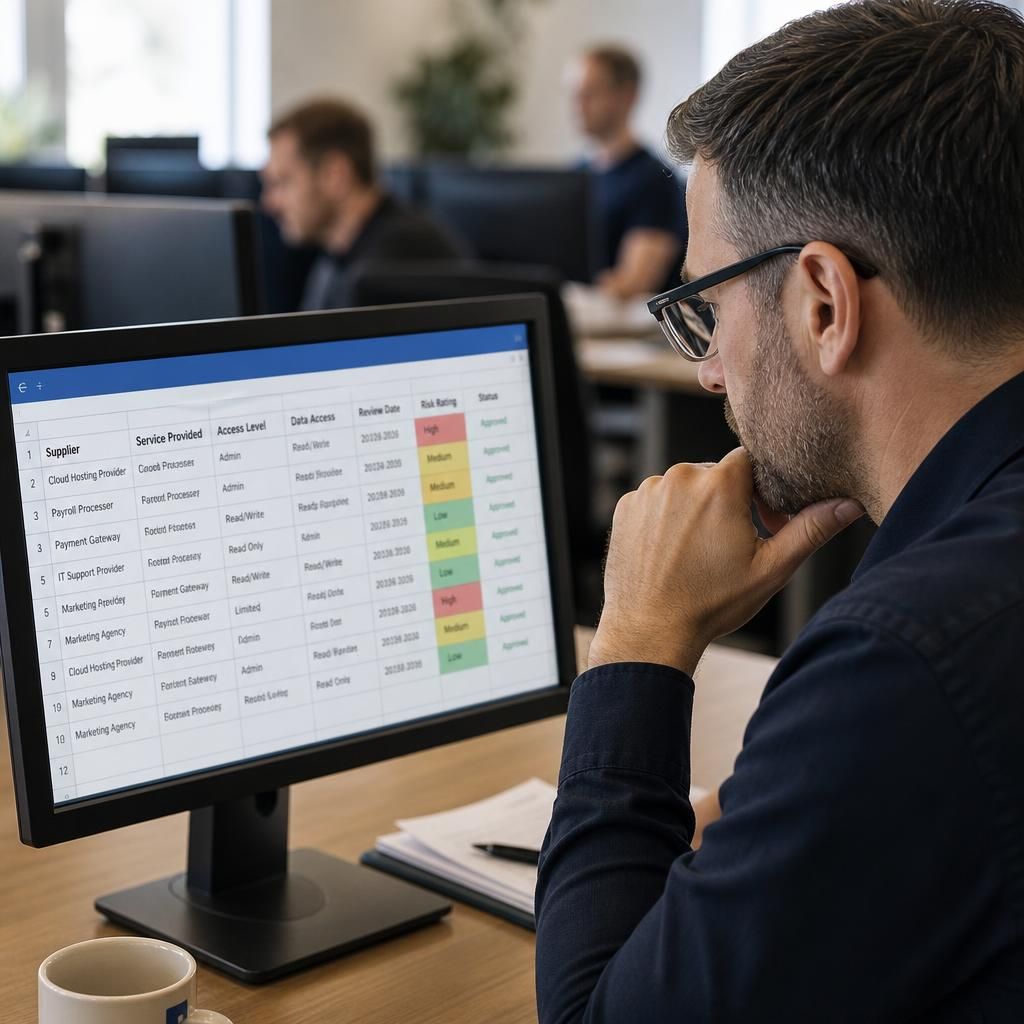
Risk cannot be assessed accurately if the business does not know which external organisations can access its information or support critical operations. A cyber security service can help maintain a supplier register containing:
- the services each supplier provides;
- the systems, networks and information involved;
- the type of access required and whether it is permanent or occasional;
- the supplier’s subcontractors and hosting dependencies where known;
- the business processes that would be affected by a failure;
- the contract owner and internal business owner; and
- the date of the last review and any unresolved issues.
This register should include informal arrangements as well as major technology suppliers. A contractor using a remote support tool or a marketing provider holding customer data may create a meaningful security dependency even when the service is not classified as an IT purchase.
Classify suppliers according to business impact
Not every supplier needs the same level of scrutiny. A useful classification considers the sensitivity of the information handled, the access granted, the importance of the service, the potential effect of disruption and the consequences of a compromise spreading into the organisation. A provider with access to administrative systems or confidential records should receive more attention than one handling publicly available information.
Classification should be reviewed when a supplier’s role changes. For example, a basic software subscription may become a higher-risk service if it is later connected to single sign-on, integrated with finance systems or given access to a larger dataset.
Assess the whole service, not just the supplier’s reputation
Supplier assessment should examine how the service operates in practice. Useful questions include:
- Where is business data stored and processed?
- How is access to the service authenticated and administered?
- How are security updates, vulnerabilities and configuration changes managed?
- How are customer environments separated from one another?
- What logging and investigation information can the supplier provide?
- How are data retention, deletion and export handled?
- Which subcontractors support the service?
- How are resilience, backup and recovery arrangements tested?
Evidence is more useful than broad statements that a supplier is secure. Depending on the service, evidence might include independent assurance reports, penetration-testing summaries, security policies, audit results, architecture information, staff screening arrangements or records of relevant certifications. The evidence should be interpreted against the organisation’s actual risk rather than accepted as a substitute for assessment.
Use technical separation to limit the consequences of compromise
Supplier risk should not be managed solely through paperwork. Technical design can reduce the damage caused by a compromised account, tool or connection. Appropriate measures may include network segmentation, separate administrative environments, application-level permissions, multifactor authentication, privileged access management, strong device controls and restrictions on where supplier sessions can originate.
Access should be granted to a defined service rather than to an unrestricted internal network wherever possible. A supplier that only needs to maintain one application should not automatically be able to browse unrelated systems. Temporary or approval-based access can be appropriate for maintenance tasks, while service accounts should have narrowly defined permissions and secure credential management.
Manage data movement and integration points
Data exchanged with a supplier should be limited to what the service genuinely requires. Unnecessary fields, duplicate records and unrestricted exports increase the potential impact of a breach. Security services can help review application programming interfaces, automated file transfers, email routes and synchronisation tools for excessive permissions and weak authentication.
Particular care is needed where a supplier can write data back into internal systems. Read-only access may present a different risk from the ability to create users, alter payment details, change customer records or modify operational settings. Integration permissions should reflect those differences, with sensitive actions subject to additional approval or verification.
Control changes throughout the supplier relationship
Supplier risk changes over time. A product may gain new features, a provider may change its ownership, a service may move to a different hosting arrangement, or the organisation may begin using the supplier for a more sensitive purpose. Security reviews should therefore be triggered by material changes rather than being treated as a one-off procurement task.
Offboarding is equally important. When a relationship ends, the business should confirm that accounts, tokens, remote tools, certificates and shared credentials have been removed. Data should be returned, securely deleted or retained only where there is a documented reason. Any connected applications and firewall rules should also be reviewed so that old access does not remain unnoticed.
Prepare for supplier failure and compromise
Resilience planning should address both service interruption and a security incident at the supplier. The business should know which processes depend on the service, what manual alternatives exist, how essential information can be recovered and which decisions would need to be made if the supplier became unavailable or untrusted.
These arrangements should be tested with realistic scenarios. A useful exercise might consider a stolen supplier credential, a ransomware incident affecting a hosted platform, a malicious software update or the loss of a critical data feed. Testing can reveal undocumented dependencies, unsuitable recovery assumptions and gaps between the supplier’s procedures and the customer’s own incident process.
Measure third-party risk through useful information
Management reporting should focus on exposure and action rather than simply counting completed questionnaires. Useful measures may include the number of critical suppliers with current assessments, unresolved high-risk findings, suppliers lacking usable assurance evidence, inactive accounts awaiting removal and dependencies without a documented recovery option. Exceptions should have an owner, a target date and a recorded acceptance decision where remediation is not immediately practical.
For a growing organisation, cyber security services can provide the structure needed to manage these activities across IT, procurement, legal and operational teams. The objective is not to eliminate every external dependency, which is rarely realistic, but to make dependencies visible, constrain their access, verify the controls that matter and ensure the business can respond when a supplier becomes a source of risk.
Supplier security requirements should be agreed before a service is approved, not added after access has been granted. Procurement, IT, legal and the relevant business owner should record the minimum controls required for the supplier’s role, along with who can approve exceptions.
- the security responsibilities assigned to the supplier and the organisation;
- the controls required for authentication, access management and data handling;
- the information the supplier must provide to support security reviews;
- the circumstances in which the supplier must report a security event or material change; and
- the action required if the supplier cannot meet an agreed security condition.
This creates a consistent decision process for accepting supplier risk. A business can then distinguish between a documented, time-limited exception with an accountable owner and an unmanaged weakness that has been overlooked. The requirements should also be reviewed when a service is renewed, expanded or connected to additional business systems.