

How should cyber security services protect privileged administrator access?
Cyber security services protect privileged administrator access by limiting elevated permissions, requiring strong authentication and monitoring administrative activity. Effective controls include separate administrator accounts, multi-factor authentication, role-based access, regular permission reviews and prompt removal of unnecessary privileges.
Privileged administrator access should be treated as an exceptional, attributable and time-bounded activity rather than as a permanent feature of a user’s account. The strongest protection combines privileged access management, controlled administrative workstations, approval processes, session oversight and detailed records, so that elevated actions can be authorised, traced and investigated.
Use a privileged access management process. A privileged access management, or PAM, process controls how administrator credentials are requested, issued, used and withdrawn. Instead of allowing administrators to retain unrestricted passwords, a PAM system can store sensitive credentials in a protected vault, release them only for an approved task and rotate them after use. This reduces the value of stolen credentials and limits the opportunity for an attacker to use an administrator account unnoticed.
Where a full PAM platform is not appropriate, the same principles can be applied through documented access procedures, secure password storage, approval records and technical controls that prevent administrators from sharing credentials. The important point is that privileged access should be managed as a controlled process, not as an informal arrangement between IT staff.
Prefer just-in-time access. Permanent administrative access creates a larger window in which an account, device or session could be compromised. Just-in-time access grants the required privilege for a defined task or period, then removes it automatically. A request might identify the system, purpose, scope and expected duration. Once the work is completed, the elevated session expires rather than remaining available by default.
This approach is particularly useful for routine maintenance, cloud administration, server changes and support tasks. It should also distinguish between the rights needed to view information, make a configuration change and manage other accounts. Administrators should receive the smallest practical level of access for the specific job.
Separate administrative work from everyday activity. An administrator should not normally use a privileged account for email, web browsing or general office work. A compromised browser session or malicious attachment can otherwise provide a route to highly sensitive systems. Administrative tasks should be carried out from a dedicated, hardened workstation or controlled management environment with limited software, restricted internet access and appropriate endpoint security.
Organisations should also prevent direct administration from unmanaged personal devices. The device used for privileged work is part of the security boundary: it needs supported software, secure configuration, encryption, protection against malware and a process for investigating suspicious activity.
Require approval for high-impact actions. Not every administrative task needs the same level of authorisation. Low-risk maintenance may follow a standard procedure, while changes affecting identity systems, backups, firewalls, financial applications or large volumes of data may require a second person to approve the request. This separation of duties reduces the risk that one compromised account, mistake or malicious insider can make a sensitive change without scrutiny.
Approval should be meaningful rather than a formality. The reviewer should be able to see what is being changed, why it is necessary, which systems are affected and how the change can be reversed. Emergency access can be supported through a documented break-glass procedure, but emergency credentials should generate prominent alerts and require retrospective review.
Record and monitor privileged sessions. Authentication logs alone may show that an administrator connected to a system, but not what happened afterwards. More complete monitoring can record commands, configuration changes, access to sensitive data, session duration and the systems involved. For particularly sensitive environments, session recording may provide an additional audit trail, subject to appropriate privacy, employment and data-protection requirements.
Monitoring should look for activity that is inconsistent with normal administration, such as access from an unusual location, connections at unexpected times, repeated failed attempts, bulk data access, attempts to disable security controls or changes to logging itself. Alerts should be directed to a process where someone can assess their significance. Collecting logs without reviewing them does not provide effective oversight.
Protect service and emergency accounts. Not all privileged access belongs to an individual. Applications, scripts, backup systems and integrations may use service accounts with elevated rights. These accounts should have a defined owner, a documented purpose, restricted permissions and credentials that are stored securely rather than embedded in scripts or configuration files. Unused accounts should be disabled, and automated credentials should be rotated without interrupting legitimate services.
Emergency accounts need equally careful treatment. Their existence, purpose and access method should be documented, with credentials protected separately from normal administrator accounts. Every use should trigger an alert and a review confirming why the account was needed and whether any follow-up action is required.
Make changes traceable. Privileged access controls work best when linked to change management and asset records. A record should connect the person or service account, the approved request, the affected asset, the action performed and the outcome. This makes it easier to distinguish an authorised change from an intrusion and helps identify whether a recurring task should be automated or redesigned.
Audit records should be protected from alteration by ordinary administrators, retained for an appropriate period and backed up separately where necessary. If an attacker can delete or rewrite the evidence of their activity, the organisation may lose an important part of its incident investigation capability.
Test the controls rather than relying on policy. A practical review should check whether privileged accounts can still be discovered, whether old credentials remain active, whether administrators can bypass the approval process and whether logs contain enough detail to reconstruct a significant event. Testing should include cloud platforms, network equipment, servers, endpoint management tools, backup systems and third-party support connections, rather than focusing only on the main directory service.
Business leaders can assess the quality of privileged access protection by asking questions such as:
- How many privileged accounts and service accounts exist, and who owns each one?
- Which accounts have permanent elevated rights rather than task-based access?
- Can every high-risk action be linked to an identified person or approved service?
- Are administrative sessions and configuration changes logged centrally?
- How are emergency credentials protected and reviewed after use?
- Can access be withdrawn promptly when a role, supplier relationship or system requirement changes?
A managed cyber security service may support these activities through ongoing configuration checks, log review, access governance and advice on control improvements. The technology is only one part of the arrangement: effective protection also depends on clear ownership, documented procedures, trained administrators and regular evidence that the controls operate as intended.
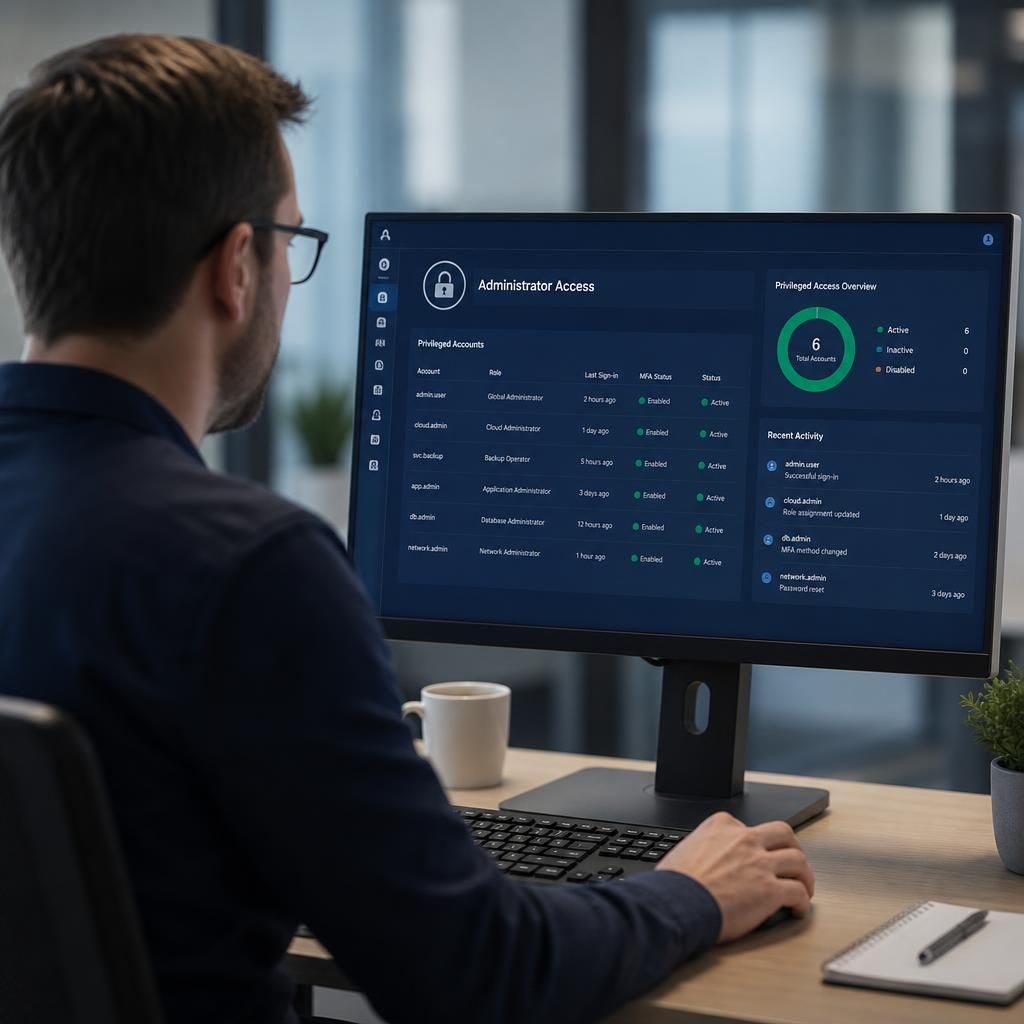
The identity provider itself requires stronger protection because it may control access to cloud services, applications and administrator accounts. Administrative access to the directory, single sign-on platform and authentication settings should be restricted to a small, clearly defined group and managed separately from ordinary system administration.
Recovery methods also need attention. Password resets, authentication-factor changes and new administrator enrolments can create an alternative route into privileged access if they are not subject to independent checks. These actions should be logged, reviewed and protected by controls that do not depend solely on the account being recovered. This helps prevent an attacker who has obtained one administrator account from weakening authentication and creating further privileged access.