
How are remote support activities recorded and reviewed?
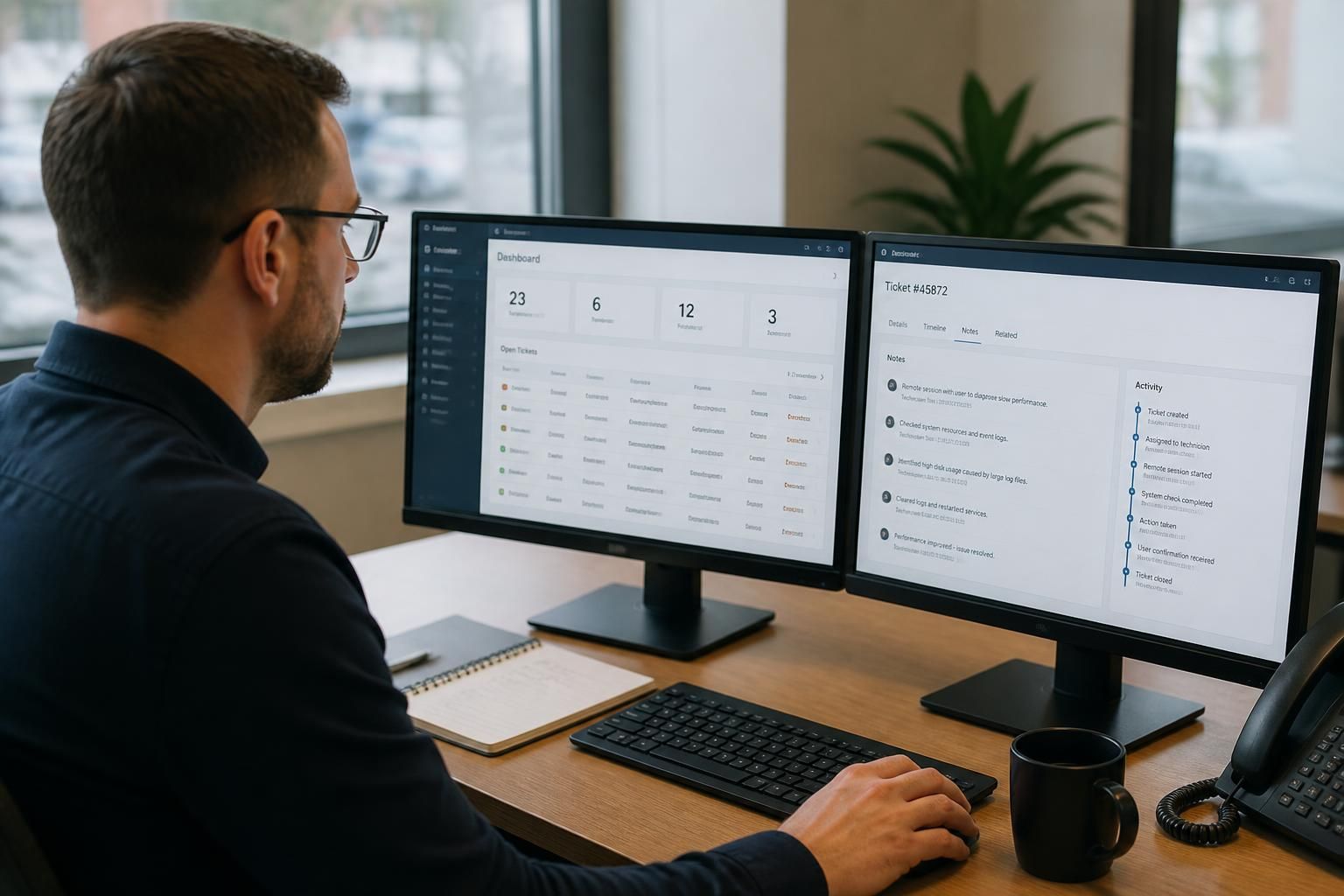
Remote support activities are recorded in service records that document the request, actions taken, changes made and outcome, creating a clear audit trail. These records can then be reviewed to verify work, identify recurring issues, assess security-relevant activity and inform improvements to IT support.
Remote support activities are recorded in a controlled service-management process and reviewed through operational, security and quality checks. The record should show what support was authorised, which systems or users were involved, how the work was carried out and whether any follow-up is required. Recording does not necessarily mean making an audio or video recording of the technician’s session; in most business environments, it means maintaining written service notes supported by relevant system logs.
A useful remote support record normally links the activity to a specific user, device, application or service. It may also identify the technician or support role involved, the reason access was needed, the approval route used and the time at which the session took place. This context allows a reviewer to distinguish legitimate support from unusual or unauthorised access without relying on a technician’s memory.
Reviewing is usually carried out at more than one level:
- Case review: a support manager or senior technician checks whether the record is complete, technically accurate and suitable for closing or progressing the case.
- Security review: access records and related alerts are examined for activity that falls outside the agreed support purpose, involves an unusual account or affects a sensitive system.
- Trend review: multiple records are assessed together to identify repeated faults, recurring user issues, unsupported equipment or weaknesses in a business process.
- Change review: work that alters configurations, permissions or infrastructure can be compared with the relevant approval and change documentation.
Good records also make the difference between an isolated incident and a pattern easier to identify. For example, several apparently unrelated support requests may point to a failing device, an unreliable connection, a poorly configured application or a training need. Reviewing cases collectively can therefore inform preventative maintenance, infrastructure planning and user guidance rather than treating each request as a separate event.
Access to support records should be restricted according to role. Technicians may need access to the cases they are handling, while managers, security personnel or authorised client contacts may require broader visibility for oversight. Review permissions should not allow unnecessary alteration of the original record. Where records are amended, the system should retain an indication of the amendment so that later reviewers can understand what changed and why.
Privacy is also part of the review process. Remote support may expose personal information, confidential documents or business data on a user’s screen. Records should therefore contain only information relevant to resolving and governing the support activity. Sensitive details should not be copied into general notes unnecessarily, and any screen sharing or remote-control capability should be used only for an approved support purpose. Retention periods should reflect the organisation’s contractual, operational and data-protection requirements.
Useful review measures include the number and type of repeat incidents, cases reopened after closure, support activity affecting critical systems, records lacking approval or completion details, and issues that required escalation. These measures should be interpreted alongside the business context rather than treated as performance scores in isolation. A high number of records in one area may indicate a common technical fault, a period of planned change or a need to improve how issues are reported.
For small and medium-sized organisations, a practical review arrangement usually combines routine case sampling with targeted checks of security-sensitive activity and periodic trend analysis. The findings can then be used to update support procedures, strengthen access controls, improve documentation and recommend technical changes. S2 Technology Group can incorporate this type of structured oversight into managed virtual IT services, helping businesses maintain clearer governance over remote assistance without requiring a full in-house IT team.
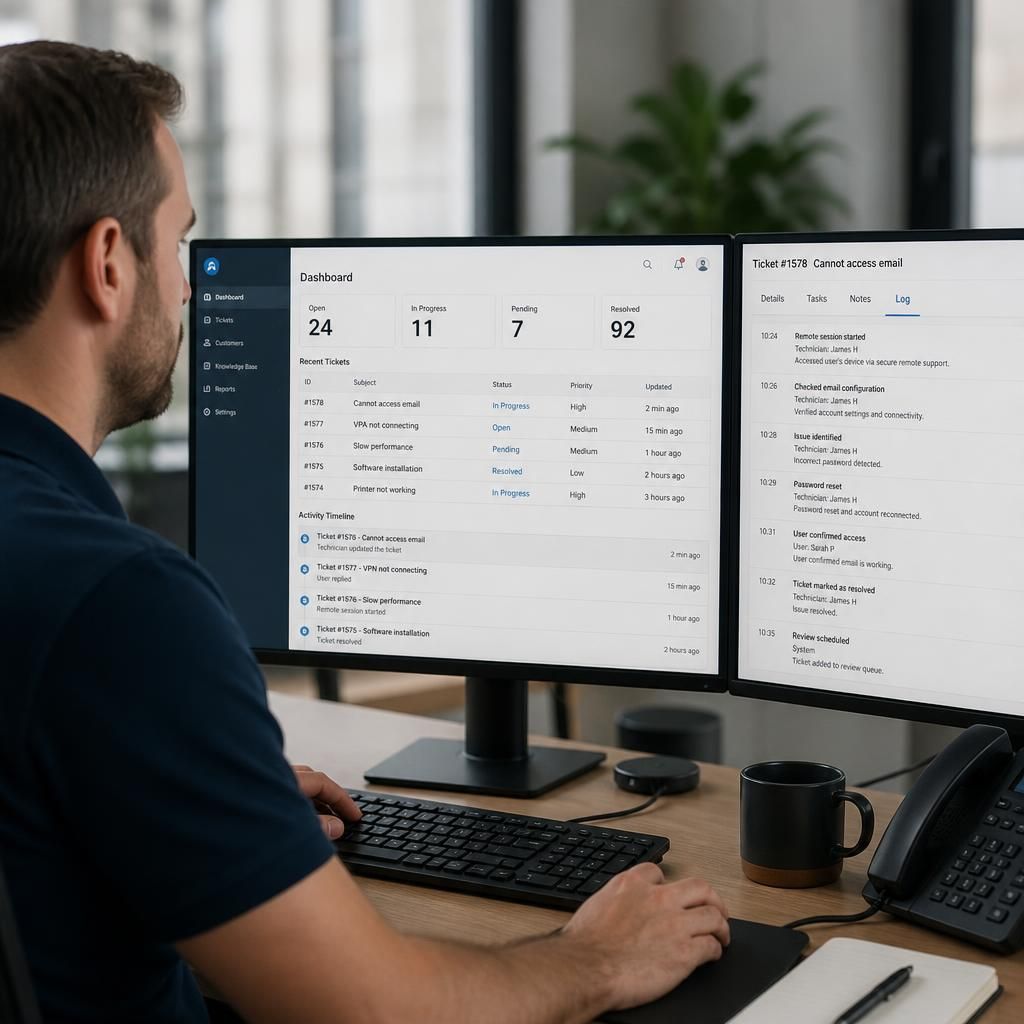
Reviewing remote support activity should include verifying that any follow-up work was completed, not simply confirming that a ticket was marked as closed. A record is more useful when it shows how identified problems were dealt with and whether the original support objective was achieved.
A closed-loop review process can include:
- Recording outstanding actions separately from the technician’s completion notes.
- Assigning each action to an appropriate person or team with a clear target date.
- Checking evidence that the action was completed, such as a configuration update, user confirmation or related service record.
- Reopening or escalating the case when the evidence does not support closure.
- Capturing the reviewer’s decision so the reason for accepting, rejecting or extending the outcome is clear.
This approach helps distinguish completed technical work from unresolved risk. It also gives managers a reliable basis for assessing whether support processes need adjustment, without relying solely on the original technician’s account. For organisations using managed virtual IT services, this follow-through can form part of the service governance process and provide a clearer view of the work still requiring attention.