What should an IT helpdesk agreement define?
An IT helpdesk agreement should clearly define the services covered, supported users and systems, responsibilities, service levels, escalation arrangements and any exclusions. It should also set out pricing and billing, data protection and security requirements, access controls, reporting, change management, review arrangements and the process for ending the agreement.
An IT helpdesk agreement should translate a general support arrangement into clear, testable operating rules. It should explain how support is requested, how faults and requests are classified, what information each party must provide, how work is accepted and closed, and how the arrangement is assessed against the organisation’s operational needs.
Define the purpose of the service. The agreement should describe the business outcomes the helpdesk is intended to support, such as maintaining access to essential systems, assisting users with approved technology, or coordinating the resolution of technical faults. This provides context when an issue does not fit neatly into a standard category and helps both parties make consistent decisions.
Set out the terminology. Terms should have agreed meanings rather than being used interchangeably. For example, an incident is an unplanned interruption or reduction in service, while a service request is a routine request for information, access or an approved change. A problem is an underlying cause that may produce repeated incidents. Defining these terms makes it easier to measure workloads, assign the right process and identify recurring faults.
Describe how users can obtain support. The agreement should identify the accepted routes for raising work and explain which people are authorised to submit requests on behalf of the organisation. It should also state what a useful request contains, such as the affected person, device or application, a description of the symptoms, relevant error messages, business impact and any troubleshooting already attempted. This reduces avoidable clarification and helps create an accurate record from the outset.
Use an agreed classification model. Priority should be based on business impact and urgency, not simply on who reports the issue first. The model may consider the number of affected users, whether a critical business process is blocked, the availability of a workaround, the sensitivity of the affected information and whether the fault is spreading. The agreement should explain who can change a priority and what evidence is needed to justify that change.
It is also useful to define how related tickets are handled. Several reports of the same fault may be linked to a parent incident rather than treated as unrelated jobs. A widespread interruption may require a major-incident process, while repeated individual incidents may justify an investigation into an underlying problem. These rules prevent duplicate effort and make the effect of a fault easier to understand.
Specify the information and cooperation needed from the customer. Support may depend on users being available to test a fix, administrators approving an action, or the organisation providing accurate asset and account details. The agreement should explain how delays caused by missing information, unavailable contacts or unapproved access are recorded. It should also identify who can authorise actions that could affect users, data or business operations.
Define access and identity checks in practical terms. A helpdesk agreement should state how a user’s identity is verified before account information is disclosed or a sensitive action is performed. It should distinguish ordinary troubleshooting from actions such as resetting privileged credentials, changing permissions or granting remote access. This reduces the risk that a support process becomes a route for social engineering or unauthorised changes.
Clarify dependencies outside the helpdesk. Some faults depend on an internet provider, software publisher, hardware supplier, landlord, internal administrator or another third party. The agreement should explain who coordinates those dependencies, what information is shared, how ownership is tracked and how progress is communicated while another party is involved. It should not imply that the helpdesk controls an outcome that depends on an external service.
Define resolution and closure. The agreement should explain what counts as a suitable resolution for different types of work. A technical fix may require confirmation that the user can complete the affected task, while an information request may be complete once an accurate answer has been supplied. It should state how the customer can challenge an incorrect closure and how an unresolved or recurring issue is returned for further investigation.
Include service continuity arrangements. The document should identify how support records, technical documentation and essential administrative information are maintained if personnel, systems or suppliers change. It should also define how important knowledge is transferred when an issue is escalated or when responsibility moves between teams. This limits dependence on informal knowledge held by one individual.
Make performance information meaningful. Rather than relying only on the number of closed tickets, the agreement can define useful measures such as first-contact resolution, ageing work, reopened tickets, recurring incidents, priority changes, user-impacting faults and requests awaiting customer input. Each measure should have a clear calculation method and an agreed reporting period so that results can be compared consistently.
Before signing, the organisation should test the agreement against realistic examples: a single-user application fault, a widespread connectivity problem, a new starter requiring access, a suspected security incident and a request involving a third-party supplier. If the parties would handle those scenarios differently, the agreement needs more precise wording. A well-defined document gives users a consistent route to assistance and gives the helpdesk enough structure to manage work without relying on assumptions.
S2 Technology Group helps small to medium-sized organisations review and manage the practical arrangements behind IT support, including helpdesk processes, secure access and the wider technology environment.
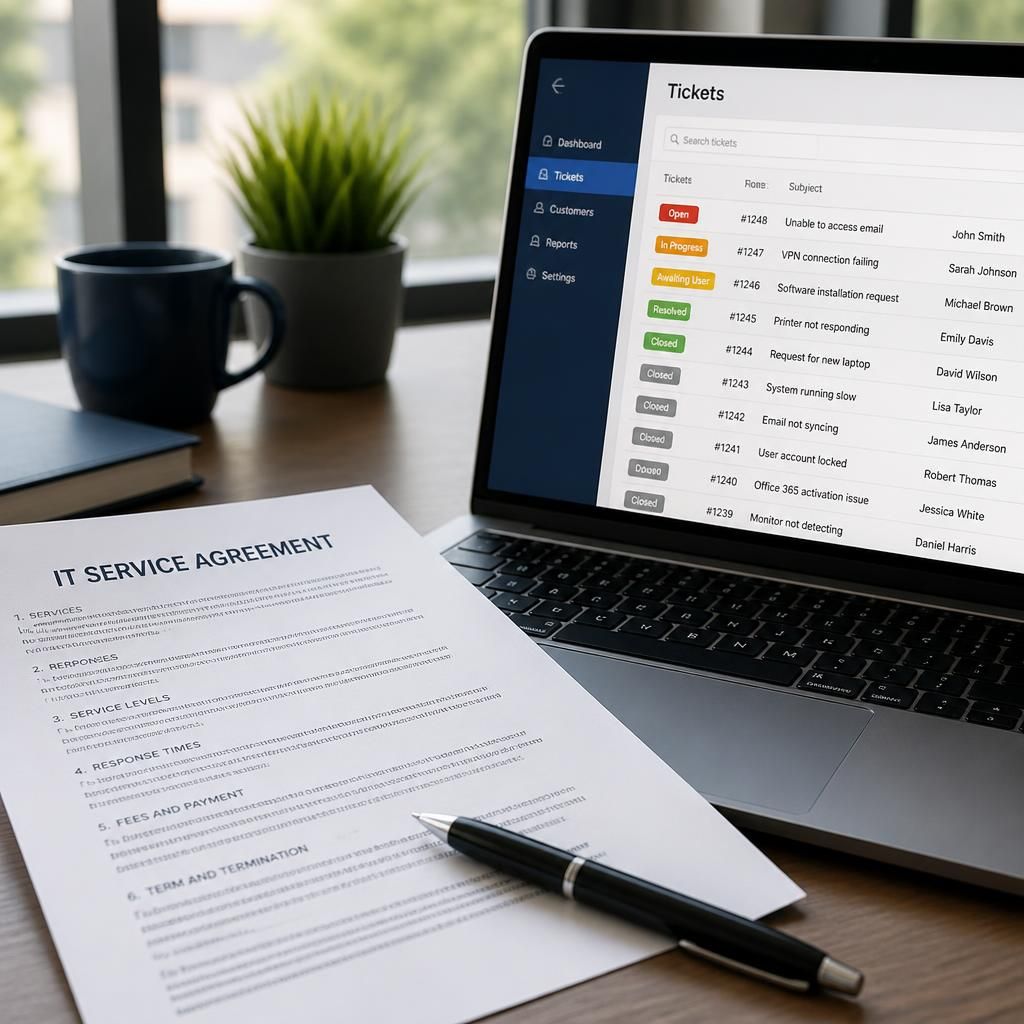
The commercial section of an IT helpdesk agreement should explain exactly what the agreed charges cover and how additional costs are authorised. A recurring support fee may cover defined users, devices, locations or services, while project work, replacement equipment, third-party charges and work outside the agreed scope may be handled separately.
It should specify:
- the charging basis, such as supported users, devices, sites or a fixed service package;
- which activities are included, excluded or subject to separate approval;
- how extra work is quoted and who can approve it;
- whether supplier, licensing, travel or equipment costs are passed on;
- the invoicing cycle, payment terms and treatment of disputed charges; and
- how changes to the supported environment affect the charges.
This level of detail prevents a technical request from becoming a commercial dispute. It also gives the customer a clear decision point before chargeable work begins, particularly where a fault requires new equipment, specialist assistance or changes to an existing service.