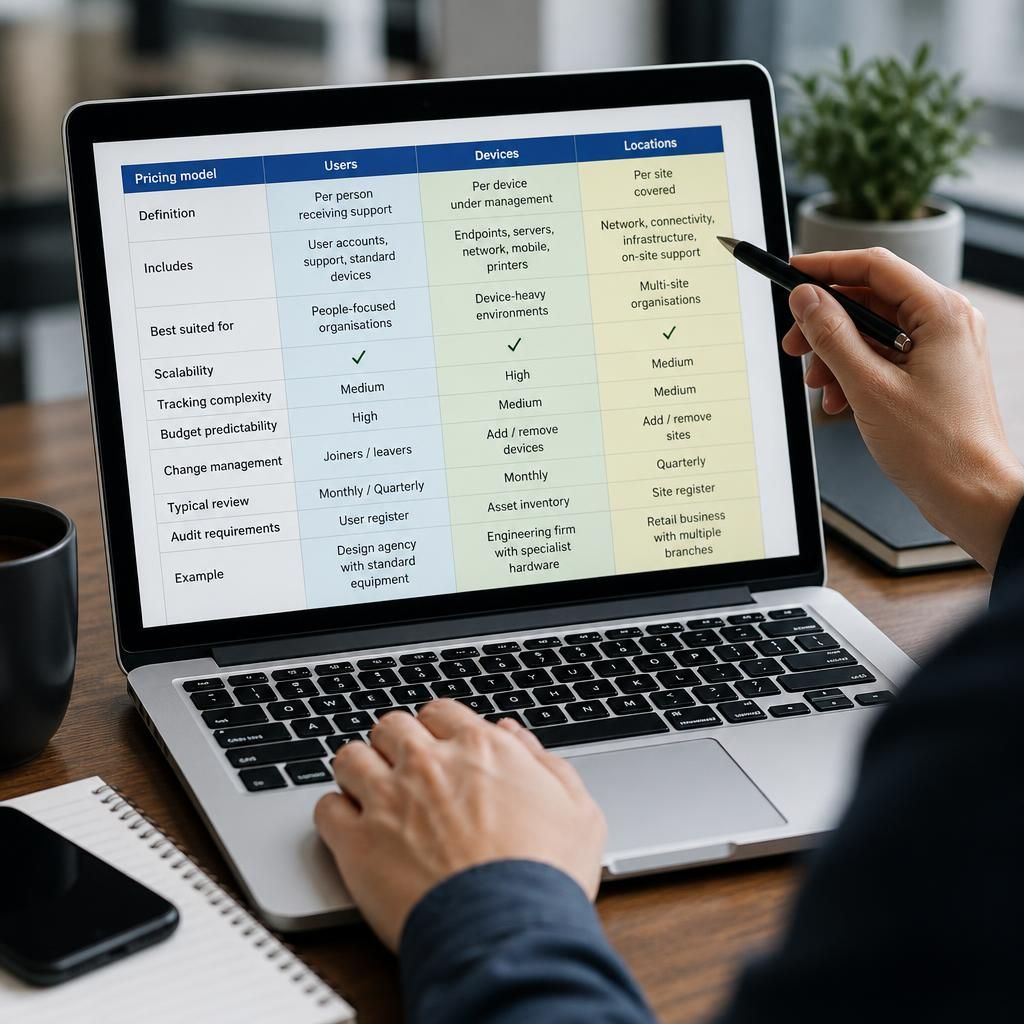
Is managed IT support pricing based on users, devices or locations?
Managed IT support pricing may be based on users, devices, locations, or a combination of these factors, depending on how the provider measures workload and coverage. User-based pricing often reflects the people receiving support, device-based pricing reflects the equipment being managed, and location-based pricing accounts for the sites requiring infrastructure and connectivity support.
Managed IT support pricing is usually calculated from the unit that best represents the provider’s management workload: supported users, managed devices, business locations, or a combination of these. The right basis depends on how many people need assistance, how much equipment must be monitored and maintained, and how widely the organisation’s IT infrastructure is distributed.
User-based pricing charges according to the number of people covered by the agreement. This can be suitable where each employee uses several managed devices, because the price is linked to the user rather than charging separately for every laptop, desktop or mobile device. It also gives a clearer basis for organisations where staff numbers are more stable than their equipment inventory.
However, the agreement should define what counts as a supported user. A full-time employee, contractor, temporary worker, shared account and occasional remote user may be treated differently. Clarify whether leavers and new starters are reconciled monthly, whether shared workstations are included, and whether users who need occasional assistance are charged in the same way as regular users.
Device-based pricing charges for the equipment under management. The inventory may include computers, servers, network equipment, mobile devices, printers or other connected assets, depending on the scope of the service. This model can be easier to audit when the provider uses a defined asset list, but the price may change as equipment is added, replaced or removed.
Device definitions are important because not every provider treats an asset in the same way. Ask whether servers, virtual machines, network appliances, phones and personal devices are included, and whether a device is covered only when actively in use. It is also worth checking whether security monitoring, patching, backup management and technical support apply equally to every device or are priced as separate services.
Location-based pricing takes account of the sites included in the service. A location may require its own network equipment, internet connection, wireless infrastructure, server room or on-site coordination. Two businesses with similar user numbers can therefore have different requirements if one operates from a single office and the other has several branches, warehouses or production sites.
A location charge should be explained in terms of the work it covers. The proposal might distinguish between fully managed sites, smaller offices, shared premises and sites with more complex connectivity. It should also state whether equipment at a branch is included in the same coverage as equipment at the main office, rather than leaving the scope to assumption.
Hybrid pricing combines these methods. For example, a provider may use users as the main measure, include standard computers within that price, and apply separate charges for servers, specialist equipment or additional sites. Another agreement may use a base fee for each location alongside user or device charges. Hybrid structures can reflect real operating costs more accurately, but they need a clear schedule of inclusions and exclusions.
When comparing quotations, look beyond the headline unit price. Establish:
- which users, devices and sites are included;
- how additions and removals are counted;
- whether shared devices and service accounts are covered;
- which infrastructure is managed at each location;
- what support, monitoring, maintenance and security activities are included;
- whether specialist systems require a separate arrangement; and
- how the provider reviews the covered estate when the business changes.
The most suitable model is the one that matches the organisation’s technology estate and makes future charges predictable. A user-based arrangement may be straightforward for a professional services firm with standard equipment, while a device- or location-led structure may provide a more accurate basis for a business with multiple sites, substantial infrastructure or varied equipment. In every case, the contract should define the charging unit, the included scope and the process for changing the number of users, devices or locations.
The reliability of managed IT support pricing depends on how the provider counts users, devices and locations, not simply on which charging model is selected. A clear agreement should identify the source of the count, who is responsible for keeping it accurate, and how any disagreement is resolved.
For example, the provider may maintain a supported-user register, an asset-management record or a list of covered sites. Ask whether these records are shared with the customer and whether changes are supported by an audit trail. This makes it easier to distinguish a genuine change in the managed estate from an administrative error.
It is also useful to establish a defined review process. The agreement should state when the records are checked, how corrections are submitted and when an updated charge takes effect. These details help prevent unexpected adjustments and give both parties a consistent basis for reviewing the managed IT support pricing.