How should managed IT support for VoIP secure administrator access?
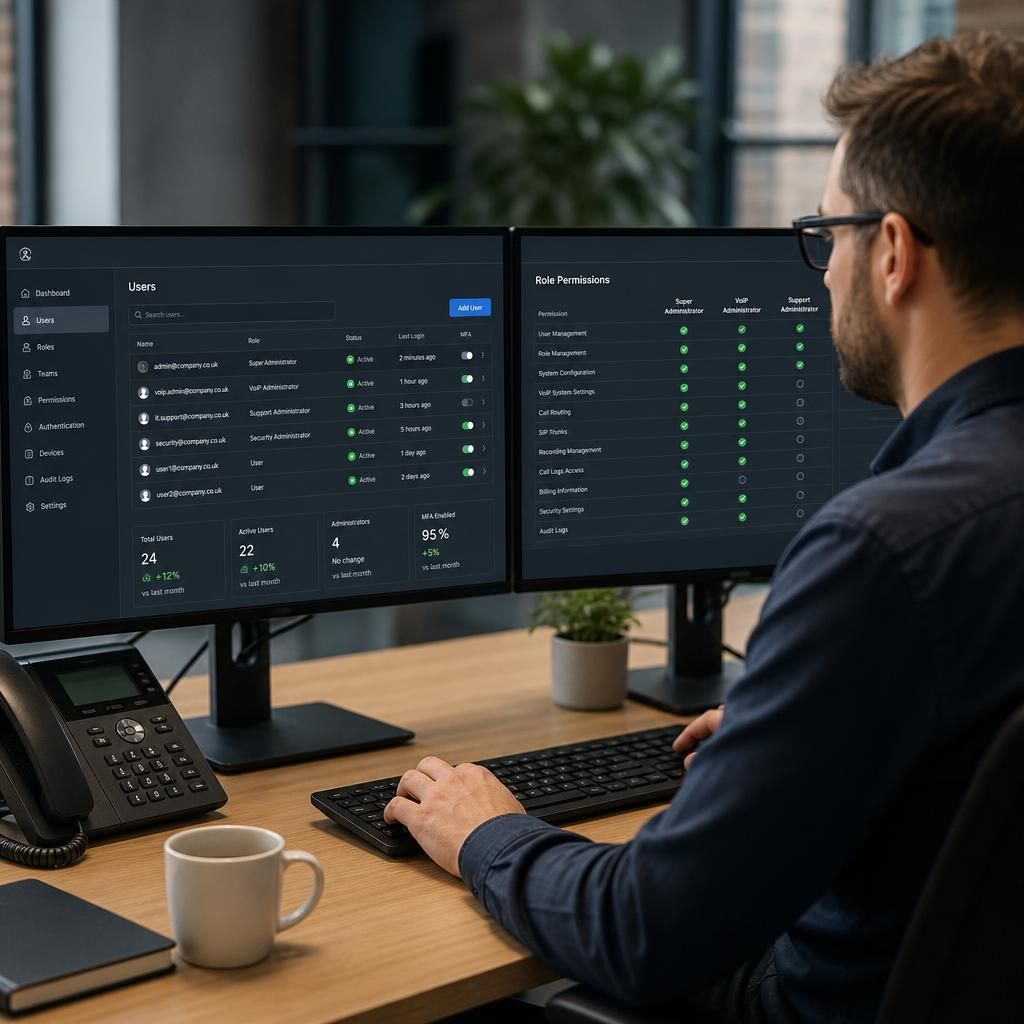
Managed IT support secures VoIP administrator access by using named user accounts, multi-factor authentication, role-based permissions and controlled credential storage rather than shared logins. Access should be reviewed regularly, protected with audit logging and removed promptly when responsibilities change, so administrative activity remains traceable and limited to authorised personnel.
Secure VoIP administrator access requires more than protecting a password. It involves reducing exposure of the management interface, separating administrative work from everyday activity, controlling privileged sessions and ensuring that configuration changes can be investigated. The approach should cover every system involved in telephony, including the hosted VoIP portal, session border controller, on-premises phone system, handsets, softphone platform, call-recording system and any connected business applications.
Restrict where administration can take place. VoIP management interfaces should not be exposed directly to the public internet unless there is a clear operational requirement and suitable protection around them. Access can instead be limited to approved corporate networks, secure remote-access services or a dedicated management segment. Firewall rules should permit only the traffic and destinations required, while unused management ports and legacy protocols should be disabled.
For on-premises systems, placing telephony administration on a separate management VLAN helps prevent a compromise on an ordinary user device from becoming a direct route to the phone system. Hosted platforms should be configured with their available network, device and session restrictions. These controls should be tested from both an approved connection and an unapproved one, because an undocumented firewall or portal change can unintentionally expose an administrative service.
Separate administrative work from normal user activity. Privileged changes should be made from a managed workstation or controlled administration environment rather than from a device used for email, web browsing and general business tasks. This reduces the likelihood that a malicious browser extension, stolen session or infected document can interfere with a VoIP configuration session.
A controlled administration workstation should have current security updates, disk encryption, endpoint protection and a limited set of installed software. Clipboard transfer, local downloads and browser password saving may need to be restricted when working with sensitive telephony systems. Where a business has several critical platforms, a hardened jump host or bastion can provide a single, controlled route to them without placing management tools on every administrator’s computer.
Use time-limited privileged sessions. Permanent access is difficult to justify when a person only needs administrative rights for a particular task. A stronger process grants elevated access for an approved change, limits the available systems and ends the session when the work is complete. The request should record the purpose, affected service, planned change and person responsible.
For higher-risk changes, a second person can review the proposed action before it is applied. This is particularly useful for alterations to call routing, emergency calling settings, number presentation, recording policies, SIP trunks and firewall rules. The aim is not to slow routine administration, but to prevent a single mistaken or unauthorised change from disrupting communications or creating a security weakness.
Protect the administration session itself. Management traffic should use encrypted connections with valid certificates, and insecure HTTP, Telnet or unencrypted remote administration should not be used. Session timeout settings should reflect the risk of the system: an unattended portal should not remain open indefinitely, especially on a shared or portable device.
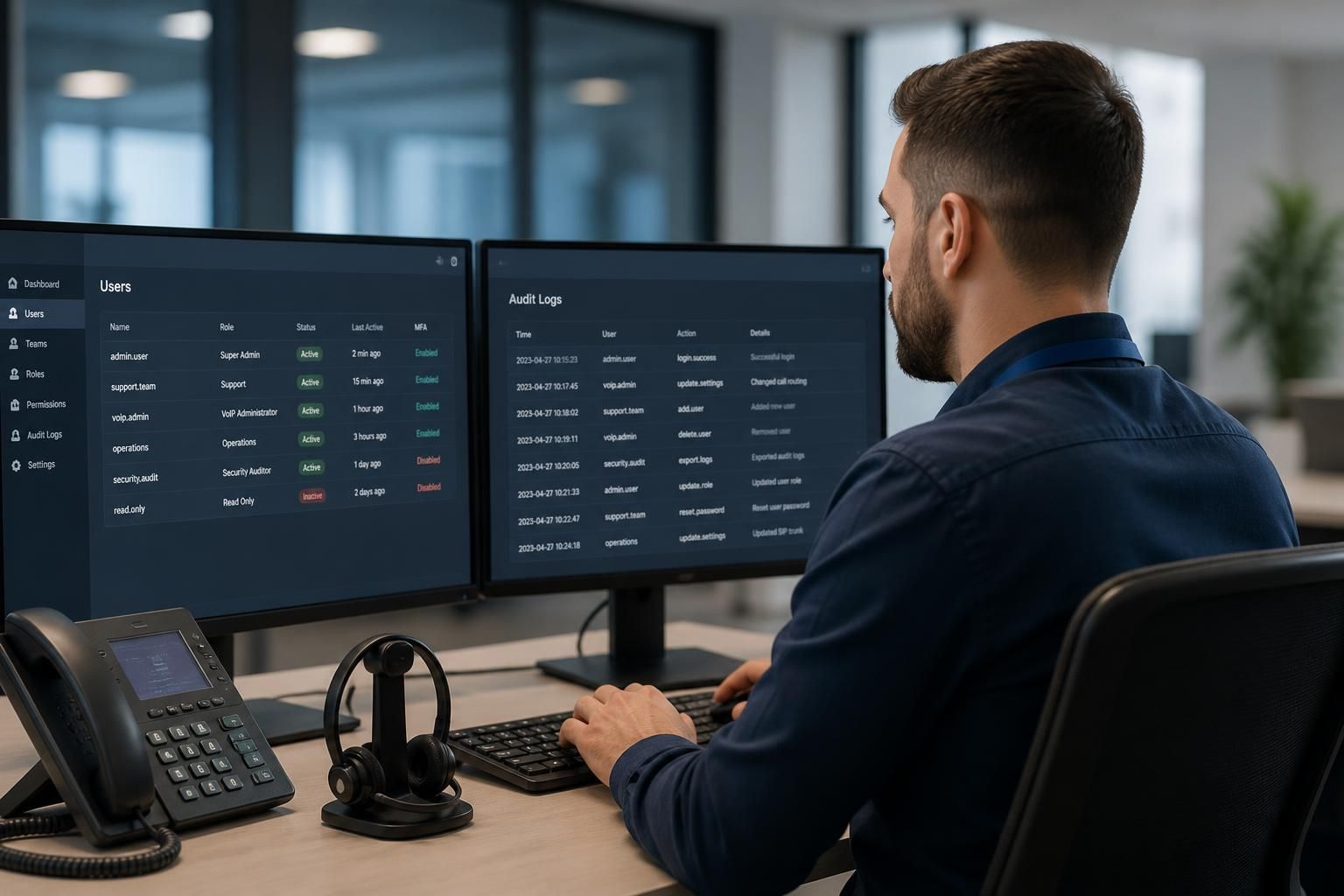
Where the VoIP platform supports it, session activity can be captured for sensitive operations. This may include the administrator, source device, time, commands or settings changed and the result of the action. Records should be protected from alteration and connected with the organisation’s wider security monitoring, while access to those records should be limited because they may contain operational details.
Control supplier and third-party access. A provider or installer may need access to diagnose a fault or complete a planned change, but that access should have a defined purpose and end date. The business should know which organisation is connecting, which systems it can reach and whether activity is supervised or recorded. Standing third-party access is harder to govern than access granted for a specific task, so it should be removed when the engagement or work is complete.
Hosted VoIP services also commonly use application programming interfaces, provisioning tools and service accounts. These should be treated as privileged access, not as harmless technical settings. API permissions should be limited to the functions required, tokens should have an expiry or renewal process, and unused integrations should be disabled. A token that can change call routing or retrieve recordings deserves controls comparable to a human administrator.
Build recovery into the design. Emergency access should be documented without becoming an unmonitored back door. The business should know how to regain control if an administrator is unavailable, a management portal is misconfigured or a security incident requires ordinary accounts to be suspended. Recovery credentials and procedures should be tested in a controlled manner, with access restricted and any use investigated afterwards.
Configuration backups also support secure administration because they allow an approved change to be reversed without improvisation. Backups should be protected separately from the VoIP system, checked for usability and handled as sensitive information. A backup that contains extension details, routing rules or recording configuration should not be left in an openly accessible shared folder.
Managed IT support can help document the VoIP control plane, identify exposed administration paths, apply device and network restrictions, manage privileged change procedures and test recovery arrangements. The most effective design treats administrator access as a controlled business process rather than a feature that is configured once and then left unchanged.
Using a central identity provider can make VoIP administrator access easier to control than maintaining separate credentials in the telephony platform. Single sign-on can apply the organisation’s existing authentication and device policies, while a dedicated administrator identity keeps privileged activity separate from ordinary email and user accounts.
Before enabling this arrangement, check how roles are mapped between the identity provider and the VoIP service. A synchronisation error could grant excessive permissions, so administrator groups should be small, clearly named and tested with non-privileged accounts. Sign-in policies should also consider device compliance, location and unusual activity, with stronger verification required for sensitive changes.
Managed IT support can document the identity flow, test role mappings and confirm that disabling a central account also removes access to the VoIP administration portal. This provides a consistent control point without treating single sign-on as a replacement for least-privilege permissions.